

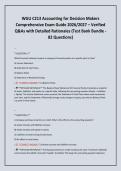
WGU C213 Accounting for Decision Makers
Comprehensive Exam Guide 2026/2027 – Verified
Q&As with Detailed Rationales (Test Bank Bundle -
82 Questions)
---
**QUESTION 1:**
Which financial statement reports a company's financial position at a specific point in time?
A) Income Statement.
B) Statement of Cash Flows.
C) Balance Sheet.
D) Statement of Retained Earnings.
> 🎯 **CORRECT ANSWER:** C) Balance Sheet.
> 💡 **DETAILED RATIONALE:** The Balance Sheet (Statement of Financial Position) provides a snapshot
of assets, liabilities, and equity on a specific date, following the accounting equation (Assets = Liabilities
+ Equity). The Income Statement covers a period, the Statement of Cash Flows shows cash movements
over time, and the Statement of Retained Earnings tracks changes in equity, but only the Balance Sheet
is a point-in-time report.
---
**QUESTION 2:**
A company purchases inventory on credit. What is the effect on the accounting equation?
A) Assets increase and liabilities increase.
B) Assets increase and equity increases.
C) Liabilities increase and equity decreases.
D) No effect on total assets.
> 🎯 **CORRECT ANSWER:** A) Assets increase and liabilities increase.
> 💡 **DETAILED RATIONALE:** Purchasing inventory on credit increases the asset "Inventory" (debited)
and increases the liability "Accounts Payable" (credited). This keeps the accounting equation balanced.
,Option B is incorrect because equity only changes with revenue/expenses or owner transactions, not
asset purchases. Option C describes a different transaction, and Option D is false because assets do
increase.
---
**QUESTION 3:**
Revenue is recognized when:
A) Cash is received from the customer.
B) The order is placed by the customer.
C) It is earned, regardless of when cash is received.
D) The invoice is sent to the customer.
> 🎯 **CORRECT ANSWER:** C) It is earned, regardless of when cash is received.
> 💡 **DETAILED RATIONALE:** Under the accrual basis of accounting, revenue is recognized when it is
earned (performance obligation satisfied), not when cash is received. This is the revenue recognition
principle. Cash is received, the order is placed, or the invoice sent are not sufficient criteria for revenue
recognition under GAAP.
---
**QUESTION 4:**
Which of the following is a liability?
A) Accounts Receivable.
B) Prepaid Rent.
C) Unearned Revenue.
D) Retained Earnings.
> 🎯 **CORRECT ANSWER:** C) Unearned Revenue.
> 💡 **DETAILED RATIONALE:** Unearned Revenue represents a company's obligation to provide
goods/services in the future for which it has already received payment, meeting the definition of a
liability. Accounts Receivable is an asset, Prepaid Rent is an asset, and Retained Earnings is a component
of equity.
---
,**QUESTION 5:**
The matching principle requires:
A) Revenues to be matched with expenses in the same period.
B) Assets to be matched with liabilities.
C) Cash inflows to be matched with cash outflows.
D) Expenses to be recorded when cash is paid.
> 🎯 **CORRECT ANSWER:** A) Revenues to be matched with expenses in the same period.
> 💡 **DETAILED RATIONALE:** The matching principle requires that expenses be recognized in the
same period as the revenues they helped generate, to accurately calculate net income. It does not
concern asset-liability matching (B) or cash flows (C), and it is an accrual, not cash-basis concept.
---
**QUESTION 6:**
A company has current assets of $100,000 and current liabilities of $60,000. What is the current ratio?
A) 1.0.
B) 1.67.
C) 0.6.
D) 1.5.
> 🎯 **CORRECT ANSWER:** B) 1.67.
> 💡 **DETAILED RATIONALE:** The current ratio is calculated as Current Assets / Current Liabilities.
$100,000 / $60,000 = 1.67. This measures the company's ability to pay short-term obligations. Option D
(1.5) is incorrect.
---
**QUESTION 7:**
Depreciation is:
A) A cash expense.
B) An operating expense.
C) A financing activity.
D) A non-cash expense that reduces net income.
, > 🎯 **CORRECT ANSWER:** D) A non-cash expense that reduces net income.
> 💡 **DETAILED RATIONALE:** Depreciation is an accounting allocation of a long-term asset's cost over
its useful life and does not involve a cash outflow; it is a non-cash expense. While it reduces net income
(operating), it is not a cash expense (A) nor a financing activity (C).
---
**QUESTION 8:**
Which of the following transactions would increase both total assets and total liabilities?
A) Payment of a dividend.
B) Issuance of common stock for cash.
C) Borrowing money from the bank.
D) Purchase of equipment with cash.
> 🎯 **CORRECT ANSWER:** C) Borrowing money from the bank.
> 💡 **DETAILED RATIONALE:** Borrowing money from the bank increases cash (an asset) and notes
payable (a liability), thus increasing both sides of the accounting equation. Payment of a dividend
decreases assets and equity, issuance of stock increases assets and equity, and purchasing equipment
with cash swaps one asset for another.
---
**QUESTION 9:**
The cost of goods sold is reported on the:
A) Balance Sheet.
B) Statement of Cash Flows.
C) Income Statement.
D) Statement of Retained Earnings.
> 🎯 **CORRECT ANSWER:** C) Income Statement.
> 💡 **DETAILED RATIONALE:** Cost of Goods Sold (COGS) is an expense representing the direct cost of
goods sold during the period, and it is reported on the Income Statement as a deduction from revenue.
It is not a balance sheet item (A) nor a cash flow item (B), and it does not directly appear on the retained
earnings statement (D).
Comprehensive Exam Guide 2026/2027 – Verified
Q&As with Detailed Rationales (Test Bank Bundle -
82 Questions)
---
**QUESTION 1:**
Which financial statement reports a company's financial position at a specific point in time?
A) Income Statement.
B) Statement of Cash Flows.
C) Balance Sheet.
D) Statement of Retained Earnings.
> 🎯 **CORRECT ANSWER:** C) Balance Sheet.
> 💡 **DETAILED RATIONALE:** The Balance Sheet (Statement of Financial Position) provides a snapshot
of assets, liabilities, and equity on a specific date, following the accounting equation (Assets = Liabilities
+ Equity). The Income Statement covers a period, the Statement of Cash Flows shows cash movements
over time, and the Statement of Retained Earnings tracks changes in equity, but only the Balance Sheet
is a point-in-time report.
---
**QUESTION 2:**
A company purchases inventory on credit. What is the effect on the accounting equation?
A) Assets increase and liabilities increase.
B) Assets increase and equity increases.
C) Liabilities increase and equity decreases.
D) No effect on total assets.
> 🎯 **CORRECT ANSWER:** A) Assets increase and liabilities increase.
> 💡 **DETAILED RATIONALE:** Purchasing inventory on credit increases the asset "Inventory" (debited)
and increases the liability "Accounts Payable" (credited). This keeps the accounting equation balanced.
,Option B is incorrect because equity only changes with revenue/expenses or owner transactions, not
asset purchases. Option C describes a different transaction, and Option D is false because assets do
increase.
---
**QUESTION 3:**
Revenue is recognized when:
A) Cash is received from the customer.
B) The order is placed by the customer.
C) It is earned, regardless of when cash is received.
D) The invoice is sent to the customer.
> 🎯 **CORRECT ANSWER:** C) It is earned, regardless of when cash is received.
> 💡 **DETAILED RATIONALE:** Under the accrual basis of accounting, revenue is recognized when it is
earned (performance obligation satisfied), not when cash is received. This is the revenue recognition
principle. Cash is received, the order is placed, or the invoice sent are not sufficient criteria for revenue
recognition under GAAP.
---
**QUESTION 4:**
Which of the following is a liability?
A) Accounts Receivable.
B) Prepaid Rent.
C) Unearned Revenue.
D) Retained Earnings.
> 🎯 **CORRECT ANSWER:** C) Unearned Revenue.
> 💡 **DETAILED RATIONALE:** Unearned Revenue represents a company's obligation to provide
goods/services in the future for which it has already received payment, meeting the definition of a
liability. Accounts Receivable is an asset, Prepaid Rent is an asset, and Retained Earnings is a component
of equity.
---
,**QUESTION 5:**
The matching principle requires:
A) Revenues to be matched with expenses in the same period.
B) Assets to be matched with liabilities.
C) Cash inflows to be matched with cash outflows.
D) Expenses to be recorded when cash is paid.
> 🎯 **CORRECT ANSWER:** A) Revenues to be matched with expenses in the same period.
> 💡 **DETAILED RATIONALE:** The matching principle requires that expenses be recognized in the
same period as the revenues they helped generate, to accurately calculate net income. It does not
concern asset-liability matching (B) or cash flows (C), and it is an accrual, not cash-basis concept.
---
**QUESTION 6:**
A company has current assets of $100,000 and current liabilities of $60,000. What is the current ratio?
A) 1.0.
B) 1.67.
C) 0.6.
D) 1.5.
> 🎯 **CORRECT ANSWER:** B) 1.67.
> 💡 **DETAILED RATIONALE:** The current ratio is calculated as Current Assets / Current Liabilities.
$100,000 / $60,000 = 1.67. This measures the company's ability to pay short-term obligations. Option D
(1.5) is incorrect.
---
**QUESTION 7:**
Depreciation is:
A) A cash expense.
B) An operating expense.
C) A financing activity.
D) A non-cash expense that reduces net income.
, > 🎯 **CORRECT ANSWER:** D) A non-cash expense that reduces net income.
> 💡 **DETAILED RATIONALE:** Depreciation is an accounting allocation of a long-term asset's cost over
its useful life and does not involve a cash outflow; it is a non-cash expense. While it reduces net income
(operating), it is not a cash expense (A) nor a financing activity (C).
---
**QUESTION 8:**
Which of the following transactions would increase both total assets and total liabilities?
A) Payment of a dividend.
B) Issuance of common stock for cash.
C) Borrowing money from the bank.
D) Purchase of equipment with cash.
> 🎯 **CORRECT ANSWER:** C) Borrowing money from the bank.
> 💡 **DETAILED RATIONALE:** Borrowing money from the bank increases cash (an asset) and notes
payable (a liability), thus increasing both sides of the accounting equation. Payment of a dividend
decreases assets and equity, issuance of stock increases assets and equity, and purchasing equipment
with cash swaps one asset for another.
---
**QUESTION 9:**
The cost of goods sold is reported on the:
A) Balance Sheet.
B) Statement of Cash Flows.
C) Income Statement.
D) Statement of Retained Earnings.
> 🎯 **CORRECT ANSWER:** C) Income Statement.
> 💡 **DETAILED RATIONALE:** Cost of Goods Sold (COGS) is an expense representing the direct cost of
goods sold during the period, and it is reported on the Income Statement as a deduction from revenue.
It is not a balance sheet item (A) nor a cash flow item (B), and it does not directly appear on the retained
earnings statement (D).

