
Adjustments: Chapter 8
Class Notes
Year end Adjustments:
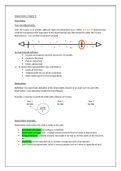
Over the course of 12 months, different types of transactions occur. When end-year is reached there
could be transactions that took place in the next financial year that should be under the current
financial year – we can then move them around.
Accrual Concept indicates
Income and expense must be correct for 12 months.
Earned vs Received.
Paid vs consumed.
Other adjustments
→ To ensure fair representation you could look at:
Levels of inventory
Stationery did we use all we consumed.
Were assets worth it (cost of operation).
Deprecation
Definition: the systematic allocation of the depreciable amount of an asset over its useful life.
Deprecation =cost allocation divided by time/lifespan.
Example: a machine is worth R12 000 with a lifespan of 3 years.
Year 1 Year 2 Year 3
R4 000 R4 000 R4 000
12000
3
Depreciation Concepts:
Deprecation starts when the asset is ready to be used.
Systematic allocation: according to 3 methods
Depreciable amount: cost – residual amount (amount that we want to depreciate).
Residual Amount: estimate amount, receivable if we had to sell the assets at the end of its
life.
Useful life: period expected use or number of expected units of production.
Land cannot be depreciable: only if it serves purpose such as a mine or agricultural land.
, 3 m ethods
Straight line method Income is genrated consitently
Income is generated more at the
Diminishing Balance Method begining of useful life and less
towards the end
Production- unit method Income genrated per unit produced
Deprecation: Accounting treatment
DR CR DR CR DR CR DR
Depreciation
Accumulated Depreciation
on Equipment
Depreciation= expense (closed off every year) is an EQUITY used for all assets.
Contra Assets (negative asset) = carries a balance on the Credit side.
The Straight-Line Method:
Asset costs R12 000 and has the lifespan of 3 years.
∴ R 12 000 ÷3=R 4 000
DR CR DR CR DR CR
Depreciation 4 000 4 000 3 999
Accumulated Depreciation 4 000 4 000 3 999
on Equipment
Ledger on: acc on 4 000 4 000+ 4 000= 8 000 4 000+4 000+3 999=
equipment 11 999
If after the 3 years we choose to keep the asset, we subtract R1 from the depreciation value to
indicate in our financial statements we still own/ use the asset: disclosure. The R1 is the carrying
amount.
Accounting treatment with residual amount:
Class Notes
Year end Adjustments:
Over the course of 12 months, different types of transactions occur. When end-year is reached there
could be transactions that took place in the next financial year that should be under the current
financial year – we can then move them around.
Accrual Concept indicates
Income and expense must be correct for 12 months.
Earned vs Received.
Paid vs consumed.
Other adjustments
→ To ensure fair representation you could look at:
Levels of inventory
Stationery did we use all we consumed.
Were assets worth it (cost of operation).
Deprecation
Definition: the systematic allocation of the depreciable amount of an asset over its useful life.
Deprecation =cost allocation divided by time/lifespan.
Example: a machine is worth R12 000 with a lifespan of 3 years.
Year 1 Year 2 Year 3
R4 000 R4 000 R4 000
12000
3
Depreciation Concepts:
Deprecation starts when the asset is ready to be used.
Systematic allocation: according to 3 methods
Depreciable amount: cost – residual amount (amount that we want to depreciate).
Residual Amount: estimate amount, receivable if we had to sell the assets at the end of its
life.
Useful life: period expected use or number of expected units of production.
Land cannot be depreciable: only if it serves purpose such as a mine or agricultural land.
, 3 m ethods
Straight line method Income is genrated consitently
Income is generated more at the
Diminishing Balance Method begining of useful life and less
towards the end
Production- unit method Income genrated per unit produced
Deprecation: Accounting treatment
DR CR DR CR DR CR DR
Depreciation
Accumulated Depreciation
on Equipment
Depreciation= expense (closed off every year) is an EQUITY used for all assets.
Contra Assets (negative asset) = carries a balance on the Credit side.
The Straight-Line Method:
Asset costs R12 000 and has the lifespan of 3 years.
∴ R 12 000 ÷3=R 4 000
DR CR DR CR DR CR
Depreciation 4 000 4 000 3 999
Accumulated Depreciation 4 000 4 000 3 999
on Equipment
Ledger on: acc on 4 000 4 000+ 4 000= 8 000 4 000+4 000+3 999=
equipment 11 999
If after the 3 years we choose to keep the asset, we subtract R1 from the depreciation value to
indicate in our financial statements we still own/ use the asset: disclosure. The R1 is the carrying
amount.
Accounting treatment with residual amount:


