

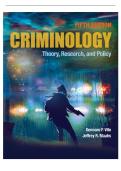
, TESTBANK FOR Criminology Fifth Edition Vito
Important Notes
The file includes the complete test bank, organized chapter by chapter.
A sample of selected pages has been provided for preview.
All available appendices and Excel files (if included in the original resources) are
provided.
Quizzes, Midterm and final exams are included (if available in the original resources).
We continuously update our files to ensure you receive the latest and most accurate
editions.
New editions are added regularly – stay connected for updates!
⚠️Note on Answer Keys: If the answer key is not included within the chapter
questions, you will find the complete answers and solutions at the end of each
chapter.
✅ Why Buy From Us?
📚 Complete & organized chapter-by-chapter – no missing content, no guessing.
⚡ Instant digital delivery – get your file the moment you pay, no waiting.
📅 Always up to date – we track new editions so you always get the latest version.
💬 Friendly support – real humans ready to help, anytime you need us.
🔒 Safe & secure – thousands of satisfied students trust us every semester.
🛡️Our Guarantees
💰 Money-Back Guarantee: Not satisfied? We offer a full refund – no questions asked.
🔄 Wrong File? No Problem: Contact us and we will replace it immediately with the
correct version, free of charge.
⏰ 24/7 Support: We are always here – reach out anytime and expect a fast response.
,Criminology: Theory, Research, and Policy, Fifth Edition
Gennaro Vito, Jeffrey Maahs
Assessment Quiz
Import Settings:
Base Settings: Brownstone Default
Information Field: Complexity
Information Field: Ahead
Information Field: Subject
Information Field: Title
Highest Answer Letter: D
Multiple Keywords in Same Paragraph: No
NAS ISBN13: 9781284182705, add to Ahead, Title tags
Chapter: Chapter 01 – Quiz
Multiple Choice
1. Crime remains an important political issue, as shown by the fact that:
A) the cost to taxpayers for the criminal justice system is roughly $270 billion per year.
B) the American prison population accounts for about 25% of the world inmate population.
C) Gallup poll findings suggest Americans largely feel crime is rising, despite sharp declines in crime
rates.
D) All of the choices are correct.
Ans: D
Complexity: Moderate
Ahead: Introduction
Subject: Chapter 1
Title: Crime and Criminology
2. While criminology focuses on the nature, extent, and causes of crime, criminal justice focuses on:
A) the violation of social norms.
B) solving crimes.
C) the response to crime.
D) training police and correctional officers.
Ans: C
Complexity: Easy
Ahead: What Is Criminology?
Subject: Chapter 1
Title: Crime and Criminology
3. Most of the U.S. criminal code is:
A) statutory law.
B) case law.
C) constitutional law.
D) common law.
Ans: A
Complexity: Easy
Copyright © 2021 by Jones & Bartlett Learning, LLC, an Ascend Learning Company
,Criminology: Theory, Research, and Policy, Fifth Edition
Gennaro Vito, Jeffrey Maahs
Assessment Quiz
Ahead: A Brief History of the Criminal Law
Subject: Chapter 1
Title: Crime and Criminology
4. Which of the following would be considered mala prohibita rather than mala in se?
A) Prostitution
B) Child neglect
C) Embezzlement
D) Armed robbery
Ans: A
Complexity: Moderate
Ahead: A Brief History of the Criminal Law
Subject: Chapter 1
Title: Crime and Criminology
5. The consensus perspective illustrates the belief that laws:
A) are in place to be fair to all members of society.
B) prohibit behaviors thought to be wrong by a majority.
C) are based on society-wide values, beliefs, and attitudes.
D) All of the choices are correct.
Ans: D
Complexity: Easy
Ahead: A Brief History of the Criminal Law
Subject: Chapter 1
Title: Crime and Criminology
6. The conflict perspective generally leads to questions:
A) about why some in society violate laws that exist to benefit all.
B) regarding the content and enforcement of the law.
C) of whether the punishment fits the crime.
D) All of the choices are correct.
Ans: B
Complexity: Moderate
Ahead: A Brief History of the Criminal Law
Subject: Chapter 1
Title: Crime and Criminology
7. A longitudinal study may be useful to:
A) understand the spatial distribution of crime.
B) test whether a correlation is spurious.
C) establish the time ordering of two variables.
D) detect tautological reasoning.
Ans: C
Complexity: Easy
Ahead: Organizing Theories of Crime
Subject: Chapter 1
Title: Crime and Criminology
Copyright © 2021 by Jones & Bartlett Learning, LLC, an Ascend Learning Company
,Criminology: Theory, Research, and Policy, Fifth Edition
Gennaro Vito, Jeffrey Maahs
Assessment Quiz
8. Which of the following is a macro-level statement?
A) Criminals tend to have performed poorly in school.
B) Cities with high unemployment rates tend to have high crime rates.
C) Youths who smoke tend to hang out with friends who smoke.
D) Crime is mostly committed by males between the ages of 14 and 24 years.
Ans: B
Complexity: Moderate
Ahead: Organizing Theories of Crime
Subject: Chapter 1
Title: Crime and Criminology
9. In 1764, Cesare Beccaria argued that the function of law was to:
A) satisfy society’s need for revenge.
B) promote justice.
C) root out the demonically possessed.
D) preserve the privileged position of the wealthy.
Ans: B
Complexity: Difficult
Ahead: The Origins of Criminological Theory
Subject: Chapter 1
Title: Crime and Criminology
10. Beccaria and Bentham believed that the purpose of punishment should be:
A) to force criminals to get treatment.
B) revenge.
C) crime prevention.
D) to preserve social norms.
Ans: C
Complexity: Moderate
Ahead: The Origins of Criminological Theory
Subject: Chapter 1
Title: Crime and Criminology
11. Which early positivist theorist thought that criminals were evolutionary throwbacks?
A) Charles Darwin
B) C. Ray Jeffrey
C) Franz Joseph Gall
D) Cesare Lombroso
Ans: D
Complexity: Easy
Ahead: The Origins of Criminological Theory
Subject: Chapter 1
Title: Crime and Criminology
Copyright © 2021 by Jones & Bartlett Learning, LLC, an Ascend Learning Company
,Criminology: Theory, Research, and Policy, Fifth Edition
Gennaro Vito, Jeffrey Maahs
Assessment Quiz
12. Research on intensive supervision programs (ISP) showed:
A) that lowering caseloads reduced probation revocations.
B) little influence on recidivism.
C) a reduction in recidivism regardless of caseload.
D) fewer probation revocations, but not parole revocations.
Ans: B
Complexity: Easy
Ahead: Crime Policy
Subject: Chapter 1
Title: Crime and Criminology
Copyright © 2021 by Jones & Bartlett Learning, LLC, an Ascend Learning Company
,Criminology: Theory, Research, and Policy, Fifth Edition
Gennaro Vito, Jeffrey Maahs
Assessment Quiz
Import Settings:
Base Settings: Brownstone Default
Information Field: Complexity
Information Field: Ahead
Information Field: Subject
Information Field: Title
Highest Answer Letter: D
Multiple Keywords in Same Paragraph: No
NAS ISBN13: 9781284182705, add to Ahead, Title tags
Chapter: Chapter 02 – Quiz
Multiple Choice
1. What does the acronym UCR stand for?
A) Unsolved Crimes Reported
B) Undercover Reconnaissance
C) Unified Crime Rate
D) Uniform Crime Report
Ans: D
Complexity: Easy
Ahead: Sources of Crime Statistics
Subject: Chapter 2
Title: The Incidence of Crime
2. Which index crime is most likely to be underreported to the UCR?
A) Murder
B) Robbery
C) Rape
D) Drug trafficking
Ans: C
Complexity: Moderate
Ahead: Sources of Crime Statistics
Subject: Chapter 2
Title: The Incidence of Crime
3. Suppose the police in your city staged a crackdown on prostitution. Assuming they accurately report
data to the UCR, how would this affect the city’s official crime rate for that year?
A) There would be no effect, because the UCR does not include prostitution.
B) The crime rate would rise.
C) The crime rate would decrease, because prostitution is linked with other crimes.
D) The crime rate would stay about the same, because other crimes would be ignored.
Ans: B
Complexity: Moderate
Copyright © 2021 by Jones & Bartlett Learning, LLC, an Ascend Learning Company
,Criminology: Theory, Research, and Policy, Fifth Edition
Gennaro Vito, Jeffrey Maahs
Assessment Quiz
Ahead: Sources of Crime Statistics
Subject: Chapter 2
Title: The Incidence of Crime
4. Which crime is most likely to be reported to police?
A) Rape
B) Motor vehicle theft
C) Burglary
D) Homicide
Ans: D
Complexity: Difficult
Ahead: Sources of Crime Statistics
Subject: Chapter 2
Title: The Incidence of Crime
5. The NCVS collects data from:
A) everyone who reports a crime to the police.
B) a random sample of crime victims.
C) a representative sample of U.S. households.
D) agencies that help crime victims.
Ans: C
Complexity: Moderate
Ahead: Sources of Crime Statistics
Subject: Chapter 2
Title: The Incidence of Crime
6. Comparing crime rates from the UCR to those from the NCVS shows that:
A) the NCVS uncovers more crimes.
B) the UCR shows higher crime rates.
C) the rates are about the same.
D) comparison is not practical because each utilizes different methods and models.
Ans: A
Complexity: Moderate
Ahead: Sources of Crime Statistics
Subject: Chapter 2
Title: The Incidence of Crime
7. The greatest difference in UCR and NCVS crime rates is for:
A) assault.
B) burglary.
C) larceny-theft.
D) motor vehicle theft.
Ans: C
Complexity: Moderate
Ahead: Sources of Crime Statistics
Subject: Chapter 2
Title: The Incidence of Crime
Copyright © 2021 by Jones & Bartlett Learning, LLC, an Ascend Learning Company
,Criminology: Theory, Research, and Policy, Fifth Edition
Gennaro Vito, Jeffrey Maahs
Assessment Quiz
8. Males are more likely than females:
A) to commit most types of crime.
B) to be a victim of every type of violent crime except rape and sexual assault.
C) to commit murder.
D) All of the choices are correct.
Ans: D
Complexity: Moderate
Ahead: Sources of Crime Statistics
Subject: Chapter 2
Title: The Incidence of Crime
9. Intimate partner violence:
A) includes crimes against former spouses, girlfriends, or boyfriends.
B) declined significantly for female victims from 1994 to 2011.
C) declined significantly for male victims from 1994 to 2011.
D) All of the choices are correct.
Ans: D
Complexity: Moderate
Ahead: Categories of Victims and Victimization
Subject: Chapter 2
Title: The Incidence of Crime
10. What data are most useful for directing crime prevention efforts?
A) The annual survey of jails, because it tells where the criminals are from
B) The probation and parole recidivism surveys
C) The NCVS data, because of the detailed victim information
D) The UCR data, because it includes attempted as well as completed crimes
Ans: C
Complexity: Moderate
Ahead: Categories of Victims and Victimization
Subject: Chapter 2
Title: The Incidence of Crime
11. Currently, the jail population:
A) is at more than 90% of jail capacity.
B) is at about half of capacity.
C) is stable or slightly decreasing.
D) None of the choices are correct.
Ans: C
Complexity: Moderate
Ahead: Criminal Justice System Statistics
Subject: Chapter 2
Title: The Incidence of Crime
Copyright © 2021 by Jones & Bartlett Learning, LLC, an Ascend Learning Company
, Criminology: Theory, Research, and Policy, Fifth Edition
Gennaro Vito, Jeffrey Maahs
Assessment Quiz
12. __________ is a form of conditional release from a prison sentence.
A) Probation
B) Parole
C) Recidivism
D) Community service
Ans: B
Complexity: Easy
Ahead: Criminal Justice System Statistics
Subject: Chapter 2
Title: The Incidence of Crime
Copyright © 2021 by Jones & Bartlett Learning, LLC, an Ascend Learning Company
Important Notes
The file includes the complete test bank, organized chapter by chapter.
A sample of selected pages has been provided for preview.
All available appendices and Excel files (if included in the original resources) are
provided.
Quizzes, Midterm and final exams are included (if available in the original resources).
We continuously update our files to ensure you receive the latest and most accurate
editions.
New editions are added regularly – stay connected for updates!
⚠️Note on Answer Keys: If the answer key is not included within the chapter
questions, you will find the complete answers and solutions at the end of each
chapter.
✅ Why Buy From Us?
📚 Complete & organized chapter-by-chapter – no missing content, no guessing.
⚡ Instant digital delivery – get your file the moment you pay, no waiting.
📅 Always up to date – we track new editions so you always get the latest version.
💬 Friendly support – real humans ready to help, anytime you need us.
🔒 Safe & secure – thousands of satisfied students trust us every semester.
🛡️Our Guarantees
💰 Money-Back Guarantee: Not satisfied? We offer a full refund – no questions asked.
🔄 Wrong File? No Problem: Contact us and we will replace it immediately with the
correct version, free of charge.
⏰ 24/7 Support: We are always here – reach out anytime and expect a fast response.
,Criminology: Theory, Research, and Policy, Fifth Edition
Gennaro Vito, Jeffrey Maahs
Assessment Quiz
Import Settings:
Base Settings: Brownstone Default
Information Field: Complexity
Information Field: Ahead
Information Field: Subject
Information Field: Title
Highest Answer Letter: D
Multiple Keywords in Same Paragraph: No
NAS ISBN13: 9781284182705, add to Ahead, Title tags
Chapter: Chapter 01 – Quiz
Multiple Choice
1. Crime remains an important political issue, as shown by the fact that:
A) the cost to taxpayers for the criminal justice system is roughly $270 billion per year.
B) the American prison population accounts for about 25% of the world inmate population.
C) Gallup poll findings suggest Americans largely feel crime is rising, despite sharp declines in crime
rates.
D) All of the choices are correct.
Ans: D
Complexity: Moderate
Ahead: Introduction
Subject: Chapter 1
Title: Crime and Criminology
2. While criminology focuses on the nature, extent, and causes of crime, criminal justice focuses on:
A) the violation of social norms.
B) solving crimes.
C) the response to crime.
D) training police and correctional officers.
Ans: C
Complexity: Easy
Ahead: What Is Criminology?
Subject: Chapter 1
Title: Crime and Criminology
3. Most of the U.S. criminal code is:
A) statutory law.
B) case law.
C) constitutional law.
D) common law.
Ans: A
Complexity: Easy
Copyright © 2021 by Jones & Bartlett Learning, LLC, an Ascend Learning Company
,Criminology: Theory, Research, and Policy, Fifth Edition
Gennaro Vito, Jeffrey Maahs
Assessment Quiz
Ahead: A Brief History of the Criminal Law
Subject: Chapter 1
Title: Crime and Criminology
4. Which of the following would be considered mala prohibita rather than mala in se?
A) Prostitution
B) Child neglect
C) Embezzlement
D) Armed robbery
Ans: A
Complexity: Moderate
Ahead: A Brief History of the Criminal Law
Subject: Chapter 1
Title: Crime and Criminology
5. The consensus perspective illustrates the belief that laws:
A) are in place to be fair to all members of society.
B) prohibit behaviors thought to be wrong by a majority.
C) are based on society-wide values, beliefs, and attitudes.
D) All of the choices are correct.
Ans: D
Complexity: Easy
Ahead: A Brief History of the Criminal Law
Subject: Chapter 1
Title: Crime and Criminology
6. The conflict perspective generally leads to questions:
A) about why some in society violate laws that exist to benefit all.
B) regarding the content and enforcement of the law.
C) of whether the punishment fits the crime.
D) All of the choices are correct.
Ans: B
Complexity: Moderate
Ahead: A Brief History of the Criminal Law
Subject: Chapter 1
Title: Crime and Criminology
7. A longitudinal study may be useful to:
A) understand the spatial distribution of crime.
B) test whether a correlation is spurious.
C) establish the time ordering of two variables.
D) detect tautological reasoning.
Ans: C
Complexity: Easy
Ahead: Organizing Theories of Crime
Subject: Chapter 1
Title: Crime and Criminology
Copyright © 2021 by Jones & Bartlett Learning, LLC, an Ascend Learning Company
,Criminology: Theory, Research, and Policy, Fifth Edition
Gennaro Vito, Jeffrey Maahs
Assessment Quiz
8. Which of the following is a macro-level statement?
A) Criminals tend to have performed poorly in school.
B) Cities with high unemployment rates tend to have high crime rates.
C) Youths who smoke tend to hang out with friends who smoke.
D) Crime is mostly committed by males between the ages of 14 and 24 years.
Ans: B
Complexity: Moderate
Ahead: Organizing Theories of Crime
Subject: Chapter 1
Title: Crime and Criminology
9. In 1764, Cesare Beccaria argued that the function of law was to:
A) satisfy society’s need for revenge.
B) promote justice.
C) root out the demonically possessed.
D) preserve the privileged position of the wealthy.
Ans: B
Complexity: Difficult
Ahead: The Origins of Criminological Theory
Subject: Chapter 1
Title: Crime and Criminology
10. Beccaria and Bentham believed that the purpose of punishment should be:
A) to force criminals to get treatment.
B) revenge.
C) crime prevention.
D) to preserve social norms.
Ans: C
Complexity: Moderate
Ahead: The Origins of Criminological Theory
Subject: Chapter 1
Title: Crime and Criminology
11. Which early positivist theorist thought that criminals were evolutionary throwbacks?
A) Charles Darwin
B) C. Ray Jeffrey
C) Franz Joseph Gall
D) Cesare Lombroso
Ans: D
Complexity: Easy
Ahead: The Origins of Criminological Theory
Subject: Chapter 1
Title: Crime and Criminology
Copyright © 2021 by Jones & Bartlett Learning, LLC, an Ascend Learning Company
,Criminology: Theory, Research, and Policy, Fifth Edition
Gennaro Vito, Jeffrey Maahs
Assessment Quiz
12. Research on intensive supervision programs (ISP) showed:
A) that lowering caseloads reduced probation revocations.
B) little influence on recidivism.
C) a reduction in recidivism regardless of caseload.
D) fewer probation revocations, but not parole revocations.
Ans: B
Complexity: Easy
Ahead: Crime Policy
Subject: Chapter 1
Title: Crime and Criminology
Copyright © 2021 by Jones & Bartlett Learning, LLC, an Ascend Learning Company
,Criminology: Theory, Research, and Policy, Fifth Edition
Gennaro Vito, Jeffrey Maahs
Assessment Quiz
Import Settings:
Base Settings: Brownstone Default
Information Field: Complexity
Information Field: Ahead
Information Field: Subject
Information Field: Title
Highest Answer Letter: D
Multiple Keywords in Same Paragraph: No
NAS ISBN13: 9781284182705, add to Ahead, Title tags
Chapter: Chapter 02 – Quiz
Multiple Choice
1. What does the acronym UCR stand for?
A) Unsolved Crimes Reported
B) Undercover Reconnaissance
C) Unified Crime Rate
D) Uniform Crime Report
Ans: D
Complexity: Easy
Ahead: Sources of Crime Statistics
Subject: Chapter 2
Title: The Incidence of Crime
2. Which index crime is most likely to be underreported to the UCR?
A) Murder
B) Robbery
C) Rape
D) Drug trafficking
Ans: C
Complexity: Moderate
Ahead: Sources of Crime Statistics
Subject: Chapter 2
Title: The Incidence of Crime
3. Suppose the police in your city staged a crackdown on prostitution. Assuming they accurately report
data to the UCR, how would this affect the city’s official crime rate for that year?
A) There would be no effect, because the UCR does not include prostitution.
B) The crime rate would rise.
C) The crime rate would decrease, because prostitution is linked with other crimes.
D) The crime rate would stay about the same, because other crimes would be ignored.
Ans: B
Complexity: Moderate
Copyright © 2021 by Jones & Bartlett Learning, LLC, an Ascend Learning Company
,Criminology: Theory, Research, and Policy, Fifth Edition
Gennaro Vito, Jeffrey Maahs
Assessment Quiz
Ahead: Sources of Crime Statistics
Subject: Chapter 2
Title: The Incidence of Crime
4. Which crime is most likely to be reported to police?
A) Rape
B) Motor vehicle theft
C) Burglary
D) Homicide
Ans: D
Complexity: Difficult
Ahead: Sources of Crime Statistics
Subject: Chapter 2
Title: The Incidence of Crime
5. The NCVS collects data from:
A) everyone who reports a crime to the police.
B) a random sample of crime victims.
C) a representative sample of U.S. households.
D) agencies that help crime victims.
Ans: C
Complexity: Moderate
Ahead: Sources of Crime Statistics
Subject: Chapter 2
Title: The Incidence of Crime
6. Comparing crime rates from the UCR to those from the NCVS shows that:
A) the NCVS uncovers more crimes.
B) the UCR shows higher crime rates.
C) the rates are about the same.
D) comparison is not practical because each utilizes different methods and models.
Ans: A
Complexity: Moderate
Ahead: Sources of Crime Statistics
Subject: Chapter 2
Title: The Incidence of Crime
7. The greatest difference in UCR and NCVS crime rates is for:
A) assault.
B) burglary.
C) larceny-theft.
D) motor vehicle theft.
Ans: C
Complexity: Moderate
Ahead: Sources of Crime Statistics
Subject: Chapter 2
Title: The Incidence of Crime
Copyright © 2021 by Jones & Bartlett Learning, LLC, an Ascend Learning Company
,Criminology: Theory, Research, and Policy, Fifth Edition
Gennaro Vito, Jeffrey Maahs
Assessment Quiz
8. Males are more likely than females:
A) to commit most types of crime.
B) to be a victim of every type of violent crime except rape and sexual assault.
C) to commit murder.
D) All of the choices are correct.
Ans: D
Complexity: Moderate
Ahead: Sources of Crime Statistics
Subject: Chapter 2
Title: The Incidence of Crime
9. Intimate partner violence:
A) includes crimes against former spouses, girlfriends, or boyfriends.
B) declined significantly for female victims from 1994 to 2011.
C) declined significantly for male victims from 1994 to 2011.
D) All of the choices are correct.
Ans: D
Complexity: Moderate
Ahead: Categories of Victims and Victimization
Subject: Chapter 2
Title: The Incidence of Crime
10. What data are most useful for directing crime prevention efforts?
A) The annual survey of jails, because it tells where the criminals are from
B) The probation and parole recidivism surveys
C) The NCVS data, because of the detailed victim information
D) The UCR data, because it includes attempted as well as completed crimes
Ans: C
Complexity: Moderate
Ahead: Categories of Victims and Victimization
Subject: Chapter 2
Title: The Incidence of Crime
11. Currently, the jail population:
A) is at more than 90% of jail capacity.
B) is at about half of capacity.
C) is stable or slightly decreasing.
D) None of the choices are correct.
Ans: C
Complexity: Moderate
Ahead: Criminal Justice System Statistics
Subject: Chapter 2
Title: The Incidence of Crime
Copyright © 2021 by Jones & Bartlett Learning, LLC, an Ascend Learning Company
, Criminology: Theory, Research, and Policy, Fifth Edition
Gennaro Vito, Jeffrey Maahs
Assessment Quiz
12. __________ is a form of conditional release from a prison sentence.
A) Probation
B) Parole
C) Recidivism
D) Community service
Ans: B
Complexity: Easy
Ahead: Criminal Justice System Statistics
Subject: Chapter 2
Title: The Incidence of Crime
Copyright © 2021 by Jones & Bartlett Learning, LLC, an Ascend Learning Company

