

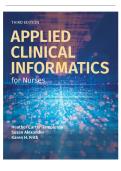
, TESTBANK FOR Applied Clinical Informatics Third Edition Heather Carter-
Templeton
Important Notes
The file includes the complete test bank, organized chapter by chapter.
A sample of selected pages has been provided for preview.
All available appendices and Excel files (if included in the original resources) are
provided.
Quizzes, Midterm and final exams are included (if available in the original resources).
We continuously update our files to ensure you receive the latest and most accurate
editions.
New editions are added regularly – stay connected for updates!
⚠️Note on Answer Keys: If the answer key is not included within the chapter
questions, you will find the complete answers and solutions at the end of each
chapter.
✅ Why Buy From Us?
📚 Complete & organized chapter-by-chapter – no missing content, no guessing.
⚡ Instant digital delivery – get your file the moment you pay, no waiting.
📅 Always up to date – we track new editions so you always get the latest version.
💬 Friendly support – real humans ready to help, anytime you need us.
🔒 Safe & secure – thousands of satisfied students trust us every semester.
🛡️Our Guarantees
💰 Money-Back Guarantee: Not satisfied? We offer a full refund – no questions asked.
🔄 Wrong File? No Problem: Contact us and we will replace it immediately with the
correct version, free of charge.
⏰ 24/7 Support: We are always here – reach out anytime and expect a fast response.
Contact Email:
,Applied Clinical Informatics for Nurses, Third Edition
Heather Carter-Templeton, Susan Alexander, and Karen Firth
Test Bank
Chapter 1
Import Settings:
Base Settings: Brownstone Default
Information Field: Complexity
Information Field: Ahead
Information Field: Subject
Information Field: Title
Information Field: Feedback
Information Field: Taxonomy
Information Field: Objective
Highest Answer Letter: D
Multiple Keywords in Same Paragraph: No
NAS ISBN13: 9781284274981, add to Ahead, Title tags
Chapter: Chapter 01 - Quiz
Multiple Choice
1. What is clinical informatics?
A) Ways information is used in patient care
B) Practices by which nurses are trained for patient care
C) Communication avenues for patients
D) Information gathering for patients
Ans: A
Complexity: Easy
Ahead: Clinical Informatics and Nursing Informatics Defined
Subject: Chapter 1
Title: Overview of Informatics in Health Care
Feedback: Clinical informatics addresses ways information systems are used in day-to-day operations of
patient care. Domains include health systems, clinical care, and information and communication
technologies. Its purpose is to improve patient care.
Taxonomy: Remembering
Objective: 1. Review the history of the development of clinical informatics in the United States.
2. Why is it important to battle fragmentation in health care?
A) To prevent lawsuits
B) To bring all subspecialties together
C) To reduce risks for poor outcomes
D) To decrease healthcare referrals
Ans: C
Complexity: Moderate
Ahead: The Culture of Health Care in the United States
Subject: Chapter 1
Title: Overview of Informatics in Health Care
Feedback: Fragmentation is a patient safety issue, whereby patients have multiple healthcare providers.
Sometimes, this results in patients with chronic diseases experiencing unnecessary complications or
adverse events because of lack of information and communication on the provider’s part.
Copyright ã 2025 Jones & Bartlett Learning, LLC, as Ascend Learning Company
,Applied Clinical Informatics for Nurses, Third Edition
Heather Carter-Templeton, Susan Alexander, and Karen Firth
Test Bank
Chapter 1
Taxonomy: Analyzing
Objective: 3. Describe the present culture of health care in the United States.
Essay
1. What is the result of technology integrated into health care?
Ans: Technology has resulted in the integration of data throughout healthcare disciplines, the
accumulation of data, the improvement of healthcare delivery, and data storage and maintenance.
Complexity: Moderate
Ahead: History of Clinical Informatics Development
Subject: Chapter 1
Title: Overview of Informatics in Health Care
Feedback: By instituting clinical informatics, health care has greatly improved.
Taxonomy: Understanding
Objective: 1. Review the history of the development of clinical informatics in the United States.
2. How can informatics hurt the healthcare system?
Ans: Informatics can be cost-prohibitive, and improper design can be more burdensome for practitioners.
Complexity: Moderate
Ahead: Introducing Information Science
Subject: Chapter 1
Title: Overview of Informatics in Health Care
Feedback: Clinical informatics has a few challenges, including the use of legacy operating systems that
cost too much to upgrade when needed. Sometimes, the technology is burdensome on nurses rather
than helpful to them, so they spend more time inputting data than on actual patient care.
Taxonomy: Analyzing
Objective: 4. Describe the role of clinical informatics in contemporary health care in the United States.
3. Why is it important for nurses to be involved with development of clinical informatics?
Ans: Nurses are end users of the information systems, so they play an integral part of being involved in
the design and ease of use to produce favorable patient outcomes.
Complexity: Moderate
Ahead: Introducing Information Science
Subject: Chapter 1
Title: Overview of Informatics in Health Care
Feedback: Nurses bridge the gap between development and clinical use. Because of their experience,
nurses know what will and will not work in the clinical setting as far as informatics goes.
Taxonomy: Analyzing
Objective: 4. Describe the role of clinical informatics in contemporary health care in the United States.
4. What is the difference between clinical informatics and nursing informatics?
Ans: Clinical informatics covers all healthcare disciplines, whereas nursing informatics pertains to nursing
only and is considered a nursing specialty.
Complexity: Moderate
Copyright ã 2025 Jones & Bartlett Learning, LLC, as Ascend Learning Company
,Applied Clinical Informatics for Nurses, Third Edition
Heather Carter-Templeton, Susan Alexander, and Karen Firth
Test Bank
Chapter 1
Ahead: Clinical Informatics and Nursing Informatics Defined
Subject: Chapter 1
Title: Overview of Informatics in Health Care
Feedback: Nursing informatics is a necessary knowledge for all nurses for effective nursing practice; it is
not just something that is “nice to know.” Nursing information is used in all aspects of care, ranging from
bedside care to billing.
Taxonomy: Analyzing
Objective: 2. Define and discuss key concepts relating to clinical informatics and information science.
Multiple Response
1. How do older adults benefit from clinical informatics? Select all that apply.
A) Decreased costs
B) Improved mobility
C) Increased scheduling of preventive appointments
D) Decreased family complaints
E) More efficient appointment reminders
Ans: A, C, E
Complexity: Moderate
Ahead: Introducing Information Science
Subject: Chapter 1
Title: Overview of Informatics in Health Care
Feedback: Clinical informatics helps older adults through identifying potentially avoidable hospitalizations,
creating less expenditures and decreasing costs. Also, studies of the ease of reminding patients about
appointments using clinical informatics have found that patients who are reminded of appointments, such
as mammography and vaccinations, are twice as likely to receive the preventive treatment.
Taxonomy: Applying
Objective: 4. Describe the role of clinical informatics in contemporary health care in the United States.
Copyright ã 2025 Jones & Bartlett Learning, LLC, as Ascend Learning Company
,Applied Clinical Informatics for Nurses, Third Edition
Heather Carter-Templeton, Susan Alexander, and Karen Firth
Test Bank
Chapter 2
Import Settings:
Base Settings: Brownstone Default
Information Field: Complexity
Information Field: Ahead
Information Field: Subject
Information Field: Title
Information Field: Feedback
Information Field: Taxonomy
Information Field: Objective
Highest Answer Letter: D
Multiple Keywords in Same Paragraph: No
NAS ISBN13: 9781284274981, add to Ahead, Title tags
Chapter: Chapter 02 - Quiz
Multiple Choice
1. Which of the following is an important element for nursing curriculum to include regarding information
technology?
A) Its use is stagnant.
B) Application of patient-care technologies is the same for every patient.
C) Data results for one patient can be applied to other patients.
D) Use of technology helps with effective communication in all healthcare settings.
Ans: D
Complexity: Moderate
Ahead: Nursing Curricula and Continuing Education
Subject: Chapter 2
Title: Information Needs for the Healthcare Professional of the 21st Century
Feedback: Nurses should be educated regarding the various means and applications of information
technology.
Taxonomy: Analyzing
Objective: 4. Describe the importance of clinical informatics in nursing curricula and continuing education.
Essay
1. A nurse needs to complete continuing education requirements but tells a coworker she just cannot find
the time to attend classes. What should the coworker advise?
Ans: The coworker should explain that many continuing education courses can be taken online, which
can save time in obtaining continuing education.
Complexity: Easy
Ahead: Ongoing Education and Nursing Informatics
Subject: Chapter 2
Title: Information Needs for the Healthcare Professional of the 21st Century
Copyright ã 2025 Jones & Bartlett Learning, LLC, as Ascend Learning Company
,Applied Clinical Informatics for Nurses, Third Edition
Heather Carter-Templeton, Susan Alexander, and Karen Firth
Test Bank
Chapter 2
Feedback: Nurses must take continuing education classes to keep their licenses current, so taking
classes online can help the nurse who may not be able to attend classes at a traditional learning
institution.
Taxonomy: Applying
Objective: 4. Describe the importance of clinical informatics in nursing curricula and continuing education.
2. How do continuous quality improvement (CQI) programs improve patient care?
Ans: Organizations that use CQI set up holistic systems that focus on every aspect of an organization and
strive to make improvement the primary purpose of the organization, resulting in better collaboration
among providers and improved patient outcomes.
Complexity: Easy
Ahead: Quality Improvement Techniques and Nursing Informatics
Subject: Chapter 2
Title: Information Needs for the Healthcare Professional of the 21st Century
Feedback: CQI’s holistic approach includes defining processes, honing organizational management,
working in teams, gathering and assessing data, and translating those assessments into changes in the
function of the practice.
Taxonomy: Understanding
Objective: 2. Recognize the importance of clinical informatics to achieve efficient quality improvement
techniques within a complex healthcare system.
Multiple Response
1. Regarding nursing guidelines, how do clinical informatics help nurses? Select all that apply.
A) They no longer require nurses to carry around guidelines.
B) They make changes to guidelines easier.
C) They use the most recent version of guidelines.
D) They help patients manage their own care.
E) They have removed processes.
Ans: A, C
Complexity: Moderate
Ahead: Accessibility to Guidelines, Protocols, and Procedures
Subject: Chapter 2
Title: Information Needs for the Healthcare Professional of the 21st Century
Feedback: Guidelines are constantly updated, so nurses will have the most recent version available
through clinical informatics. Prior to informatics, nurses would have to carry around guidelines for their
chronically ill patients; informatics no longer requires this.
Taxonomy: Understanding
Objective: 1. Describe the importance of informatics related to the nurse’s role in clinical guidelines,
protocols, procedures, and accessibility for all clinicians.
2. What are the most commonly accessed clinical guidelines? Select all that apply.
A) Cancer
B) Colorectal cancer screening
C) Diabetes
Copyright ã 2025 Jones & Bartlett Learning, LLC, as Ascend Learning Company
,Applied Clinical Informatics for Nurses, Third Edition
Heather Carter-Templeton, Susan Alexander, and Karen Firth
Test Bank
Chapter 2
D) Hypertension
E) Asthma
Ans: B, C, D, E
Complexity: Easy
Ahead: Accessibility to Guidelines, Protocols, and Procedures
Subject: Chapter 2
Title: Information Needs for the Healthcare Professional of the 21st Century
Feedback: Colorectal cancer screening, diabetes, hypertension, and asthma are the most sought-after
resources online. See Table 2-1 for specific websites and organizations related to these.
Taxonomy: Remembering
Objective: 1. Describe the importance of informatics related to the nurse’s role in clinical guidelines,
protocols, procedures, and accessibility for all clinicians.
3. How has interprofessional collaboration changed because of clinical informatics? Select all that apply.
A) There is better communication between providers.
B) Collaboration is now done through portals and electronic medical records (EMRs).
C) It is easier to access information through various handheld devices.
D) Patients can access their own records through patient portals.
E) Group work has become more difficult.
Ans: A, B, C
Complexity: Easy
Ahead: Interprofessional Collaboration and Practice Workflow
Subject: Chapter 2
Title: Information Needs for the Healthcare Professional of the 21st Century
Feedback: Clinical informatics has enhanced collaboration in a number of ways. For example, it makes it
possible for professionals to interact and build upon each other’s contribution to care, it allows records to
be accessed through portals and other IT mediums, and interoperability improves.
Taxonomy: Applying
Objective: 3. Discuss the application of clinical informatics in optimizing the nurse’s role in
interprofessional collaboration and practice workflow through nursing leadership in information
technology.
Copyright ã 2025 Jones & Bartlett Learning, LLC, as Ascend Learning Company
,Applied Clinical Informatics for Nurses, Third Edition
Heather Carter-Templeton, Susan Alexander, and Karen Firth
Test Bank
Chapter 3
Import Settings:
Base Settings: Brownstone Default
Information Field: Complexity
Information Field: Ahead
Information Field: Subject
Information Field: Title
Information Field: Feedback
Information Field: Taxonomy
Information Field: Objective
Highest Answer Letter: D
Multiple Keywords in Same Paragraph: No
NAS ISBN13: 9781284274981, add to Ahead, Title tags
Chapter: Chapter 03 - Quiz
Multiple Choice
1. What is the difference between RAM and ROM when referring to the central processing unit?
A) RAM is temporary storage of data during input, and ROM is permanent memory on the hard drive.
B) ROM is temporary storage of data input, and RAM is permanent memory on the hard drive.
C) ROM is where a computer chip collects data, and ROM is the real operating menu of the system.
D) RAM is the part of the computer that provides access to the memory.
Ans: A
Complexity: Moderate
Ahead: Introduction to Information and Computer Science
Subject: Chapter 3
Title: Informatics and Evidence-Based Practice
Feedback: RAM means random-access memory, and ROM is read-only memory. RAM is temporary, and
ROM is permanent until it is deleted manually.
Taxonomy: Understanding
Objective: 1. Distinguish between the hardware and software components of computer systems.
2. A hospital wants to have a computer network that reaches all of its facilities in a metropolitan area.
Which type of network should the hospital employ?
A) LAN
B) MAN
C) WAN
D) DSL
Ans: C
Complexity: Easy
Ahead: Introduction to Information and Computer Science
Subject: Chapter 3
Title: Informatics and Evidence-Based Practice
Feedback: A WAN is a wide area network, which reaches far beyond a single location and connects
many local area networks (LANs) together.
Copyright ã 2025 Jones & Bartlett Learning, LLC, as Ascend Learning Company
, Applied Clinical Informatics for Nurses, Third Edition
Heather Carter-Templeton, Susan Alexander, and Karen Firth
Test Bank
Chapter 3
Taxonomy: Applying
Objective: 1. Distinguish between the hardware and software components of computer systems.
True/False
1. True or False? A nurse reads a research article about a new way to help patients with asthma. The
nurse decides to try that new way to see if it works. This is how evidence-based practice works.
Ans: False
Complexity: Moderate
Ahead: Integrating Evidence Based Practice
Subject: Chapter 3
Title: Informatics and Evidence-Based Practice
Feedback: It would be imprudent to base care on a single research article. Nurses and other healthcare
providers need to take the time to examine their current practices with respect to best practices when
EHRs or other health IT are implemented.
Taxonomy: Analyzing
Objective: 5. Discuss the role of health information technology standards in EBP.
Essay
1. What is the most efficient way to integrate evidence-based practice into electronic health records?
Ans: The best way is to have a clinical decision-support system (CDSS) embedded in health information
technology (health IT).
Complexity: Moderate
Ahead: Evidenced-based Practice Integrated into Clinical Decision Support Systems
Subject: Chapter 3
Title: Informatics and Evidence-Based Practice
Feedback: Integrating CDSS with electronic health record technology has been a method used to
improve decision making in the clinical setting, which can ensure quality care and safety.
Taxonomy: Understanding
Objective: 3. Discuss methods of integrating EBP into electronic health records or other health
information technology.
2. How is information of evidence-based practice (EBP) used in the nursing profession?
Ans: Components of EBP include a systematic and critical evaluation of current literature, the nurse’s
clinical exercise and available resources, and patients’ values and preferences, and these are used to
improve the quality of care.
Complexity: Difficult
Ahead: Integrating Evidence Practice
Subject: Chapter 3
Title: Informatics and Evidence-Based Practice
Feedback: EBP is used to make deliberate clinical decisions based on theory and relevant research that
guide patient care.
Copyright ã 2025 Jones & Bartlett Learning, LLC, as Ascend Learning Company
Templeton
Important Notes
The file includes the complete test bank, organized chapter by chapter.
A sample of selected pages has been provided for preview.
All available appendices and Excel files (if included in the original resources) are
provided.
Quizzes, Midterm and final exams are included (if available in the original resources).
We continuously update our files to ensure you receive the latest and most accurate
editions.
New editions are added regularly – stay connected for updates!
⚠️Note on Answer Keys: If the answer key is not included within the chapter
questions, you will find the complete answers and solutions at the end of each
chapter.
✅ Why Buy From Us?
📚 Complete & organized chapter-by-chapter – no missing content, no guessing.
⚡ Instant digital delivery – get your file the moment you pay, no waiting.
📅 Always up to date – we track new editions so you always get the latest version.
💬 Friendly support – real humans ready to help, anytime you need us.
🔒 Safe & secure – thousands of satisfied students trust us every semester.
🛡️Our Guarantees
💰 Money-Back Guarantee: Not satisfied? We offer a full refund – no questions asked.
🔄 Wrong File? No Problem: Contact us and we will replace it immediately with the
correct version, free of charge.
⏰ 24/7 Support: We are always here – reach out anytime and expect a fast response.
Contact Email:
,Applied Clinical Informatics for Nurses, Third Edition
Heather Carter-Templeton, Susan Alexander, and Karen Firth
Test Bank
Chapter 1
Import Settings:
Base Settings: Brownstone Default
Information Field: Complexity
Information Field: Ahead
Information Field: Subject
Information Field: Title
Information Field: Feedback
Information Field: Taxonomy
Information Field: Objective
Highest Answer Letter: D
Multiple Keywords in Same Paragraph: No
NAS ISBN13: 9781284274981, add to Ahead, Title tags
Chapter: Chapter 01 - Quiz
Multiple Choice
1. What is clinical informatics?
A) Ways information is used in patient care
B) Practices by which nurses are trained for patient care
C) Communication avenues for patients
D) Information gathering for patients
Ans: A
Complexity: Easy
Ahead: Clinical Informatics and Nursing Informatics Defined
Subject: Chapter 1
Title: Overview of Informatics in Health Care
Feedback: Clinical informatics addresses ways information systems are used in day-to-day operations of
patient care. Domains include health systems, clinical care, and information and communication
technologies. Its purpose is to improve patient care.
Taxonomy: Remembering
Objective: 1. Review the history of the development of clinical informatics in the United States.
2. Why is it important to battle fragmentation in health care?
A) To prevent lawsuits
B) To bring all subspecialties together
C) To reduce risks for poor outcomes
D) To decrease healthcare referrals
Ans: C
Complexity: Moderate
Ahead: The Culture of Health Care in the United States
Subject: Chapter 1
Title: Overview of Informatics in Health Care
Feedback: Fragmentation is a patient safety issue, whereby patients have multiple healthcare providers.
Sometimes, this results in patients with chronic diseases experiencing unnecessary complications or
adverse events because of lack of information and communication on the provider’s part.
Copyright ã 2025 Jones & Bartlett Learning, LLC, as Ascend Learning Company
,Applied Clinical Informatics for Nurses, Third Edition
Heather Carter-Templeton, Susan Alexander, and Karen Firth
Test Bank
Chapter 1
Taxonomy: Analyzing
Objective: 3. Describe the present culture of health care in the United States.
Essay
1. What is the result of technology integrated into health care?
Ans: Technology has resulted in the integration of data throughout healthcare disciplines, the
accumulation of data, the improvement of healthcare delivery, and data storage and maintenance.
Complexity: Moderate
Ahead: History of Clinical Informatics Development
Subject: Chapter 1
Title: Overview of Informatics in Health Care
Feedback: By instituting clinical informatics, health care has greatly improved.
Taxonomy: Understanding
Objective: 1. Review the history of the development of clinical informatics in the United States.
2. How can informatics hurt the healthcare system?
Ans: Informatics can be cost-prohibitive, and improper design can be more burdensome for practitioners.
Complexity: Moderate
Ahead: Introducing Information Science
Subject: Chapter 1
Title: Overview of Informatics in Health Care
Feedback: Clinical informatics has a few challenges, including the use of legacy operating systems that
cost too much to upgrade when needed. Sometimes, the technology is burdensome on nurses rather
than helpful to them, so they spend more time inputting data than on actual patient care.
Taxonomy: Analyzing
Objective: 4. Describe the role of clinical informatics in contemporary health care in the United States.
3. Why is it important for nurses to be involved with development of clinical informatics?
Ans: Nurses are end users of the information systems, so they play an integral part of being involved in
the design and ease of use to produce favorable patient outcomes.
Complexity: Moderate
Ahead: Introducing Information Science
Subject: Chapter 1
Title: Overview of Informatics in Health Care
Feedback: Nurses bridge the gap between development and clinical use. Because of their experience,
nurses know what will and will not work in the clinical setting as far as informatics goes.
Taxonomy: Analyzing
Objective: 4. Describe the role of clinical informatics in contemporary health care in the United States.
4. What is the difference between clinical informatics and nursing informatics?
Ans: Clinical informatics covers all healthcare disciplines, whereas nursing informatics pertains to nursing
only and is considered a nursing specialty.
Complexity: Moderate
Copyright ã 2025 Jones & Bartlett Learning, LLC, as Ascend Learning Company
,Applied Clinical Informatics for Nurses, Third Edition
Heather Carter-Templeton, Susan Alexander, and Karen Firth
Test Bank
Chapter 1
Ahead: Clinical Informatics and Nursing Informatics Defined
Subject: Chapter 1
Title: Overview of Informatics in Health Care
Feedback: Nursing informatics is a necessary knowledge for all nurses for effective nursing practice; it is
not just something that is “nice to know.” Nursing information is used in all aspects of care, ranging from
bedside care to billing.
Taxonomy: Analyzing
Objective: 2. Define and discuss key concepts relating to clinical informatics and information science.
Multiple Response
1. How do older adults benefit from clinical informatics? Select all that apply.
A) Decreased costs
B) Improved mobility
C) Increased scheduling of preventive appointments
D) Decreased family complaints
E) More efficient appointment reminders
Ans: A, C, E
Complexity: Moderate
Ahead: Introducing Information Science
Subject: Chapter 1
Title: Overview of Informatics in Health Care
Feedback: Clinical informatics helps older adults through identifying potentially avoidable hospitalizations,
creating less expenditures and decreasing costs. Also, studies of the ease of reminding patients about
appointments using clinical informatics have found that patients who are reminded of appointments, such
as mammography and vaccinations, are twice as likely to receive the preventive treatment.
Taxonomy: Applying
Objective: 4. Describe the role of clinical informatics in contemporary health care in the United States.
Copyright ã 2025 Jones & Bartlett Learning, LLC, as Ascend Learning Company
,Applied Clinical Informatics for Nurses, Third Edition
Heather Carter-Templeton, Susan Alexander, and Karen Firth
Test Bank
Chapter 2
Import Settings:
Base Settings: Brownstone Default
Information Field: Complexity
Information Field: Ahead
Information Field: Subject
Information Field: Title
Information Field: Feedback
Information Field: Taxonomy
Information Field: Objective
Highest Answer Letter: D
Multiple Keywords in Same Paragraph: No
NAS ISBN13: 9781284274981, add to Ahead, Title tags
Chapter: Chapter 02 - Quiz
Multiple Choice
1. Which of the following is an important element for nursing curriculum to include regarding information
technology?
A) Its use is stagnant.
B) Application of patient-care technologies is the same for every patient.
C) Data results for one patient can be applied to other patients.
D) Use of technology helps with effective communication in all healthcare settings.
Ans: D
Complexity: Moderate
Ahead: Nursing Curricula and Continuing Education
Subject: Chapter 2
Title: Information Needs for the Healthcare Professional of the 21st Century
Feedback: Nurses should be educated regarding the various means and applications of information
technology.
Taxonomy: Analyzing
Objective: 4. Describe the importance of clinical informatics in nursing curricula and continuing education.
Essay
1. A nurse needs to complete continuing education requirements but tells a coworker she just cannot find
the time to attend classes. What should the coworker advise?
Ans: The coworker should explain that many continuing education courses can be taken online, which
can save time in obtaining continuing education.
Complexity: Easy
Ahead: Ongoing Education and Nursing Informatics
Subject: Chapter 2
Title: Information Needs for the Healthcare Professional of the 21st Century
Copyright ã 2025 Jones & Bartlett Learning, LLC, as Ascend Learning Company
,Applied Clinical Informatics for Nurses, Third Edition
Heather Carter-Templeton, Susan Alexander, and Karen Firth
Test Bank
Chapter 2
Feedback: Nurses must take continuing education classes to keep their licenses current, so taking
classes online can help the nurse who may not be able to attend classes at a traditional learning
institution.
Taxonomy: Applying
Objective: 4. Describe the importance of clinical informatics in nursing curricula and continuing education.
2. How do continuous quality improvement (CQI) programs improve patient care?
Ans: Organizations that use CQI set up holistic systems that focus on every aspect of an organization and
strive to make improvement the primary purpose of the organization, resulting in better collaboration
among providers and improved patient outcomes.
Complexity: Easy
Ahead: Quality Improvement Techniques and Nursing Informatics
Subject: Chapter 2
Title: Information Needs for the Healthcare Professional of the 21st Century
Feedback: CQI’s holistic approach includes defining processes, honing organizational management,
working in teams, gathering and assessing data, and translating those assessments into changes in the
function of the practice.
Taxonomy: Understanding
Objective: 2. Recognize the importance of clinical informatics to achieve efficient quality improvement
techniques within a complex healthcare system.
Multiple Response
1. Regarding nursing guidelines, how do clinical informatics help nurses? Select all that apply.
A) They no longer require nurses to carry around guidelines.
B) They make changes to guidelines easier.
C) They use the most recent version of guidelines.
D) They help patients manage their own care.
E) They have removed processes.
Ans: A, C
Complexity: Moderate
Ahead: Accessibility to Guidelines, Protocols, and Procedures
Subject: Chapter 2
Title: Information Needs for the Healthcare Professional of the 21st Century
Feedback: Guidelines are constantly updated, so nurses will have the most recent version available
through clinical informatics. Prior to informatics, nurses would have to carry around guidelines for their
chronically ill patients; informatics no longer requires this.
Taxonomy: Understanding
Objective: 1. Describe the importance of informatics related to the nurse’s role in clinical guidelines,
protocols, procedures, and accessibility for all clinicians.
2. What are the most commonly accessed clinical guidelines? Select all that apply.
A) Cancer
B) Colorectal cancer screening
C) Diabetes
Copyright ã 2025 Jones & Bartlett Learning, LLC, as Ascend Learning Company
,Applied Clinical Informatics for Nurses, Third Edition
Heather Carter-Templeton, Susan Alexander, and Karen Firth
Test Bank
Chapter 2
D) Hypertension
E) Asthma
Ans: B, C, D, E
Complexity: Easy
Ahead: Accessibility to Guidelines, Protocols, and Procedures
Subject: Chapter 2
Title: Information Needs for the Healthcare Professional of the 21st Century
Feedback: Colorectal cancer screening, diabetes, hypertension, and asthma are the most sought-after
resources online. See Table 2-1 for specific websites and organizations related to these.
Taxonomy: Remembering
Objective: 1. Describe the importance of informatics related to the nurse’s role in clinical guidelines,
protocols, procedures, and accessibility for all clinicians.
3. How has interprofessional collaboration changed because of clinical informatics? Select all that apply.
A) There is better communication between providers.
B) Collaboration is now done through portals and electronic medical records (EMRs).
C) It is easier to access information through various handheld devices.
D) Patients can access their own records through patient portals.
E) Group work has become more difficult.
Ans: A, B, C
Complexity: Easy
Ahead: Interprofessional Collaboration and Practice Workflow
Subject: Chapter 2
Title: Information Needs for the Healthcare Professional of the 21st Century
Feedback: Clinical informatics has enhanced collaboration in a number of ways. For example, it makes it
possible for professionals to interact and build upon each other’s contribution to care, it allows records to
be accessed through portals and other IT mediums, and interoperability improves.
Taxonomy: Applying
Objective: 3. Discuss the application of clinical informatics in optimizing the nurse’s role in
interprofessional collaboration and practice workflow through nursing leadership in information
technology.
Copyright ã 2025 Jones & Bartlett Learning, LLC, as Ascend Learning Company
,Applied Clinical Informatics for Nurses, Third Edition
Heather Carter-Templeton, Susan Alexander, and Karen Firth
Test Bank
Chapter 3
Import Settings:
Base Settings: Brownstone Default
Information Field: Complexity
Information Field: Ahead
Information Field: Subject
Information Field: Title
Information Field: Feedback
Information Field: Taxonomy
Information Field: Objective
Highest Answer Letter: D
Multiple Keywords in Same Paragraph: No
NAS ISBN13: 9781284274981, add to Ahead, Title tags
Chapter: Chapter 03 - Quiz
Multiple Choice
1. What is the difference between RAM and ROM when referring to the central processing unit?
A) RAM is temporary storage of data during input, and ROM is permanent memory on the hard drive.
B) ROM is temporary storage of data input, and RAM is permanent memory on the hard drive.
C) ROM is where a computer chip collects data, and ROM is the real operating menu of the system.
D) RAM is the part of the computer that provides access to the memory.
Ans: A
Complexity: Moderate
Ahead: Introduction to Information and Computer Science
Subject: Chapter 3
Title: Informatics and Evidence-Based Practice
Feedback: RAM means random-access memory, and ROM is read-only memory. RAM is temporary, and
ROM is permanent until it is deleted manually.
Taxonomy: Understanding
Objective: 1. Distinguish between the hardware and software components of computer systems.
2. A hospital wants to have a computer network that reaches all of its facilities in a metropolitan area.
Which type of network should the hospital employ?
A) LAN
B) MAN
C) WAN
D) DSL
Ans: C
Complexity: Easy
Ahead: Introduction to Information and Computer Science
Subject: Chapter 3
Title: Informatics and Evidence-Based Practice
Feedback: A WAN is a wide area network, which reaches far beyond a single location and connects
many local area networks (LANs) together.
Copyright ã 2025 Jones & Bartlett Learning, LLC, as Ascend Learning Company
, Applied Clinical Informatics for Nurses, Third Edition
Heather Carter-Templeton, Susan Alexander, and Karen Firth
Test Bank
Chapter 3
Taxonomy: Applying
Objective: 1. Distinguish between the hardware and software components of computer systems.
True/False
1. True or False? A nurse reads a research article about a new way to help patients with asthma. The
nurse decides to try that new way to see if it works. This is how evidence-based practice works.
Ans: False
Complexity: Moderate
Ahead: Integrating Evidence Based Practice
Subject: Chapter 3
Title: Informatics and Evidence-Based Practice
Feedback: It would be imprudent to base care on a single research article. Nurses and other healthcare
providers need to take the time to examine their current practices with respect to best practices when
EHRs or other health IT are implemented.
Taxonomy: Analyzing
Objective: 5. Discuss the role of health information technology standards in EBP.
Essay
1. What is the most efficient way to integrate evidence-based practice into electronic health records?
Ans: The best way is to have a clinical decision-support system (CDSS) embedded in health information
technology (health IT).
Complexity: Moderate
Ahead: Evidenced-based Practice Integrated into Clinical Decision Support Systems
Subject: Chapter 3
Title: Informatics and Evidence-Based Practice
Feedback: Integrating CDSS with electronic health record technology has been a method used to
improve decision making in the clinical setting, which can ensure quality care and safety.
Taxonomy: Understanding
Objective: 3. Discuss methods of integrating EBP into electronic health records or other health
information technology.
2. How is information of evidence-based practice (EBP) used in the nursing profession?
Ans: Components of EBP include a systematic and critical evaluation of current literature, the nurse’s
clinical exercise and available resources, and patients’ values and preferences, and these are used to
improve the quality of care.
Complexity: Difficult
Ahead: Integrating Evidence Practice
Subject: Chapter 3
Title: Informatics and Evidence-Based Practice
Feedback: EBP is used to make deliberate clinical decisions based on theory and relevant research that
guide patient care.
Copyright ã 2025 Jones & Bartlett Learning, LLC, as Ascend Learning Company

