

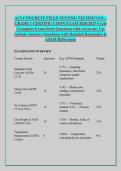
ACI CONCRETE FIELD TESTING TECHNICIAN –
GRADE 1 CERTIFICATION EXAM 2026/2027 Cycle
| Complete Exam-Style Questions with Accurate, Up-
to-Date Answers Questions with Detailed Rationales &
ASTM References
EXAMINATION OVERVIEW
Content Domain Questions Key ASTM Standards Weight
C172 — Sampling
Sampling Fresh
procedures, time limits,
Concrete (ASTM 20 22%
composite sample
C172)
requirements
C143 — Slump cone,
Slump Test (ASTM
12 rodding, measurement 13%
C143)
procedure
C173 — Volumetric
Air Content (ASTM
12 method; C231 — Pressure 13%
C173 & C231)
method
Unit Weight & Yield C138 — Density, yield, air
10 11%
(ASTM C138) content calculations
Temperature
C1064 — Temperature
Measurement (ASTM 8 9%
measuring device, procedure
C1064)
,Content Domain Questions Key ASTM Standards Weight
Making & Curing
C31 — Molding, curing,
Test Specimens 10 11%
transporting specimens
(ASTM C31)
General Field Testing Multiple standards, ACI
10 11%
Knowledge certification requirements
Calculations & Yield, air content, unit
8 10%
Problem Solving weight calculations
Q1. Start molding specimens for strength tests within 30 minutes after
fabricating the composite sample.
• A) True
• B) False
Correct Answer: B
Rationale: ASTM C172, Paragraph 4.1.2 states that molding of specimens for
strength tests must begin within 15 minutes after fabricating the composite
sample, not 30 minutes.
Why Wrong: The 30-minute timeframe is incorrect. The standard requires 15
minutes to ensure the concrete does not lose its workability before specimen
fabrication.
Q2. The maximum allowable time between obtaining the first and last
portions of the composite sample may not exceed 5 minutes.
• A) True
• B) False
Correct Answer: B
,Rationale: ASTM C172, Paragraph 4.1 specifies that the elapsed time between
obtaining the first and final portions of the composite sample shall not exceed 15
minutes, not 5 minutes.
Why Wrong: The 5-minute limit is incorrect. The standard allows 15 minutes to
collect all portions of the composite sample.
Q3. The composite concrete sample must be protected from sun, wind,
contamination, and rapid evaporation.
• A) True
• B) False
Correct Answer: A
Rationale: ASTM C172, Paragraph 4.1.2 requires that the sample be protected
from the sun, wind, and other sources of rapid evaporation, as well as from
contamination.
Why Wrong: This statement is correct. Protecting the sample is essential to
maintain its properties and ensure accurate test results.
Q4. If the concrete contains aggregates larger than those that are appropriate
for a size of mold or equipment used, the sample should be wet sieved before
making the test.
• A) True
• B) False
Correct Answer: A
Rationale: ASTM C172, Paragraph 6.1 requires wet sieving of the sample when
aggregates are larger than appropriate for the mold or equipment being used.
Why Wrong: This statement is correct. Wet sieving removes oversized aggregates
that would interfere with testing.
Q5. The composite sample should not be remixed before beginning any tests.
• A) True
, • B) False
Correct Answer: B
Rationale: ASTM C172, Paragraph 4.1.1 requires that the sample shall be
combined and remixed with a shovel the minimum amount necessary to ensure
uniformity and compliance with the maximum time limits.
Why Wrong: The sample must be remixed to ensure uniformity before testing.
The statement is false.
Q6. Sampling should normally be performed as the concrete is discharged
from the mixer.
• A) True
• B) False
Correct Answer: B
Rationale: ASTM C172, Paragraph 5, Note 2 states: "Sampling should normally
be performed as the concrete is delivered from the mixer to the conveying
vehicle used to transport the concrete to the forms".
Why Wrong: Sampling occurs as concrete is delivered from the mixer to the
transport vehicle, not as it is discharged from the mixer at the point of placement.
Q7. ASTM Method C172 includes sampling from stationary mixers, paving
mixers, truck mixers, agitators, and non-agitating equipment.
• A) True
• B) False
Correct Answer: A
Rationale: ASTM C172, Paragraph 1.1 states that the practice includes sampling
from stationary, paving, and truck mixers, as well as from agitating and non-
agitating equipment.
Why Wrong: This statement is correct. C172 covers all these types of equipment.
GRADE 1 CERTIFICATION EXAM 2026/2027 Cycle
| Complete Exam-Style Questions with Accurate, Up-
to-Date Answers Questions with Detailed Rationales &
ASTM References
EXAMINATION OVERVIEW
Content Domain Questions Key ASTM Standards Weight
C172 — Sampling
Sampling Fresh
procedures, time limits,
Concrete (ASTM 20 22%
composite sample
C172)
requirements
C143 — Slump cone,
Slump Test (ASTM
12 rodding, measurement 13%
C143)
procedure
C173 — Volumetric
Air Content (ASTM
12 method; C231 — Pressure 13%
C173 & C231)
method
Unit Weight & Yield C138 — Density, yield, air
10 11%
(ASTM C138) content calculations
Temperature
C1064 — Temperature
Measurement (ASTM 8 9%
measuring device, procedure
C1064)
,Content Domain Questions Key ASTM Standards Weight
Making & Curing
C31 — Molding, curing,
Test Specimens 10 11%
transporting specimens
(ASTM C31)
General Field Testing Multiple standards, ACI
10 11%
Knowledge certification requirements
Calculations & Yield, air content, unit
8 10%
Problem Solving weight calculations
Q1. Start molding specimens for strength tests within 30 minutes after
fabricating the composite sample.
• A) True
• B) False
Correct Answer: B
Rationale: ASTM C172, Paragraph 4.1.2 states that molding of specimens for
strength tests must begin within 15 minutes after fabricating the composite
sample, not 30 minutes.
Why Wrong: The 30-minute timeframe is incorrect. The standard requires 15
minutes to ensure the concrete does not lose its workability before specimen
fabrication.
Q2. The maximum allowable time between obtaining the first and last
portions of the composite sample may not exceed 5 minutes.
• A) True
• B) False
Correct Answer: B
,Rationale: ASTM C172, Paragraph 4.1 specifies that the elapsed time between
obtaining the first and final portions of the composite sample shall not exceed 15
minutes, not 5 minutes.
Why Wrong: The 5-minute limit is incorrect. The standard allows 15 minutes to
collect all portions of the composite sample.
Q3. The composite concrete sample must be protected from sun, wind,
contamination, and rapid evaporation.
• A) True
• B) False
Correct Answer: A
Rationale: ASTM C172, Paragraph 4.1.2 requires that the sample be protected
from the sun, wind, and other sources of rapid evaporation, as well as from
contamination.
Why Wrong: This statement is correct. Protecting the sample is essential to
maintain its properties and ensure accurate test results.
Q4. If the concrete contains aggregates larger than those that are appropriate
for a size of mold or equipment used, the sample should be wet sieved before
making the test.
• A) True
• B) False
Correct Answer: A
Rationale: ASTM C172, Paragraph 6.1 requires wet sieving of the sample when
aggregates are larger than appropriate for the mold or equipment being used.
Why Wrong: This statement is correct. Wet sieving removes oversized aggregates
that would interfere with testing.
Q5. The composite sample should not be remixed before beginning any tests.
• A) True
, • B) False
Correct Answer: B
Rationale: ASTM C172, Paragraph 4.1.1 requires that the sample shall be
combined and remixed with a shovel the minimum amount necessary to ensure
uniformity and compliance with the maximum time limits.
Why Wrong: The sample must be remixed to ensure uniformity before testing.
The statement is false.
Q6. Sampling should normally be performed as the concrete is discharged
from the mixer.
• A) True
• B) False
Correct Answer: B
Rationale: ASTM C172, Paragraph 5, Note 2 states: "Sampling should normally
be performed as the concrete is delivered from the mixer to the conveying
vehicle used to transport the concrete to the forms".
Why Wrong: Sampling occurs as concrete is delivered from the mixer to the
transport vehicle, not as it is discharged from the mixer at the point of placement.
Q7. ASTM Method C172 includes sampling from stationary mixers, paving
mixers, truck mixers, agitators, and non-agitating equipment.
• A) True
• B) False
Correct Answer: A
Rationale: ASTM C172, Paragraph 1.1 states that the practice includes sampling
from stationary, paving, and truck mixers, as well as from agitating and non-
agitating equipment.
Why Wrong: This statement is correct. C172 covers all these types of equipment.

