ASWB RSW-BSW Exam Prep 2026/2027 | Questions & Correct
Answers | Graded A+
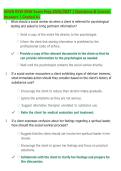
1. What should a social worker do when a client is referred for psychological
testing and asked to bring pertinent information?
Send a copy of the entire file directly to the psychologist.
Inform the client that sharing information is prohibited by the
professional code of ethics.
Provide a copy of the relevant documents to the client so that he
can provide information to the psychologist as needed.
Wait until the psychologist contacts the social worker directly.
2. If a social worker encounters a client exhibiting signs of delirium tremens,
what immediate action should they consider based on the client's history of
substance use?
Encourage the client to reduce their alcohol intake gradually.
Ignore the symptoms as they are not serious.
Suggest alternative therapies unrelated to substance use.
Refer the client for medical evaluation and treatment.
3. If a client expresses confusion about her feelings regarding a spiritual leader,
how should the social worker proceed?
Suggest that the client should not involve her spiritual leader in her
issues.
Encourage the client to ignore her feelings and focus on practical
solutions.
Collaborate with the client to clarify her feelings and prepare for
the discussion.
, Directly confront the client about her beliefs in evil spirits.
4. In a clinical setting, if a patient is diagnosed with Alzheimer's disease, what
implications does this have for their care regarding dementia symptoms?
The patient should be referred to a specialist for unrelated conditions.
The focus should be solely on physical health, ignoring cognitive
symptoms.
The care plan should address the dementia symptoms caused by
Alzheimer's disease.
The patient should be treated as if they do not have dementia.
5. Which of the following describes comorbidity?
The DSM of a disorder in a population
When a disorder is life threatening
The co-occurence of two disorders
When multiple family members have the same disorder
6. What is the primary focus for a social worker when addressing a client's
concerns about agency bias?
Find another job that will offer advancement opportunities
Determine if other employees have suffered discrimination
Fight the agency's discriminatory practices
Address the emotional consequences of discrimination
7. Discuss why a social worker might consider a client's competency when
deciding to release records.
, A social worker might consider a client's competency to ensure that
the client can appropriately process and understand the sensitive
information in their records.
A social worker might deny the request simply because the client is no
longer receiving services.
A social worker should only consider the client's age when making this
decision.
A social worker must always release records regardless of the client's
situation.
8. What term describes a family member who is often blamed for problems
within the family dynamic, particularly in cases of substance abuse?
Mascot
Scapegoat
Enabler
Lost child
9. A client complains to a social worker that her 12-year-old daughter recently
began bed-wetting after having no such issues "for years." The client states
that her daughter is having no problems at home or in school and she does
not know the cause of her behavior. The client is very distressed and asks the
social worker for help. In order to assist, the social worker should FIRST:
Contact child protective services to rule out the possibility of sexual
abuse
Request a copy of the school records to determine if there are any
developmental delays
Recommend that the client take her daughter to her physician for a
medical examination
, Meet with the daughter to see if there are problems of which the
mother is not aware
10. Why is role playing considered an effective strategy for helping an
adolescent girl with self-destructive behavior?
Role playing focuses solely on her parents' behavior.
Role playing can help her practice assertiveness and improve her
communication skills.
Role playing distracts her from her self-destructive thoughts.
Role playing allows her to avoid discussing her feelings.
11. Describe the significance of separation anxiety in early childhood
development.
Separation anxiety is a sign of a psychological disorder in children.
Separation anxiety shows that a child is overly dependent on their
caregiver.
Separation anxiety occurs only in children with insecure attachments.
Separation anxiety is a normal developmental stage that indicates a
child's attachment to their caregiver.
12. Describe the relationship between delirium tremens and alcoholism.
Delirium tremens is a common symptom of Tourette syndrome.
Delirium tremens is a condition that affects individuals with Parkinson's
disease.
Delirium tremens is a neurological disorder unrelated to substance
use.
Answers | Graded A+
1. What should a social worker do when a client is referred for psychological
testing and asked to bring pertinent information?
Send a copy of the entire file directly to the psychologist.
Inform the client that sharing information is prohibited by the
professional code of ethics.
Provide a copy of the relevant documents to the client so that he
can provide information to the psychologist as needed.
Wait until the psychologist contacts the social worker directly.
2. If a social worker encounters a client exhibiting signs of delirium tremens,
what immediate action should they consider based on the client's history of
substance use?
Encourage the client to reduce their alcohol intake gradually.
Ignore the symptoms as they are not serious.
Suggest alternative therapies unrelated to substance use.
Refer the client for medical evaluation and treatment.
3. If a client expresses confusion about her feelings regarding a spiritual leader,
how should the social worker proceed?
Suggest that the client should not involve her spiritual leader in her
issues.
Encourage the client to ignore her feelings and focus on practical
solutions.
Collaborate with the client to clarify her feelings and prepare for
the discussion.
, Directly confront the client about her beliefs in evil spirits.
4. In a clinical setting, if a patient is diagnosed with Alzheimer's disease, what
implications does this have for their care regarding dementia symptoms?
The patient should be referred to a specialist for unrelated conditions.
The focus should be solely on physical health, ignoring cognitive
symptoms.
The care plan should address the dementia symptoms caused by
Alzheimer's disease.
The patient should be treated as if they do not have dementia.
5. Which of the following describes comorbidity?
The DSM of a disorder in a population
When a disorder is life threatening
The co-occurence of two disorders
When multiple family members have the same disorder
6. What is the primary focus for a social worker when addressing a client's
concerns about agency bias?
Find another job that will offer advancement opportunities
Determine if other employees have suffered discrimination
Fight the agency's discriminatory practices
Address the emotional consequences of discrimination
7. Discuss why a social worker might consider a client's competency when
deciding to release records.
, A social worker might consider a client's competency to ensure that
the client can appropriately process and understand the sensitive
information in their records.
A social worker might deny the request simply because the client is no
longer receiving services.
A social worker should only consider the client's age when making this
decision.
A social worker must always release records regardless of the client's
situation.
8. What term describes a family member who is often blamed for problems
within the family dynamic, particularly in cases of substance abuse?
Mascot
Scapegoat
Enabler
Lost child
9. A client complains to a social worker that her 12-year-old daughter recently
began bed-wetting after having no such issues "for years." The client states
that her daughter is having no problems at home or in school and she does
not know the cause of her behavior. The client is very distressed and asks the
social worker for help. In order to assist, the social worker should FIRST:
Contact child protective services to rule out the possibility of sexual
abuse
Request a copy of the school records to determine if there are any
developmental delays
Recommend that the client take her daughter to her physician for a
medical examination
, Meet with the daughter to see if there are problems of which the
mother is not aware
10. Why is role playing considered an effective strategy for helping an
adolescent girl with self-destructive behavior?
Role playing focuses solely on her parents' behavior.
Role playing can help her practice assertiveness and improve her
communication skills.
Role playing distracts her from her self-destructive thoughts.
Role playing allows her to avoid discussing her feelings.
11. Describe the significance of separation anxiety in early childhood
development.
Separation anxiety is a sign of a psychological disorder in children.
Separation anxiety shows that a child is overly dependent on their
caregiver.
Separation anxiety occurs only in children with insecure attachments.
Separation anxiety is a normal developmental stage that indicates a
child's attachment to their caregiver.
12. Describe the relationship between delirium tremens and alcoholism.
Delirium tremens is a common symptom of Tourette syndrome.
Delirium tremens is a condition that affects individuals with Parkinson's
disease.
Delirium tremens is a neurological disorder unrelated to substance
use.