
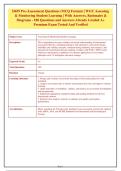
D659 Pre-Assessment Questions (MCQ Format) | WGU Assessing
& Monitoring Student Learning | With Answers, Rationales &
Diagrams - 180 Questions and Answers Already Graded A+
Premium Exam Tested And Verified
Subject Area Assessing & Monitoring Student Learning
Description This comprehensive exam evaluates advanced understanding of educational
assessment theories, including formative and summative assessment design,
reliability and validity concepts, standard-setting methods, item analysis, and
data-driven instructional decision-making. It aligns with WGU's D659 course
objectives and prepares candidates for rigorous application of assessment
principles in K-12 and higher education settings.
Expected Grade A+
Total Questions 180
Duration 3 hours
Learning Outcomes 1. Design and evaluate assessments that align with learning objectives and
standards.
2. Analyze assessment data to inform instructional decisions and improve student
learning.
3. Apply principles of reliability, validity, and fairness in assessment development
and interpretation.
4. Implement appropriate standard-setting and grading methods for diverse
educational contexts.
5. Interpret item analysis statistics to enhance test quality and student
performance.
Accreditation Meets standards for US university graduate-level assessment coursework, aligned
with AERA, APA, and NCME Standards for Educational and Psychological
Testing.
Page 1
,1. A school district is implementing a new interim assessment system to monitor
student progress in mathematics. The assessments are administered three times per
year and are aligned to state standards. After the first administration, item analysis
reveals that several items have discrimination indices below 0.20. Which of the
following actions is most appropriate for improving the quality of future
assessments?
A. Increase the number of items to improve reliability
B. Remove or revise items with low discrimination indices to enhance validity
C. Adjust the cut scores to compensate for poor item performance
D. Provide retesting opportunities for students who performed poorly
Answer: B. Remove or revise items with low discrimination indices to enhance
validity
Items with low discrimination indices do not effectively differentiate between high and
low performers, reducing test validity. Removing or revising such items directly
addresses this issue. Increasing item count (A) may improve reliability but does not fix
flawed items. Adjusting cut scores (C) or retesting (D) does not improve the assessment
itself.
2. A university professor is designing a final exam for a large introductory course.
The exam consists of 50 multiple-choice items. To ensure content validity, the
professor creates a table of specifications. Which of the following best describes the
primary purpose of this table?
A. To calculate the reliability coefficient of the exam
B. To map assessment items to learning objectives and cognitive levels
C. To determine the optimal cut score for pass/fail decisions
D. To analyze item difficulty and discrimination indices
Answer: B. To map assessment items to learning objectives and cognitive levels
A table of specifications (or test blueprint) ensures content validity by systematically
aligning items with learning objectives and cognitive levels (e.g., Bloom's taxonomy).
Reliability (A) is addressed through other methods like KR-20. Cut scores (C) are set
via standard-setting methods. Item analysis (D) occurs after test administration.
Page 2
,3. A school uses a norm-referenced grading system. A student scores at the 85th
percentile on a standardized achievement test. Which of the following interpretations
is most accurate?
A. The student answered 85% of the items correctly.
B. The student's performance exceeds that of 85% of the norm group.
C. The student is performing at grade level.
D. The student's score is 85% of the maximum possible score.
Answer: B. The student's performance exceeds that of 85% of the norm group.
Percentile ranks indicate the percentage of scores in the norm group that fall below a
given score. Thus, the 85th percentile means the student outperformed 85% of the norm
group. Option A describes percentage correct (criterion-referenced). Option C is not
directly indicated by percentile rank. Option D describes a percentage score, not a
percentile.
4. A teacher administers a pre-test and post-test to measure learning gains. The
pre-test mean is 45% and the post-test mean is 78%. The effect size (Cohen's d) is
calculated as 0.6. Which of the following is the most appropriate interpretation?
A. The intervention had a large effect on student learning.
B. The average student in the post-test scored 0.6 standard deviations above the pre-test
average.
C. The correlation between pre-test and post-test scores is 0.6.
D. The intervention caused a 33% increase in scores.
Answer: B. The average student in the post-test scored 0.6 standard deviations
above the pre-test average.
Cohen's d is a standardized mean difference; d=0.6 indicates a medium effect size,
meaning the post-test mean is 0.6 standard deviations higher than the pre-test mean.
Option A is incorrect because d=0.6 is considered medium, not large (large is typically
0.8). Option C misinterprets d as a correlation. Option D is a raw percentage change,
not effect size.
Page 3
, 5. A test development team is validating a new assessment for critical thinking. They
administer the test to a group of students and also collect their scores on a
well-established critical thinking test. The correlation between the two sets of scores
is 0.72. This provides evidence of which type of validity?
A. Content validity
B. Criterion-related validity (concurrent)
C. Construct validity
D. Face validity
Answer: B. Criterion-related validity (concurrent)
Concurrent validity is a form of criterion-related validity that examines the correlation
between a new measure and an established measure administered at the same time. A
high correlation (0.72) supports that the new test measures a similar construct. Content
validity (A) is established through expert review. Construct validity (C) is broader and
often requires multiple sources. Face validity (D) is a subjective judgment.
6. A teacher uses a rubric to score student essays. Two raters independently score the
same set of 20 essays, and their scores correlate at r = 0.85. Which type of reliability
is being assessed?
A. Test-retest reliability
B. Internal consistency reliability
C. Inter-rater reliability
D. Parallel forms reliability
Answer: C. Inter-rater reliability
Inter-rater reliability measures the consistency of scores across different raters. A high
correlation (0.85) indicates good agreement. Test-retest (A) involves administering the
same test twice over time. Internal consistency (B) is assessed via split-half or coefficient
alpha. Parallel forms (D) requires two equivalent test forms.
Page 4
& Monitoring Student Learning | With Answers, Rationales &
Diagrams - 180 Questions and Answers Already Graded A+
Premium Exam Tested And Verified
Subject Area Assessing & Monitoring Student Learning
Description This comprehensive exam evaluates advanced understanding of educational
assessment theories, including formative and summative assessment design,
reliability and validity concepts, standard-setting methods, item analysis, and
data-driven instructional decision-making. It aligns with WGU's D659 course
objectives and prepares candidates for rigorous application of assessment
principles in K-12 and higher education settings.
Expected Grade A+
Total Questions 180
Duration 3 hours
Learning Outcomes 1. Design and evaluate assessments that align with learning objectives and
standards.
2. Analyze assessment data to inform instructional decisions and improve student
learning.
3. Apply principles of reliability, validity, and fairness in assessment development
and interpretation.
4. Implement appropriate standard-setting and grading methods for diverse
educational contexts.
5. Interpret item analysis statistics to enhance test quality and student
performance.
Accreditation Meets standards for US university graduate-level assessment coursework, aligned
with AERA, APA, and NCME Standards for Educational and Psychological
Testing.
Page 1
,1. A school district is implementing a new interim assessment system to monitor
student progress in mathematics. The assessments are administered three times per
year and are aligned to state standards. After the first administration, item analysis
reveals that several items have discrimination indices below 0.20. Which of the
following actions is most appropriate for improving the quality of future
assessments?
A. Increase the number of items to improve reliability
B. Remove or revise items with low discrimination indices to enhance validity
C. Adjust the cut scores to compensate for poor item performance
D. Provide retesting opportunities for students who performed poorly
Answer: B. Remove or revise items with low discrimination indices to enhance
validity
Items with low discrimination indices do not effectively differentiate between high and
low performers, reducing test validity. Removing or revising such items directly
addresses this issue. Increasing item count (A) may improve reliability but does not fix
flawed items. Adjusting cut scores (C) or retesting (D) does not improve the assessment
itself.
2. A university professor is designing a final exam for a large introductory course.
The exam consists of 50 multiple-choice items. To ensure content validity, the
professor creates a table of specifications. Which of the following best describes the
primary purpose of this table?
A. To calculate the reliability coefficient of the exam
B. To map assessment items to learning objectives and cognitive levels
C. To determine the optimal cut score for pass/fail decisions
D. To analyze item difficulty and discrimination indices
Answer: B. To map assessment items to learning objectives and cognitive levels
A table of specifications (or test blueprint) ensures content validity by systematically
aligning items with learning objectives and cognitive levels (e.g., Bloom's taxonomy).
Reliability (A) is addressed through other methods like KR-20. Cut scores (C) are set
via standard-setting methods. Item analysis (D) occurs after test administration.
Page 2
,3. A school uses a norm-referenced grading system. A student scores at the 85th
percentile on a standardized achievement test. Which of the following interpretations
is most accurate?
A. The student answered 85% of the items correctly.
B. The student's performance exceeds that of 85% of the norm group.
C. The student is performing at grade level.
D. The student's score is 85% of the maximum possible score.
Answer: B. The student's performance exceeds that of 85% of the norm group.
Percentile ranks indicate the percentage of scores in the norm group that fall below a
given score. Thus, the 85th percentile means the student outperformed 85% of the norm
group. Option A describes percentage correct (criterion-referenced). Option C is not
directly indicated by percentile rank. Option D describes a percentage score, not a
percentile.
4. A teacher administers a pre-test and post-test to measure learning gains. The
pre-test mean is 45% and the post-test mean is 78%. The effect size (Cohen's d) is
calculated as 0.6. Which of the following is the most appropriate interpretation?
A. The intervention had a large effect on student learning.
B. The average student in the post-test scored 0.6 standard deviations above the pre-test
average.
C. The correlation between pre-test and post-test scores is 0.6.
D. The intervention caused a 33% increase in scores.
Answer: B. The average student in the post-test scored 0.6 standard deviations
above the pre-test average.
Cohen's d is a standardized mean difference; d=0.6 indicates a medium effect size,
meaning the post-test mean is 0.6 standard deviations higher than the pre-test mean.
Option A is incorrect because d=0.6 is considered medium, not large (large is typically
0.8). Option C misinterprets d as a correlation. Option D is a raw percentage change,
not effect size.
Page 3
, 5. A test development team is validating a new assessment for critical thinking. They
administer the test to a group of students and also collect their scores on a
well-established critical thinking test. The correlation between the two sets of scores
is 0.72. This provides evidence of which type of validity?
A. Content validity
B. Criterion-related validity (concurrent)
C. Construct validity
D. Face validity
Answer: B. Criterion-related validity (concurrent)
Concurrent validity is a form of criterion-related validity that examines the correlation
between a new measure and an established measure administered at the same time. A
high correlation (0.72) supports that the new test measures a similar construct. Content
validity (A) is established through expert review. Construct validity (C) is broader and
often requires multiple sources. Face validity (D) is a subjective judgment.
6. A teacher uses a rubric to score student essays. Two raters independently score the
same set of 20 essays, and their scores correlate at r = 0.85. Which type of reliability
is being assessed?
A. Test-retest reliability
B. Internal consistency reliability
C. Inter-rater reliability
D. Parallel forms reliability
Answer: C. Inter-rater reliability
Inter-rater reliability measures the consistency of scores across different raters. A high
correlation (0.85) indicates good agreement. Test-retest (A) involves administering the
same test twice over time. Internal consistency (B) is assessed via split-half or coefficient
alpha. Parallel forms (D) requires two equivalent test forms.
Page 4

