

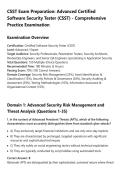
CSST Exam Preparation: Advanced Certified
Software Security Tester (CSST) - Comprehensive
Practice Examination
Examination Overview
Certification: Certified Software Security Tester (CSST)
Level: Advanced / Expert
Target Audience: Security Professionals, Penetration Testers, Security Architects,
DevSecOps Engineers, and Senior QA Engineers specializing in Application Security
Total Questions: 150 Multiple-Choice Questions
Recommended Time: 180 Minutes (3 Hours)
Passing Score: 70% (105 Correct Answers)
Domain Coverage: Security Risk Management (25%), Asset Identification &
Classification (15%), Security Policies & Governance (20%), Security Auditing &
Assessment (20%), Testing Methodologies (10%), Information Assurance &
Organizational Context (10%)
Domain 1: Advanced Security Risk Management and
Threat Analysis (Questions 1-35)
1. In the context of Advanced Persistent Threats (APTs), which of the following
characteristics most accurately distinguishes them from standard cyber attacks?
A) They exclusively target financial institutions and use only zero-day exploits
B) They are characterized by prolonged, targeted operations with significant
resources and sophisticated techniques
C) They rely solely on social engineering tactics without technical exploitation
D) They are typically conducted by script kiddies using automated tools
Correct Answer: B
Rationale: APTs are distinguished by their sophisticated, sustained nature where threat
,actors maintain long-term access using advanced techniques. They are well-resourced,
targeted, and persistent, unlike single-event attacks conducted by less sophisticated
actors.
2. Which of the following represents the MOST comprehensive risk assessment
approach when evaluating a complex distributed system?
A) Performing a quantitative risk analysis using Annualized Loss Expectancy (ALE)
calculations
B) Conducting a qualitative risk assessment with stakeholder interviews
C) Implementing a hybrid approach combining quantitative metrics with
qualitative expert judgment
D) Relying solely on automated vulnerability scanning results
Correct Answer: C
Rationale: Complex distributed systems require a hybrid approach that combines the
numerical precision of quantitative analysis with the contextual insights of qualitative
assessment. This provides a more comprehensive understanding of risks in
multifaceted environments where pure quantitative or qualitative approaches alone
are insufficient.
3. The concept of "risk aggregation" in enterprise security testing refers to:
A) Adding individual risk scores to calculate total organizational risk
B) The process of combining and correlating risks across different business units
and systems
C) Multiplying risk probabilities by impacts for each asset
D) The practice of ignoring low-level risks in favor of high-level ones
Correct Answer: B
Rationale: Risk aggregation involves combining and correlating risks across an
organization to understand cumulative exposure. Individual risks can interact and
compound, creating systemic risk that exceeds the sum of individual risk scores.
4. When performing a threat modeling exercise using the STRIDE methodology,
which threat category addresses the scenario where an attacker modifies data in
transit?
, A) Spoofing
B) Tampering
C) Repudiation
D) Information Disclosure
Correct Answer: B
Rationale: STRIDE categorizes tampering as unauthorized modification of data. This
includes data modification in transit, at rest, or during processing. Tampering attacks
compromise data integrity.
5. In the DREAD risk assessment model, the "Discoverability" component
primarily evaluates:
A) How easy it is for attackers to find the vulnerability
B) How much damage the vulnerability could cause
C) How many users are affected by the vulnerability
D) How easy it is to exploit the vulnerability
Correct Answer: A
Rationale: In the DREAD model, Discoverability measures how easy it is for an attacker
to identify and find the vulnerability. This factor is particularly important because even
severe vulnerabilities that are difficult to discover may pose lower overall risk than
easily found ones.
6. What is the primary limitation of using Common Vulnerability Scoring System
(CVSS) v3.1 scores in isolation for risk prioritization?
A) CVSS scores are too difficult to calculate accurately
B) CVSS does not account for organizational context and business impact
C) CVSS only applies to network vulnerabilities
D) CVSS scores cannot be compared across different vulnerability types
Correct Answer: B
Rationale: CVSS provides a standardized severity score based on technical
characteristics, but it does not incorporate organizational context such as asset
criticality, business impact, or existing compensating controls. Organizations must
supplement CVSS with contextual risk factors.
, 7. Which of the following best describes the relationship between threat
intelligence and security testing?
A) Threat intelligence replaces the need for security testing
B) Threat intelligence informs testing priorities by identifying current attack
patterns and techniques
C) Threat intelligence is only useful after a security breach occurs
D) Threat intelligence and security testing are unrelated activities
Correct Answer: B
Rationale: Threat intelligence provides actionable information about current threats,
attack patterns, and adversary techniques, which helps security testers focus on the
most relevant and current attack vectors during testing.
8. In Bayesian risk analysis, the posterior probability of a security incident is
calculated by:
A) Multiplying prior probability by likelihood of evidence
B) Dividing prior probability by the likelihood of evidence
C) Combining prior probability with new evidence using Bayes' theorem
D) Calculating the absolute frequency of incidents
Correct Answer: C
Rationale: Bayesian risk analysis updates prior probabilities with new evidence using
Bayes' theorem to calculate posterior probabilities. This approach allows for dynamic
risk assessment as new threat intelligence and security events emerge.
9. The "Confidentiality, Integrity, and Availability" (CIA) triad, when applied to risk
assessment, requires that:
A) All three components must always be equally prioritized
B) The relative importance of each component varies based on business
requirements and data classification
C) Availability is always the most critical component
D) Confidentiality always takes precedence over other components
Software Security Tester (CSST) - Comprehensive
Practice Examination
Examination Overview
Certification: Certified Software Security Tester (CSST)
Level: Advanced / Expert
Target Audience: Security Professionals, Penetration Testers, Security Architects,
DevSecOps Engineers, and Senior QA Engineers specializing in Application Security
Total Questions: 150 Multiple-Choice Questions
Recommended Time: 180 Minutes (3 Hours)
Passing Score: 70% (105 Correct Answers)
Domain Coverage: Security Risk Management (25%), Asset Identification &
Classification (15%), Security Policies & Governance (20%), Security Auditing &
Assessment (20%), Testing Methodologies (10%), Information Assurance &
Organizational Context (10%)
Domain 1: Advanced Security Risk Management and
Threat Analysis (Questions 1-35)
1. In the context of Advanced Persistent Threats (APTs), which of the following
characteristics most accurately distinguishes them from standard cyber attacks?
A) They exclusively target financial institutions and use only zero-day exploits
B) They are characterized by prolonged, targeted operations with significant
resources and sophisticated techniques
C) They rely solely on social engineering tactics without technical exploitation
D) They are typically conducted by script kiddies using automated tools
Correct Answer: B
Rationale: APTs are distinguished by their sophisticated, sustained nature where threat
,actors maintain long-term access using advanced techniques. They are well-resourced,
targeted, and persistent, unlike single-event attacks conducted by less sophisticated
actors.
2. Which of the following represents the MOST comprehensive risk assessment
approach when evaluating a complex distributed system?
A) Performing a quantitative risk analysis using Annualized Loss Expectancy (ALE)
calculations
B) Conducting a qualitative risk assessment with stakeholder interviews
C) Implementing a hybrid approach combining quantitative metrics with
qualitative expert judgment
D) Relying solely on automated vulnerability scanning results
Correct Answer: C
Rationale: Complex distributed systems require a hybrid approach that combines the
numerical precision of quantitative analysis with the contextual insights of qualitative
assessment. This provides a more comprehensive understanding of risks in
multifaceted environments where pure quantitative or qualitative approaches alone
are insufficient.
3. The concept of "risk aggregation" in enterprise security testing refers to:
A) Adding individual risk scores to calculate total organizational risk
B) The process of combining and correlating risks across different business units
and systems
C) Multiplying risk probabilities by impacts for each asset
D) The practice of ignoring low-level risks in favor of high-level ones
Correct Answer: B
Rationale: Risk aggregation involves combining and correlating risks across an
organization to understand cumulative exposure. Individual risks can interact and
compound, creating systemic risk that exceeds the sum of individual risk scores.
4. When performing a threat modeling exercise using the STRIDE methodology,
which threat category addresses the scenario where an attacker modifies data in
transit?
, A) Spoofing
B) Tampering
C) Repudiation
D) Information Disclosure
Correct Answer: B
Rationale: STRIDE categorizes tampering as unauthorized modification of data. This
includes data modification in transit, at rest, or during processing. Tampering attacks
compromise data integrity.
5. In the DREAD risk assessment model, the "Discoverability" component
primarily evaluates:
A) How easy it is for attackers to find the vulnerability
B) How much damage the vulnerability could cause
C) How many users are affected by the vulnerability
D) How easy it is to exploit the vulnerability
Correct Answer: A
Rationale: In the DREAD model, Discoverability measures how easy it is for an attacker
to identify and find the vulnerability. This factor is particularly important because even
severe vulnerabilities that are difficult to discover may pose lower overall risk than
easily found ones.
6. What is the primary limitation of using Common Vulnerability Scoring System
(CVSS) v3.1 scores in isolation for risk prioritization?
A) CVSS scores are too difficult to calculate accurately
B) CVSS does not account for organizational context and business impact
C) CVSS only applies to network vulnerabilities
D) CVSS scores cannot be compared across different vulnerability types
Correct Answer: B
Rationale: CVSS provides a standardized severity score based on technical
characteristics, but it does not incorporate organizational context such as asset
criticality, business impact, or existing compensating controls. Organizations must
supplement CVSS with contextual risk factors.
, 7. Which of the following best describes the relationship between threat
intelligence and security testing?
A) Threat intelligence replaces the need for security testing
B) Threat intelligence informs testing priorities by identifying current attack
patterns and techniques
C) Threat intelligence is only useful after a security breach occurs
D) Threat intelligence and security testing are unrelated activities
Correct Answer: B
Rationale: Threat intelligence provides actionable information about current threats,
attack patterns, and adversary techniques, which helps security testers focus on the
most relevant and current attack vectors during testing.
8. In Bayesian risk analysis, the posterior probability of a security incident is
calculated by:
A) Multiplying prior probability by likelihood of evidence
B) Dividing prior probability by the likelihood of evidence
C) Combining prior probability with new evidence using Bayes' theorem
D) Calculating the absolute frequency of incidents
Correct Answer: C
Rationale: Bayesian risk analysis updates prior probabilities with new evidence using
Bayes' theorem to calculate posterior probabilities. This approach allows for dynamic
risk assessment as new threat intelligence and security events emerge.
9. The "Confidentiality, Integrity, and Availability" (CIA) triad, when applied to risk
assessment, requires that:
A) All three components must always be equally prioritized
B) The relative importance of each component varies based on business
requirements and data classification
C) Availability is always the most critical component
D) Confidentiality always takes precedence over other components

