Question 1 pts
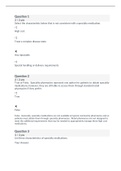
Select the characteristic below that is not consistent with a specialty medication. High cost Treat a complex disease state Correct! Any injectable Special handling or delivery requirements Question 2 pts
True or False. Specialty pharmacies represent one option for patients to obtain specialty
medications; however, they are still able to access them through standard retail pharmacies if they prefer. True Correct! False False. Generally, specialty medications are not available at typical community pharmacies and so
patients must obtain them through specialty pharmacies. Retail pharmacies are not designed to meet the additional requirements that may be needed to appropriately manage these high cost medications. Question 3 pts
List three characteristics of specialty medications.
Your Answer: high cost, treat rare diseases, require special handling, storage and delivery
Answer: any three of the following:
High Cost
Potential for limited or exclusive availability for distribution
Complex treatment regimen that require ongoing monitoring and patient education
Treat rare diseases
Special handling, storage, or delivery requirements
Treat diseases known to have long term or severe side effects or increased fatality
Biologically derived and available in injection, infusion, or oral form
Payers may define what they consider to be a specialty medication for reimbursement and contracting purposes. Question 4 pts
List three disease states that are commonly treated with a specialty medication. (1 point each)
Your Answer:
cancer, Rheumatoid arthritis, Hepatitis C
Any three of the following:
oncology, multiple sclerosis, rheumatoid arthritis, Crohn’s disease, hepatitis C, and HIV/AIDs. Question 5 pts
Match the disease state with the statement that is true of that disease. (1 point each)
Correct!
Cancer Correct!
Multiple Sclerosis Involves the development of abnormal cells
Involved the central nervous system
Select the characteristic below that is not consistent with a specialty medication. High cost Treat a complex disease state Correct! Any injectable Special handling or delivery requirements Question 2 pts
True or False. Specialty pharmacies represent one option for patients to obtain specialty
medications; however, they are still able to access them through standard retail pharmacies if they prefer. True Correct! False False. Generally, specialty medications are not available at typical community pharmacies and so
patients must obtain them through specialty pharmacies. Retail pharmacies are not designed to meet the additional requirements that may be needed to appropriately manage these high cost medications. Question 3 pts
List three characteristics of specialty medications.
Your Answer: high cost, treat rare diseases, require special handling, storage and delivery
Answer: any three of the following:
High Cost
Potential for limited or exclusive availability for distribution
Complex treatment regimen that require ongoing monitoring and patient education
Treat rare diseases
Special handling, storage, or delivery requirements
Treat diseases known to have long term or severe side effects or increased fatality
Biologically derived and available in injection, infusion, or oral form
Payers may define what they consider to be a specialty medication for reimbursement and contracting purposes. Question 4 pts
List three disease states that are commonly treated with a specialty medication. (1 point each)
Your Answer:
cancer, Rheumatoid arthritis, Hepatitis C
Any three of the following:
oncology, multiple sclerosis, rheumatoid arthritis, Crohn’s disease, hepatitis C, and HIV/AIDs. Question 5 pts
Match the disease state with the statement that is true of that disease. (1 point each)
Correct!
Cancer Correct!
Multiple Sclerosis Involves the development of abnormal cells
Involved the central nervous system