
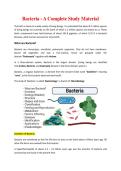
Bacteria - A Complete Study Material
The Earth is home to a wide variety of living beings. It is estimated that about 8.7 million species
of living beings are currently on the Earth of which 1.2 million species are known to us. These
biotic components have total biomass of about 545.8 gigatons, of which 12.8 % is bacterial
biomass, while human accounts for only 0.01%.
What are Bacteria?
Bacteria are microscopic, unicellular, prokaryotic organisms. They do not have membrane-
bound cell organelles and lack a true nucleus, hence are grouped under the
domain “Prokaryota” together with Archae.
In a three-domain system, Bacteria is the largest domain. (Living beings are classified
into Archae, Bacteria, and Eukaryota domain in the three-domain system.)
Bacteria, a singular bacterium, is derived from the Ancient Greek word “backērion” meaning
“cane”, as the first bacteria observed were bacilli.
The study of ‘Bacteria’ is called ‘Bacteriology’; a branch of ‘Microbiology’.
Evolution of Bacteria
Bacteria are considered as the first life-form to arise on the Earth about 4 billion years ago. All
other life-forms are evolved from the bacteria.
A hyperthermophile of about 2.5 – 3.2 billion years ago was the ancestor of bacteria and
archaea that are found in the present time.
,Endosymbiotic association between different bacteria around 1.6 – 2.0 billion years ago give rise
to the first proto-eukaryotic cell, which gradually gives rise to eukaryotes.
Ecology (Habitat) of Bacteria
Bacteria are evolved to adapt and survive in any kind of ecological niches; from normal
to extreme environments. Hence, they are ubiquitous.
They are found in every possible habitat on the Earth; soil, air, and water. They are associated
with all the biotic and abiotic components of the Earth. They are essential components of every
ecosystem.
They are not only in normal ecological habitats but are also found in extreme environments.
Such bacteria are called extremophilic bacteria. They are found in extreme cold (Psychrophiles),
extremely hot (thermophiles), extreme pH (acidophiles and Alkaliphiles), extreme pressure
(barophiles), anoxic environments (anaerobic), desertic area (xerophiles), high radiation area,
toxic wastes, barren sand and rocks, deep underground and mountain tip, etc.
Ecology (Habitat) of Bacteria
Soil is the most heavily habituated place where they constitute about 0.5% W/W of the soil
mass. One gram of topsoil may contain as many as one billion bacterial cells.
It is estimated that there are approximately 2×1030 bacteria on the Earth, but only around 2% of
them are fully studied to date. Hence, there is a huge research gap on the diversity and ecology
of many unknown bacterial species.
Wide varieties of bacteria live in the body of all living beings, including higher plants, animals,
and even the human body. In an average human body (normal), there are about 10 14 bacterial
cells, while the body itself is made up of only 1013 human cells.
, Structure of a Bacterial Cell
Bacteria are unicellular i.e., made up of a single cell. They are prokaryotes and their cells are
different from animal and plant cells. In general, the structure of bacteria can be studied as
external and internal structures;
Structure of a Bacterial Cell
External Structure of a Bacteria
It includes a cell wall and all the structures outside the cell wall.
1. Flagella (sing. Flagellum)
Flagella are long hair-like filamentous structures of about 4 – 5 μm long and 0.01 – 0.03 μm in
diameter. They confer motility to the bacteria. Flagella are divided into three parts; filament,
hook, and the basal body.
The filament is a threadlike part extending outside the cell wall. It is made up of flagellin
protein.
The hook is a short-curved structure that joins filament with the basal body. It produces
repulsion like the propeller during the revolving of flagella.
The basal body is a set of rings embedded in the cell wall and plasma membrane. It consists of 2
pairs of rings in Gram-Negative bacteria and 1 pair of rings in Gram-Positive bacteria. It

