
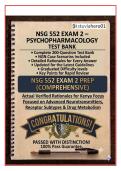
,NSG 552 EXAM 2 – PSYCHOPHARMACOLOGY
Complete 200-Question Test Bank with NGN Case
Scenarios & Detailed Rationales
Wilkes University | 2026/2027 Edition | 100%
Pass Guarantee
EXAM 2
Topic Area
Anxiety Disorders & Pharmacotherapy
Trauma & Stressor-Related Disorders
(PTSD, ASD, Adjustment Disorders)
Dissociative & Somatic Symptom
Disorders
Obsessive-Compulsive & Related
Disorders
Antidepressants (SSRIs, SNRIs, TCAs,
MAOIs, Atypicals)
,Topic Area
Antipsychotics (Typical & Atypical)
Mood Stabilizers & Anticonvulsants
Substance Use Disorders &
Pharmacotherapy
NGN Case Scenarios (Integrated)
SECTION 1: ANXIETY DISORDERS &
PHARMACOTHERAPY (Questions 1–30)
1. A patient is prescribed a benzodiazepine for
generalized anxiety disorder. The PMHNP explains
the mechanism of action. Which statement best
describes how benzodiazepines work?
A) They block serotonin reuptake in the synaptic
cleft
B) They enhance the activity of GABA at the GABA-A
receptor
, C) They inhibit monoamine oxidase
D) They block dopamine receptors
Answer: B) They enhance the activity of GABA at the
GABA-A receptor
Rationale: Benzodiazepines act as positive allosteric
modulators at the GABA-A receptor, increasing the
receptor's affinity for GABA. This results in increased
chloride ion influx, hyperpolarization of the neuron,
and reduced neuronal excitability, producing
anxiolytic, sedative, muscle relaxant, and
anticonvulsant effects. They do not directly block
serotonin reuptake (A), inhibit MAO (C), or block
dopamine receptors (D).
2. A patient on a benzodiazepine for anxiety is
considering pregnancy. The PMHNP should educate
the patient about which potential teratogenic
effects?
A) Fetal alcohol syndrome
B) Floppy baby syndrome and cleft palate
C) Neural tube defects
D) Cardiac anomalies
Complete 200-Question Test Bank with NGN Case
Scenarios & Detailed Rationales
Wilkes University | 2026/2027 Edition | 100%
Pass Guarantee
EXAM 2
Topic Area
Anxiety Disorders & Pharmacotherapy
Trauma & Stressor-Related Disorders
(PTSD, ASD, Adjustment Disorders)
Dissociative & Somatic Symptom
Disorders
Obsessive-Compulsive & Related
Disorders
Antidepressants (SSRIs, SNRIs, TCAs,
MAOIs, Atypicals)
,Topic Area
Antipsychotics (Typical & Atypical)
Mood Stabilizers & Anticonvulsants
Substance Use Disorders &
Pharmacotherapy
NGN Case Scenarios (Integrated)
SECTION 1: ANXIETY DISORDERS &
PHARMACOTHERAPY (Questions 1–30)
1. A patient is prescribed a benzodiazepine for
generalized anxiety disorder. The PMHNP explains
the mechanism of action. Which statement best
describes how benzodiazepines work?
A) They block serotonin reuptake in the synaptic
cleft
B) They enhance the activity of GABA at the GABA-A
receptor
, C) They inhibit monoamine oxidase
D) They block dopamine receptors
Answer: B) They enhance the activity of GABA at the
GABA-A receptor
Rationale: Benzodiazepines act as positive allosteric
modulators at the GABA-A receptor, increasing the
receptor's affinity for GABA. This results in increased
chloride ion influx, hyperpolarization of the neuron,
and reduced neuronal excitability, producing
anxiolytic, sedative, muscle relaxant, and
anticonvulsant effects. They do not directly block
serotonin reuptake (A), inhibit MAO (C), or block
dopamine receptors (D).
2. A patient on a benzodiazepine for anxiety is
considering pregnancy. The PMHNP should educate
the patient about which potential teratogenic
effects?
A) Fetal alcohol syndrome
B) Floppy baby syndrome and cleft palate
C) Neural tube defects
D) Cardiac anomalies


