

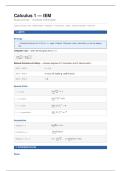
Calculus 1 — IEM
Study summary · University of Groningen
Topics covered: Limits · Differentiation · Integration · Taylor Series · ODEs · Complex Numbers · Extremes
1. LIMITS
Strategy
→ Substitute directly first. If 0/0 or ∞/∞, apply L'Hôpital. Otherwise: factor, rationalise, or use the degree
rule.
L'Hôpital's rule — when the limit gives 0/0 or ∞/∞:
Rational functions at infinity — compare degrees of P (numerator) and Q (denominator):
deg P > deg Q
deg P = deg Q
deg P < deg Q
Special limits
x → 0, sine
x → 0, cosine
n → ∞, Euler
n → ∞, generalised
Asymptotes
Vertical x = a
Horizontal y = a
Oblique y = mx + n
2. DIFFERENTIATION
Rules
, Product
Quotient
Chain
Standard derivatives
x^n tan x
e^x arcsin x
a^x
arccos x
ln x
arctan x
sin x
sqrt(x)
cos x
log_a x
Logarithmic differentiation — for f(x) = [g(x)]^{h(x)}
1 Take ln of both sides:
2 Differentiate implicitly:
3 Multiply both sides by y to get y'(x); apply initial conditions if given.
! Exam favourite: r(x) = (cos x)^{cos x} and h(x) = x^{sin x}. Always use log differentiation for
function^function forms.
3. INTEGRATION
→ Decision order: basic form → substitution → integration by parts → trig identity → partial fractions.
Standard integrals
int x^n dx (n != -1)
int e^x dx
int 1/x dx
int a^x dx
Study summary · University of Groningen
Topics covered: Limits · Differentiation · Integration · Taylor Series · ODEs · Complex Numbers · Extremes
1. LIMITS
Strategy
→ Substitute directly first. If 0/0 or ∞/∞, apply L'Hôpital. Otherwise: factor, rationalise, or use the degree
rule.
L'Hôpital's rule — when the limit gives 0/0 or ∞/∞:
Rational functions at infinity — compare degrees of P (numerator) and Q (denominator):
deg P > deg Q
deg P = deg Q
deg P < deg Q
Special limits
x → 0, sine
x → 0, cosine
n → ∞, Euler
n → ∞, generalised
Asymptotes
Vertical x = a
Horizontal y = a
Oblique y = mx + n
2. DIFFERENTIATION
Rules
, Product
Quotient
Chain
Standard derivatives
x^n tan x
e^x arcsin x
a^x
arccos x
ln x
arctan x
sin x
sqrt(x)
cos x
log_a x
Logarithmic differentiation — for f(x) = [g(x)]^{h(x)}
1 Take ln of both sides:
2 Differentiate implicitly:
3 Multiply both sides by y to get y'(x); apply initial conditions if given.
! Exam favourite: r(x) = (cos x)^{cos x} and h(x) = x^{sin x}. Always use log differentiation for
function^function forms.
3. INTEGRATION
→ Decision order: basic form → substitution → integration by parts → trig identity → partial fractions.
Standard integrals
int x^n dx (n != -1)
int e^x dx
int 1/x dx
int a^x dx

