

6/27/26, 8:26 AM NR507- Advanced Pathophysiology Final EXAM Questions and Answers (latest version verified for accuracy) | 2026\2027 Latest!! (…
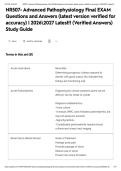
NR507- Advanced Pathophysiology Final EXAM
Questions and Answers (latest version verified for
accuracy) | 2026\2027 Latest!! (Verified Answers)
Study Guide
Save Add to calendar
Terms in this set (51)
Acute renal failure Reversible
Determining prognosis- kidneys respond to
diuretic with good output; this indicates that
kidneys are functioning well
Acute Pyelonephritis Diagnosing by clinical symptoms alone can be
difficult; can be similar to cystitis
Diagnosis established by:
-Urine culture
-Urinalysis (WBC casts indicates pyelonephritis, but
may not always be present)
-Signs/Symptoms
-Complicated pyelonephritis requires blood
cultures and urinary tract imaging
Renal Calculi (Renal Stones) Goals of Treatment:
Manage acute pain
Promote passage of stone
Reduce size of stone
Prevent new stone formation
https://quizlet.com/1191991458/nr507-advanced-pathophysiology-final-exam-questions-and-answers-latest-version-verified-for-accuracy-20262027-la… 1/19
,6/27/26, 8:26 AM NR507- Advanced Pathophysiology Final EXAM Questions and Answers (latest version verified for accuracy) | 2026\2027 Latest!! (…
Chronic Renal Failure Chronic Kidney Disease (CKD) is a progressive loss
of renal function associated with systemic disease
such as hypertension, diabetes mellitus (most
significant risk factor), systemic lupus
erythematosus or intrinsic kidney disease
CKD stage is determined by estimates of GFR and
albuminuria
Who is a candidate for dialysis? End-stage renal disease (ESRD) is the final stage of
CKD with the number one cause being diabetes
mellitus combined with hypertension. At this point,
the patient is completely dependent on dialysis to
survive.
CKD is classified into five stages and is based on
the patient's GFR rather than symptoms.
Patients will need dialysis when the following
symptoms are present:
--Metabolic acidosis.
--Hyperkalemia: Hyperkalemia in the presence of
EKG changes (peaked T-waves) is an indication for
dialysis. --Hyperkalemia by itself is not an
indication for dialysis.
--Drug toxicity: Drug toxicity due to the following
drugs is an indication for dialysis and include
salicylates, Lithium, Isopropanol, Methanol and
Ethylene glycol).
--Fluid volume overload that is not responsive to
diuretics.
--Uremic symptoms due to nitrogenous wastes in
the blood stream.
Stage I CKD There is kidney damage with normal or elevated
GFR
90-120
https://quizlet.com/1191991458/nr507-advanced-pathophysiology-final-exam-questions-and-answers-latest-version-verified-for-accuracy-20262027-la… 2/19
, 6/27/26, 8:26 AM NR507- Advanced Pathophysiology Final EXAM Questions and Answers (latest version verified for accuracy) | 2026\2027 Latest!! (…
Stage II CKD There is kidney damage with mild decrease in GFR
60-89
Stage III CKD There is a moderate decrease in GFR
30-59
Stage IV CKD There is a severe decrease in GFR
15-29
Stage V CKD Kidney failure- End-stage renal disease
<15 (dialysis) Once Stage IV is reached, progression
to Stage V is inevitable as well as dialysis or kidney
transplant
Complications of Decreased GFR Anemia
Hypertension
Decreased calcium absorption
Hyperlipidemia
Heart failure
Left ventricular hypertrophy
Fluid volume overload
Hyperkalemia
Hyperparathyroidism
Hyperphosphatemia
Metabolic acidosis
Malnutrition (late complication)
https://quizlet.com/1191991458/nr507-advanced-pathophysiology-final-exam-questions-and-answers-latest-version-verified-for-accuracy-20262027-la… 3/19
NR507- Advanced Pathophysiology Final EXAM
Questions and Answers (latest version verified for
accuracy) | 2026\2027 Latest!! (Verified Answers)
Study Guide
Save Add to calendar
Terms in this set (51)
Acute renal failure Reversible
Determining prognosis- kidneys respond to
diuretic with good output; this indicates that
kidneys are functioning well
Acute Pyelonephritis Diagnosing by clinical symptoms alone can be
difficult; can be similar to cystitis
Diagnosis established by:
-Urine culture
-Urinalysis (WBC casts indicates pyelonephritis, but
may not always be present)
-Signs/Symptoms
-Complicated pyelonephritis requires blood
cultures and urinary tract imaging
Renal Calculi (Renal Stones) Goals of Treatment:
Manage acute pain
Promote passage of stone
Reduce size of stone
Prevent new stone formation
https://quizlet.com/1191991458/nr507-advanced-pathophysiology-final-exam-questions-and-answers-latest-version-verified-for-accuracy-20262027-la… 1/19
,6/27/26, 8:26 AM NR507- Advanced Pathophysiology Final EXAM Questions and Answers (latest version verified for accuracy) | 2026\2027 Latest!! (…
Chronic Renal Failure Chronic Kidney Disease (CKD) is a progressive loss
of renal function associated with systemic disease
such as hypertension, diabetes mellitus (most
significant risk factor), systemic lupus
erythematosus or intrinsic kidney disease
CKD stage is determined by estimates of GFR and
albuminuria
Who is a candidate for dialysis? End-stage renal disease (ESRD) is the final stage of
CKD with the number one cause being diabetes
mellitus combined with hypertension. At this point,
the patient is completely dependent on dialysis to
survive.
CKD is classified into five stages and is based on
the patient's GFR rather than symptoms.
Patients will need dialysis when the following
symptoms are present:
--Metabolic acidosis.
--Hyperkalemia: Hyperkalemia in the presence of
EKG changes (peaked T-waves) is an indication for
dialysis. --Hyperkalemia by itself is not an
indication for dialysis.
--Drug toxicity: Drug toxicity due to the following
drugs is an indication for dialysis and include
salicylates, Lithium, Isopropanol, Methanol and
Ethylene glycol).
--Fluid volume overload that is not responsive to
diuretics.
--Uremic symptoms due to nitrogenous wastes in
the blood stream.
Stage I CKD There is kidney damage with normal or elevated
GFR
90-120
https://quizlet.com/1191991458/nr507-advanced-pathophysiology-final-exam-questions-and-answers-latest-version-verified-for-accuracy-20262027-la… 2/19
, 6/27/26, 8:26 AM NR507- Advanced Pathophysiology Final EXAM Questions and Answers (latest version verified for accuracy) | 2026\2027 Latest!! (…
Stage II CKD There is kidney damage with mild decrease in GFR
60-89
Stage III CKD There is a moderate decrease in GFR
30-59
Stage IV CKD There is a severe decrease in GFR
15-29
Stage V CKD Kidney failure- End-stage renal disease
<15 (dialysis) Once Stage IV is reached, progression
to Stage V is inevitable as well as dialysis or kidney
transplant
Complications of Decreased GFR Anemia
Hypertension
Decreased calcium absorption
Hyperlipidemia
Heart failure
Left ventricular hypertrophy
Fluid volume overload
Hyperkalemia
Hyperparathyroidism
Hyperphosphatemia
Metabolic acidosis
Malnutrition (late complication)
https://quizlet.com/1191991458/nr507-advanced-pathophysiology-final-exam-questions-and-answers-latest-version-verified-for-accuracy-20262027-la… 3/19

