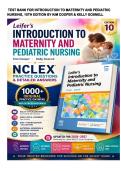
TEST BANK FOR INTRODUCTION TO MATERNITY AND PEDIATRIC
NURSING, 10TH EDITION BY KIM COOPER & KELLY GOSNELL
,TABLE OF CONTENTS
Introduction to Maternity and Pediatric Nursing, 10th Edition
Kim Cooper & Kelly Gosnell
Complete Premium NCLEX® Exam Bank
1,000 plus Original Practice Questions & Detailed Rationales
UNIT I
Overview of Maternity & Pediatric Nursing
Chapter Title Questions
1 Foundations of Maternity & Pediatric Nursing 1–60
Key Topics
• Nursing Roles
• Family-Centered Care
• Evidence-Based Practice
• Cultural Competence
• Legal & Ethical Concepts
UNIT II
Maternal-Newborn Nursing & Women's Health
Chapter Title Questions
2 Reproductive Anatomy & Physiology 61–140
3 Conception, Fetal Development & Genetics 141–220
4 Pregnancy Assessment & Prenatal Care 221–320
5 Nursing Care During Pregnancy 321–420
6 Labor & Birth Process 421–500
7 Pain Management During Labor & Birth 501–580
,Chapter Title Questions
8 Nursing Care During Birth 581–660
9 Nursing Care of the Family After Birth 661–740
10 Maternal Complications 741–820
11 Women's Health Nursing 821–860
12 Nursing Care of the Newborn 861–900
13 The Newborn at Risk 901–940
14 The Newborn With a Perinatal Injury or Congenital Malformation 941–960
UNIT III
The Growing Child and Family
Chapter Title Questions
15 Growth, Development & Nutrition 961–970
16 The Infant 971–975
17 The Toddler 976–980
18 The Preschool Child 981–985
19 The School-Age Child 986–990
20 The Adolescent 991–995
UNIT IV
Adapting Care to the Pediatric Patient
Chapter Title Questions
21 The Child's Experience of Hospitalization 996–997
998–999 (recommended continuous
22 Health Care Adaptations for the Child and Family
numbering)
Complementary & Alternative Therapies in 980–1000 (adjust to maintain continuous
23
Maternity & Pediatric Nursing numbering if desired)
,UNIT V
The Child Needing Nursing Care
Chapter Title Questions
24 The Child With a Sensory or Neurological Condition 1001–1020
25 The Child With a Musculoskeletal Condition 1021–1040
26 The Child With a Respiratory Disorder 1041–1080
27 The Child With a Cardiovascular Disorder 1081–1110
28 The Child With a Condition of the Blood, Blood-Forming Organs, or Lymphatic System 1111–1130
29 The Child With a Gastrointestinal Condition 1131–1150
30 The Child With a Genitourinary Condition 1151–1169
31 The Child With an Endocrine or Metabolic Condition 1170–1200
32 The Child With an Integumentary Condition 1201–1230
33 The Child With an Infectious or Communicable Disorder 1231–1270
34 The Child With an Immunologic Disorder or Cancer 1271–1300
PREMIUM FEATURES
✓ 1,300 Original NCLEX®-Style Questions
✓ Detailed Rationales
✓ Next Generation NCLEX (NGN)
✓ Clinical Judgment Cases
✓ Select-All-That-Apply (SATA)
✓ Prioritization & Delegation
✓ Evidence-Based Nursing Care
✓ Maternal-Newborn Nursing
✓ Pediatric Nursing
✓ Health Promotion
,✓ Family-Centered Care
✓ Updated 2026–2027
Section I: Foundations of Maternity & Pediatric Nursing
Nursing Roles in Maternity & Pediatric Nursing
Question 1
A newly licensed nurse asks a preceptor about the primary role of the maternity and pediatric nurse. Which
response by the preceptor is most accurate?
A. "The primary role is to treat illness after it develops."
B. "The primary role is to promote, maintain, and restore health for women, children, and families."
C. "The primary role is limited to assisting physicians."
D. "The primary role focuses only on hospitalized patients."
Correct Answer: B
Rationale: Maternity and pediatric nurses provide comprehensive care aimed at promoting wellness,
preventing disease, restoring health, and supporting families throughout the childbearing and developmental
continuum. Their responsibilities extend beyond treating illness to include education, advocacy, health
promotion, developmental support, and care coordination. Modern nursing practice emphasizes holistic care
that addresses physical, emotional, social, developmental, and cultural needs.
Why Not the Other Options?
A: Nursing emphasizes prevention and health promotion in addition to treatment.
C: Nurses function as independent professionals and collaborative healthcare team members.
D: Care occurs in hospitals, clinics, schools, homes, and community settings.
Clinical Judgment Tip: Always view maternity and pediatric care through a holistic lens that includes family
dynamics and developmental needs.
Priority Framework: Health Promotion
NCLEX Pearl: The nurse's role extends far beyond disease management to include education, prevention, and
advocacy.
Question 2
,A pediatric nurse is preparing a care plan for a hospitalized child. Which nursing responsibility should receive
the highest priority?
A. Completing paperwork
B. Ensuring patient safety
C. Organizing supplies
D. Attending staff meetings
Correct Answer: B
Rationale: Patient safety is a fundamental responsibility of every nurse and forms the foundation of quality
nursing care. Pediatric patients are particularly vulnerable to medication errors, falls, identification mistakes,
and developmental risks. Safety measures such as accurate patient identification, medication verification,
environmental assessments, and supervision are essential components of nursing practice.
Why Not the Other Options?
A: Documentation is important but secondary to immediate patient safety.
C: Supplies support care but are not the highest priority.
D: Meetings are valuable but do not supersede direct patient safety.
Clinical Judgment Tip: When prioritizing care, always consider safety risks first.
Priority Framework: Safety and Risk Reduction
NCLEX Pearl: Safety is the foundation upon which all other nursing interventions are built.
Question 3
A maternity nurse is teaching a prenatal class. Which nursing role is primarily being demonstrated?
A. Educator
B. Researcher
C. Administrator
D. Technician
Correct Answer: A
Rationale: Education is a vital nursing role that empowers patients and families to make informed healthcare
decisions. Prenatal education promotes healthy behaviors, improves maternal and neonatal outcomes,
reduces anxiety, and prepares families for childbirth and parenting responsibilities.
Why Not the Other Options?
B: Research involves generating or applying evidence.
C: Administration focuses on management functions.
,D: Technical skills are only one component of nursing care.
Clinical Judgment Tip: Effective education should be individualized, understandable, and evidence-based.
Priority Framework: Health Education
NCLEX Pearl: Patient education is one of the most effective tools for improving outcomes.
Question 4
A nurse identifies that a child is experiencing increasing respiratory distress and immediately notifies the
healthcare provider. Which nursing role is being demonstrated?
A. Advocate
B. Social organizer
C. Financial counselor
D. Recruiter
Correct Answer: A
Rationale: Advocacy involves protecting patient welfare and ensuring that concerns are addressed promptly.
Nurses serve as advocates by recognizing changes in patient status, communicating concerns, protecting
patient rights, and ensuring access to appropriate care.
Why Not the Other Options?
B: Not applicable to this scenario.
C: Financial counseling is unrelated.
D: Recruitment is not involved.
Clinical Judgment Tip: Early recognition and communication of deterioration can prevent adverse outcomes.
Priority Framework: Patient Advocacy and Safety
NCLEX Pearl: Advocacy often begins with recognizing subtle changes in patient condition.
Question 5
A nurse collaborates with physicians, respiratory therapists, social workers, and dietitians to develop a
comprehensive plan of care. This demonstrates which nursing role?
A. Independent practitioner only
B. Interdisciplinary team member
C. Technician
D. Research participant
Correct Answer: B
,Rationale: Collaboration among healthcare professionals promotes comprehensive, coordinated, and patient-
centered care. Maternity and pediatric nurses frequently work with multidisciplinary teams to address the
complex needs of women, children, and families.
Why Not the Other Options?
A: Nursing includes both independent and collaborative functions.
C: Collaboration extends beyond technical skills.
D: Research is not the primary focus here.
Clinical Judgment Tip: Effective communication among team members improves patient outcomes.
Priority Framework: Collaborative Care
NCLEX Pearl: Teamwork enhances patient safety and quality of care.
Question 6
A nurse caring for a child uses developmental milestones to guide communication and interventions. Which
nursing competency is being demonstrated?
A. Developmentally appropriate care
B. Administrative management
C. Financial planning
D. Marketing
Correct Answer: A
Rationale: Pediatric nurses must understand developmental principles to provide age-appropriate care.
Communication, teaching, assessments, and interventions should be adapted to the child's developmental
level to maximize understanding and cooperation.
Why Not the Other Options?
B: Administrative functions are unrelated.
C: Financial planning is not involved.
D: Marketing is unrelated to nursing care.
Clinical Judgment Tip: Consider developmental age even when chronological age appears normal.
Priority Framework: Developmental Assessment
NCLEX Pearl: Developmentally appropriate care improves cooperation and reduces anxiety.
Question 7
A maternity nurse encourages breastfeeding and provides education about infant nutrition. Which nursing role
is being demonstrated?
,A. Health promoter
B. Accountant
C. Recruiter
D. Auditor
Correct Answer: A
Rationale: Health promotion focuses on helping individuals achieve optimal wellness through education,
prevention, and healthy lifestyle choices. Breastfeeding education is a key health-promotion intervention that
benefits both mother and infant.
Why Not the Other Options?
B: Financial responsibilities are unrelated.
C: Recruitment is not involved.
D: Auditing is not the primary nursing role.
Clinical Judgment Tip: Health promotion should begin before illness develops.
Priority Framework: Prevention and Wellness
NCLEX Pearl: Promoting healthy behaviors can have lifelong benefits for families.
Question 8
A nurse reviews current research before implementing a new intervention for newborn pain management.
Which professional responsibility is being demonstrated?
A. Evidence-based practice
B. Personal preference
C. Routine care
D. Tradition-based practice
Correct Answer: A
Rationale: Evidence-based practice integrates current research findings, clinical expertise, and patient
preferences to improve healthcare outcomes. Nurses have a professional responsibility to stay informed about
best practices and apply evidence to clinical care.
Why Not the Other Options?
B: Personal preferences should not guide care.
C: Routine care may not reflect current evidence.
D: Tradition alone is insufficient.
, Clinical Judgment Tip: Always evaluate the quality and relevance of research before applying it to practice.
Priority Framework: Evidence-Based Care
NCLEX Pearl: Evidence-based interventions improve patient safety and outcomes.
Question 9
A nurse notices a medication dosage that appears unusually high for an infant and questions the order before
administration. Which nursing role is being demonstrated?
A. Patient advocate
B. Administrative assistant
C. Office manager
D. Inventory coordinator
Correct Answer: A
Rationale: Nurses are responsible for protecting patients from harm. Questioning potentially unsafe orders
demonstrates accountability, critical thinking, and advocacy. Pediatric patients are especially vulnerable to
medication errors due to weight-based dosing.
Why Not the Other Options?
B: Administrative roles are not involved.
C: Office management is unrelated.
D: Inventory management is not the focus.
Clinical Judgment Tip: Never administer a medication if safety concerns exist.
Priority Framework: Safety and Risk Reduction
NCLEX Pearl: When in doubt, stop and verify.
Question 10
A nurse participates in a hospital initiative to reduce newborn falls. Which nursing role is primarily being
demonstrated?
A. Quality improvement participant
B. Marketing specialist
C. Recruiter
D. Accountant
Correct Answer: A
NURSING, 10TH EDITION BY KIM COOPER & KELLY GOSNELL
,TABLE OF CONTENTS
Introduction to Maternity and Pediatric Nursing, 10th Edition
Kim Cooper & Kelly Gosnell
Complete Premium NCLEX® Exam Bank
1,000 plus Original Practice Questions & Detailed Rationales
UNIT I
Overview of Maternity & Pediatric Nursing
Chapter Title Questions
1 Foundations of Maternity & Pediatric Nursing 1–60
Key Topics
• Nursing Roles
• Family-Centered Care
• Evidence-Based Practice
• Cultural Competence
• Legal & Ethical Concepts
UNIT II
Maternal-Newborn Nursing & Women's Health
Chapter Title Questions
2 Reproductive Anatomy & Physiology 61–140
3 Conception, Fetal Development & Genetics 141–220
4 Pregnancy Assessment & Prenatal Care 221–320
5 Nursing Care During Pregnancy 321–420
6 Labor & Birth Process 421–500
7 Pain Management During Labor & Birth 501–580
,Chapter Title Questions
8 Nursing Care During Birth 581–660
9 Nursing Care of the Family After Birth 661–740
10 Maternal Complications 741–820
11 Women's Health Nursing 821–860
12 Nursing Care of the Newborn 861–900
13 The Newborn at Risk 901–940
14 The Newborn With a Perinatal Injury or Congenital Malformation 941–960
UNIT III
The Growing Child and Family
Chapter Title Questions
15 Growth, Development & Nutrition 961–970
16 The Infant 971–975
17 The Toddler 976–980
18 The Preschool Child 981–985
19 The School-Age Child 986–990
20 The Adolescent 991–995
UNIT IV
Adapting Care to the Pediatric Patient
Chapter Title Questions
21 The Child's Experience of Hospitalization 996–997
998–999 (recommended continuous
22 Health Care Adaptations for the Child and Family
numbering)
Complementary & Alternative Therapies in 980–1000 (adjust to maintain continuous
23
Maternity & Pediatric Nursing numbering if desired)
,UNIT V
The Child Needing Nursing Care
Chapter Title Questions
24 The Child With a Sensory or Neurological Condition 1001–1020
25 The Child With a Musculoskeletal Condition 1021–1040
26 The Child With a Respiratory Disorder 1041–1080
27 The Child With a Cardiovascular Disorder 1081–1110
28 The Child With a Condition of the Blood, Blood-Forming Organs, or Lymphatic System 1111–1130
29 The Child With a Gastrointestinal Condition 1131–1150
30 The Child With a Genitourinary Condition 1151–1169
31 The Child With an Endocrine or Metabolic Condition 1170–1200
32 The Child With an Integumentary Condition 1201–1230
33 The Child With an Infectious or Communicable Disorder 1231–1270
34 The Child With an Immunologic Disorder or Cancer 1271–1300
PREMIUM FEATURES
✓ 1,300 Original NCLEX®-Style Questions
✓ Detailed Rationales
✓ Next Generation NCLEX (NGN)
✓ Clinical Judgment Cases
✓ Select-All-That-Apply (SATA)
✓ Prioritization & Delegation
✓ Evidence-Based Nursing Care
✓ Maternal-Newborn Nursing
✓ Pediatric Nursing
✓ Health Promotion
,✓ Family-Centered Care
✓ Updated 2026–2027
Section I: Foundations of Maternity & Pediatric Nursing
Nursing Roles in Maternity & Pediatric Nursing
Question 1
A newly licensed nurse asks a preceptor about the primary role of the maternity and pediatric nurse. Which
response by the preceptor is most accurate?
A. "The primary role is to treat illness after it develops."
B. "The primary role is to promote, maintain, and restore health for women, children, and families."
C. "The primary role is limited to assisting physicians."
D. "The primary role focuses only on hospitalized patients."
Correct Answer: B
Rationale: Maternity and pediatric nurses provide comprehensive care aimed at promoting wellness,
preventing disease, restoring health, and supporting families throughout the childbearing and developmental
continuum. Their responsibilities extend beyond treating illness to include education, advocacy, health
promotion, developmental support, and care coordination. Modern nursing practice emphasizes holistic care
that addresses physical, emotional, social, developmental, and cultural needs.
Why Not the Other Options?
A: Nursing emphasizes prevention and health promotion in addition to treatment.
C: Nurses function as independent professionals and collaborative healthcare team members.
D: Care occurs in hospitals, clinics, schools, homes, and community settings.
Clinical Judgment Tip: Always view maternity and pediatric care through a holistic lens that includes family
dynamics and developmental needs.
Priority Framework: Health Promotion
NCLEX Pearl: The nurse's role extends far beyond disease management to include education, prevention, and
advocacy.
Question 2
,A pediatric nurse is preparing a care plan for a hospitalized child. Which nursing responsibility should receive
the highest priority?
A. Completing paperwork
B. Ensuring patient safety
C. Organizing supplies
D. Attending staff meetings
Correct Answer: B
Rationale: Patient safety is a fundamental responsibility of every nurse and forms the foundation of quality
nursing care. Pediatric patients are particularly vulnerable to medication errors, falls, identification mistakes,
and developmental risks. Safety measures such as accurate patient identification, medication verification,
environmental assessments, and supervision are essential components of nursing practice.
Why Not the Other Options?
A: Documentation is important but secondary to immediate patient safety.
C: Supplies support care but are not the highest priority.
D: Meetings are valuable but do not supersede direct patient safety.
Clinical Judgment Tip: When prioritizing care, always consider safety risks first.
Priority Framework: Safety and Risk Reduction
NCLEX Pearl: Safety is the foundation upon which all other nursing interventions are built.
Question 3
A maternity nurse is teaching a prenatal class. Which nursing role is primarily being demonstrated?
A. Educator
B. Researcher
C. Administrator
D. Technician
Correct Answer: A
Rationale: Education is a vital nursing role that empowers patients and families to make informed healthcare
decisions. Prenatal education promotes healthy behaviors, improves maternal and neonatal outcomes,
reduces anxiety, and prepares families for childbirth and parenting responsibilities.
Why Not the Other Options?
B: Research involves generating or applying evidence.
C: Administration focuses on management functions.
,D: Technical skills are only one component of nursing care.
Clinical Judgment Tip: Effective education should be individualized, understandable, and evidence-based.
Priority Framework: Health Education
NCLEX Pearl: Patient education is one of the most effective tools for improving outcomes.
Question 4
A nurse identifies that a child is experiencing increasing respiratory distress and immediately notifies the
healthcare provider. Which nursing role is being demonstrated?
A. Advocate
B. Social organizer
C. Financial counselor
D. Recruiter
Correct Answer: A
Rationale: Advocacy involves protecting patient welfare and ensuring that concerns are addressed promptly.
Nurses serve as advocates by recognizing changes in patient status, communicating concerns, protecting
patient rights, and ensuring access to appropriate care.
Why Not the Other Options?
B: Not applicable to this scenario.
C: Financial counseling is unrelated.
D: Recruitment is not involved.
Clinical Judgment Tip: Early recognition and communication of deterioration can prevent adverse outcomes.
Priority Framework: Patient Advocacy and Safety
NCLEX Pearl: Advocacy often begins with recognizing subtle changes in patient condition.
Question 5
A nurse collaborates with physicians, respiratory therapists, social workers, and dietitians to develop a
comprehensive plan of care. This demonstrates which nursing role?
A. Independent practitioner only
B. Interdisciplinary team member
C. Technician
D. Research participant
Correct Answer: B
,Rationale: Collaboration among healthcare professionals promotes comprehensive, coordinated, and patient-
centered care. Maternity and pediatric nurses frequently work with multidisciplinary teams to address the
complex needs of women, children, and families.
Why Not the Other Options?
A: Nursing includes both independent and collaborative functions.
C: Collaboration extends beyond technical skills.
D: Research is not the primary focus here.
Clinical Judgment Tip: Effective communication among team members improves patient outcomes.
Priority Framework: Collaborative Care
NCLEX Pearl: Teamwork enhances patient safety and quality of care.
Question 6
A nurse caring for a child uses developmental milestones to guide communication and interventions. Which
nursing competency is being demonstrated?
A. Developmentally appropriate care
B. Administrative management
C. Financial planning
D. Marketing
Correct Answer: A
Rationale: Pediatric nurses must understand developmental principles to provide age-appropriate care.
Communication, teaching, assessments, and interventions should be adapted to the child's developmental
level to maximize understanding and cooperation.
Why Not the Other Options?
B: Administrative functions are unrelated.
C: Financial planning is not involved.
D: Marketing is unrelated to nursing care.
Clinical Judgment Tip: Consider developmental age even when chronological age appears normal.
Priority Framework: Developmental Assessment
NCLEX Pearl: Developmentally appropriate care improves cooperation and reduces anxiety.
Question 7
A maternity nurse encourages breastfeeding and provides education about infant nutrition. Which nursing role
is being demonstrated?
,A. Health promoter
B. Accountant
C. Recruiter
D. Auditor
Correct Answer: A
Rationale: Health promotion focuses on helping individuals achieve optimal wellness through education,
prevention, and healthy lifestyle choices. Breastfeeding education is a key health-promotion intervention that
benefits both mother and infant.
Why Not the Other Options?
B: Financial responsibilities are unrelated.
C: Recruitment is not involved.
D: Auditing is not the primary nursing role.
Clinical Judgment Tip: Health promotion should begin before illness develops.
Priority Framework: Prevention and Wellness
NCLEX Pearl: Promoting healthy behaviors can have lifelong benefits for families.
Question 8
A nurse reviews current research before implementing a new intervention for newborn pain management.
Which professional responsibility is being demonstrated?
A. Evidence-based practice
B. Personal preference
C. Routine care
D. Tradition-based practice
Correct Answer: A
Rationale: Evidence-based practice integrates current research findings, clinical expertise, and patient
preferences to improve healthcare outcomes. Nurses have a professional responsibility to stay informed about
best practices and apply evidence to clinical care.
Why Not the Other Options?
B: Personal preferences should not guide care.
C: Routine care may not reflect current evidence.
D: Tradition alone is insufficient.
, Clinical Judgment Tip: Always evaluate the quality and relevance of research before applying it to practice.
Priority Framework: Evidence-Based Care
NCLEX Pearl: Evidence-based interventions improve patient safety and outcomes.
Question 9
A nurse notices a medication dosage that appears unusually high for an infant and questions the order before
administration. Which nursing role is being demonstrated?
A. Patient advocate
B. Administrative assistant
C. Office manager
D. Inventory coordinator
Correct Answer: A
Rationale: Nurses are responsible for protecting patients from harm. Questioning potentially unsafe orders
demonstrates accountability, critical thinking, and advocacy. Pediatric patients are especially vulnerable to
medication errors due to weight-based dosing.
Why Not the Other Options?
B: Administrative roles are not involved.
C: Office management is unrelated.
D: Inventory management is not the focus.
Clinical Judgment Tip: Never administer a medication if safety concerns exist.
Priority Framework: Safety and Risk Reduction
NCLEX Pearl: When in doubt, stop and verify.
Question 10
A nurse participates in a hospital initiative to reduce newborn falls. Which nursing role is primarily being
demonstrated?
A. Quality improvement participant
B. Marketing specialist
C. Recruiter
D. Accountant
Correct Answer: A