

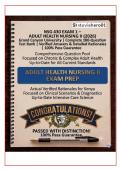
,NSG 430 EXAM 1 – ADULT HEALTH NURSING II
(2026)
Grand Canyon University | Complete 100-Question
Test Bank | Verified Answers & Detailed
Rationales | 100% Pass Guarantee
SECTION 1: PALLIATIVE CARE & END-OF-LIFE
(Questions 1–20)
1. A nurse is caring for a patient with end-stage
heart failure. The patient asks, "What is the
difference between palliative care and hospice
care?" Which response by the nurse is most
accurate?
A) "Palliative care is only for patients who are
actively dying, while hospice care is for patients
with chronic illness."
,B) "Palliative care focuses on comfort and quality of
life at any stage of illness, while hospice care is
specifically for patients with a life expectancy of 6
months or less."
C) "Hospice care is provided in the hospital only,
while palliative care is provided at home."
D) "There is no difference between palliative care
and hospice care."
Answer: B
Rationale: Palliative care is a multidisciplinary
approach that focuses on symptom management,
comfort, and quality of life for patients at any stage
of a serious illness, regardless of prognosis. Hospice
care is a specific type of palliative care provided to
patients with a life expectancy of 6 months or less,
often focused on comfort at the end of life rather
than curative treatment. Option A is incorrect
because palliative care is not limited to actively
dying patients. Option C is incorrect because both
can be provided in various settings. Option D is
incorrect because while related, they are distinct.
, 2. A patient with terminal cancer is receiving morphine
k k k k k k k k
for severe pain. The patient's respiratory rate drops to
k k k k k k k k k
8 breaths/min. What is the priority nursing action?
k k k k k k k k
A) Administer naloxone immediately
k k k
B) Stop the morphine infusion and notify the provider
k k k k k k k k
C) Place the patient in Trendelenburg position
k k k k k k
D) Encourage the patient to take deep breaths
k k k k k k k
Answer: B k
Rationale: The priority is to discontinue the morphine k k k k k k k
infusion (or hold the next dose) and notify the
k k k k k k k k k
provider. Naloxone (A) may be used if respiratory
k k k k k k k k
depression is severe, but it is not the first action; it can
k k k k k k k k k k k k
also reverse analgesia, causing increased pain.
k k k k k k
Trendelenburg position (C) is not appropriate and may
k k k k k k k k
worsen respiratory effort. Encouraging deep breaths
k k k k k k
(D) is insufficient. The nurse should assess the patient,
k k k k k k k k k
support breathing, and prepare to administer
k k k k k k
naloxone if ordered.
k k k
3. A patient with end-stage COPD is receiving hospice
k k k k k k k k
care. The family asks the nurse, "Why is my father so
k k k k k k k k k k k
(2026)
Grand Canyon University | Complete 100-Question
Test Bank | Verified Answers & Detailed
Rationales | 100% Pass Guarantee
SECTION 1: PALLIATIVE CARE & END-OF-LIFE
(Questions 1–20)
1. A nurse is caring for a patient with end-stage
heart failure. The patient asks, "What is the
difference between palliative care and hospice
care?" Which response by the nurse is most
accurate?
A) "Palliative care is only for patients who are
actively dying, while hospice care is for patients
with chronic illness."
,B) "Palliative care focuses on comfort and quality of
life at any stage of illness, while hospice care is
specifically for patients with a life expectancy of 6
months or less."
C) "Hospice care is provided in the hospital only,
while palliative care is provided at home."
D) "There is no difference between palliative care
and hospice care."
Answer: B
Rationale: Palliative care is a multidisciplinary
approach that focuses on symptom management,
comfort, and quality of life for patients at any stage
of a serious illness, regardless of prognosis. Hospice
care is a specific type of palliative care provided to
patients with a life expectancy of 6 months or less,
often focused on comfort at the end of life rather
than curative treatment. Option A is incorrect
because palliative care is not limited to actively
dying patients. Option C is incorrect because both
can be provided in various settings. Option D is
incorrect because while related, they are distinct.
, 2. A patient with terminal cancer is receiving morphine
k k k k k k k k
for severe pain. The patient's respiratory rate drops to
k k k k k k k k k
8 breaths/min. What is the priority nursing action?
k k k k k k k k
A) Administer naloxone immediately
k k k
B) Stop the morphine infusion and notify the provider
k k k k k k k k
C) Place the patient in Trendelenburg position
k k k k k k
D) Encourage the patient to take deep breaths
k k k k k k k
Answer: B k
Rationale: The priority is to discontinue the morphine k k k k k k k
infusion (or hold the next dose) and notify the
k k k k k k k k k
provider. Naloxone (A) may be used if respiratory
k k k k k k k k
depression is severe, but it is not the first action; it can
k k k k k k k k k k k k
also reverse analgesia, causing increased pain.
k k k k k k
Trendelenburg position (C) is not appropriate and may
k k k k k k k k
worsen respiratory effort. Encouraging deep breaths
k k k k k k
(D) is insufficient. The nurse should assess the patient,
k k k k k k k k k
support breathing, and prepare to administer
k k k k k k
naloxone if ordered.
k k k
3. A patient with end-stage COPD is receiving hospice
k k k k k k k k
care. The family asks the nurse, "Why is my father so
k k k k k k k k k k k

