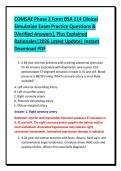
COMSAE Phase 3 Form CSA 106 Advanced
Clinical Synthesis Exam Practice Questions &
[Verified Answers], Plus Explained
Rationales|2026 Latest Update| Instant
Download PDF
1. A 68-year-old man is admitted with progressive dyspnea,
orthopnea, and bilateral lower-extremity edema.
Echocardiography demonstrates a left ventricular ejection fraction
of 25%. During osteopathic structural examination, tissue texture
changes are noted at T1–T5 bilaterally. Which physiologic
mechanism most directly contributes to the development of these
viscerosomatic reflexes?
A. Increased parasympathetic activity through the vagus nerve
B. Somatic dysfunction causing myocardial ischemia
C. Convergence of visceral and somatic afferent input within the spinal
cord
D. Compression of thoracic sympathetic ganglia by edematous tissue
E. Direct myocardial stimulation of skeletal muscle fibers
Answer: C
Rationale: Viscerosomatic reflexes occur when visceral afferent fibers
converge with somatic afferent neurons in the spinal cord. Cardiac
pathology commonly produces tissue texture changes and facilitation
at T1–T5. Increased sympathetic activity and neuronal convergence
create the observed somatic manifestations.
2. A 24-year-old woman presents with fever, malar rash, pleuritic
chest pain, and proteinuria. Laboratory evaluation reveals positive
, ANA and anti–double-stranded DNA antibodies. Renal biopsy
demonstrates diffuse proliferative glomerulonephritis. Which
immunologic mechanism is primarily responsible for her renal
disease?
A. Antibody-mediated cytotoxicity
B. Type I hypersensitivity reaction
C. Type II hypersensitivity reaction
D. Type III hypersensitivity reaction
E. T-cell mediated delayed hypersensitivity
Answer: D
Rationale: Systemic lupus erythematosus causes immune complex
deposition in glomeruli, activating complement and inflammation.
This represents a Type III hypersensitivity reaction. Diffuse
proliferative glomerulonephritis is among the most severe forms of
lupus nephritis.
3. A 59-year-old woman develops sudden right-sided weakness and
expressive aphasia. CT angiography reveals occlusion of the
superior division of the left middle cerebral artery. Which deficit is
most likely present?
A. Left homonymous hemianopia only
B. Fluent aphasia with impaired comprehension
C. Contralateral facial and arm weakness greater than leg weakness
D. Contralateral leg weakness greater than arm weakness
E. Ipsilateral facial paralysis
Answer: C
Rationale: The superior division of the dominant MCA supplies Broca
area and the lateral motor cortex controlling face and upper extremity
,function. Resulting deficits include expressive aphasia and
contralateral face/arm weakness.
4. A 72-year-old smoker presents with painless hematuria.
Cystoscopy reveals a bladder mass. Histology demonstrates
papillary fronds lined by atypical transitional epithelium. Which
risk factor is most strongly associated with this malignancy?
A. Epstein-Barr virus infection
B. Cigarette smoking
C. Barrett esophagus
D. Helicobacter pylori infection
E. Chronic pancreatitis
Answer: B
Rationale: Urothelial carcinoma is strongly associated with cigarette
smoking, aromatic amines, cyclophosphamide exposure, and chronic
inflammation. Smoking is the most significant risk factor in developed
countries.
5. A 32-year-old woman develops fatigue and weight gain several
months after delivery. Laboratory studies reveal elevated TSH and
anti-thyroid peroxidase antibodies. Histology would most likely
show which finding?
A. Reed-Sternberg cells
B. Psammoma bodies
C. Germinal center formation with lymphocytic infiltration
D. Noncaseating granulomas
E. Hyperplastic parafollicular cells
Answer: C
, Rationale: Hashimoto thyroiditis demonstrates extensive lymphocytic
infiltration with germinal center formation and Hurthle cell change.
Autoimmune destruction produces hypothyroidism and elevated
thyroid antibodies.
6. A patient with septic shock receives aggressive fluid resuscitation.
Despite adequate volume replacement, hypotension persists due
to profound vasodilation. Which mediator is most directly
responsible?
A. Endothelin
B. Nitric oxide
C. Angiotensin II
D. Thromboxane A2
E. Vasopressin
Answer: B
Rationale: Septic shock is characterized by widespread nitric oxide
production induced by inflammatory cytokines. Excess nitric oxide
causes severe vasodilation and decreased systemic vascular
resistance.
7. A 48-year-old man develops acute pancreatitis secondary to
gallstones. Which laboratory abnormality most strongly predicts
severe disease?
A. Mild elevation of lipase
B. Hyperalbuminemia
C. Elevated hematocrit due to hemoconcentration
D. Decreased glucose level
E. Elevated HDL cholesterol
Answer: C
Clinical Synthesis Exam Practice Questions &
[Verified Answers], Plus Explained
Rationales|2026 Latest Update| Instant
Download PDF
1. A 68-year-old man is admitted with progressive dyspnea,
orthopnea, and bilateral lower-extremity edema.
Echocardiography demonstrates a left ventricular ejection fraction
of 25%. During osteopathic structural examination, tissue texture
changes are noted at T1–T5 bilaterally. Which physiologic
mechanism most directly contributes to the development of these
viscerosomatic reflexes?
A. Increased parasympathetic activity through the vagus nerve
B. Somatic dysfunction causing myocardial ischemia
C. Convergence of visceral and somatic afferent input within the spinal
cord
D. Compression of thoracic sympathetic ganglia by edematous tissue
E. Direct myocardial stimulation of skeletal muscle fibers
Answer: C
Rationale: Viscerosomatic reflexes occur when visceral afferent fibers
converge with somatic afferent neurons in the spinal cord. Cardiac
pathology commonly produces tissue texture changes and facilitation
at T1–T5. Increased sympathetic activity and neuronal convergence
create the observed somatic manifestations.
2. A 24-year-old woman presents with fever, malar rash, pleuritic
chest pain, and proteinuria. Laboratory evaluation reveals positive
, ANA and anti–double-stranded DNA antibodies. Renal biopsy
demonstrates diffuse proliferative glomerulonephritis. Which
immunologic mechanism is primarily responsible for her renal
disease?
A. Antibody-mediated cytotoxicity
B. Type I hypersensitivity reaction
C. Type II hypersensitivity reaction
D. Type III hypersensitivity reaction
E. T-cell mediated delayed hypersensitivity
Answer: D
Rationale: Systemic lupus erythematosus causes immune complex
deposition in glomeruli, activating complement and inflammation.
This represents a Type III hypersensitivity reaction. Diffuse
proliferative glomerulonephritis is among the most severe forms of
lupus nephritis.
3. A 59-year-old woman develops sudden right-sided weakness and
expressive aphasia. CT angiography reveals occlusion of the
superior division of the left middle cerebral artery. Which deficit is
most likely present?
A. Left homonymous hemianopia only
B. Fluent aphasia with impaired comprehension
C. Contralateral facial and arm weakness greater than leg weakness
D. Contralateral leg weakness greater than arm weakness
E. Ipsilateral facial paralysis
Answer: C
Rationale: The superior division of the dominant MCA supplies Broca
area and the lateral motor cortex controlling face and upper extremity
,function. Resulting deficits include expressive aphasia and
contralateral face/arm weakness.
4. A 72-year-old smoker presents with painless hematuria.
Cystoscopy reveals a bladder mass. Histology demonstrates
papillary fronds lined by atypical transitional epithelium. Which
risk factor is most strongly associated with this malignancy?
A. Epstein-Barr virus infection
B. Cigarette smoking
C. Barrett esophagus
D. Helicobacter pylori infection
E. Chronic pancreatitis
Answer: B
Rationale: Urothelial carcinoma is strongly associated with cigarette
smoking, aromatic amines, cyclophosphamide exposure, and chronic
inflammation. Smoking is the most significant risk factor in developed
countries.
5. A 32-year-old woman develops fatigue and weight gain several
months after delivery. Laboratory studies reveal elevated TSH and
anti-thyroid peroxidase antibodies. Histology would most likely
show which finding?
A. Reed-Sternberg cells
B. Psammoma bodies
C. Germinal center formation with lymphocytic infiltration
D. Noncaseating granulomas
E. Hyperplastic parafollicular cells
Answer: C
, Rationale: Hashimoto thyroiditis demonstrates extensive lymphocytic
infiltration with germinal center formation and Hurthle cell change.
Autoimmune destruction produces hypothyroidism and elevated
thyroid antibodies.
6. A patient with septic shock receives aggressive fluid resuscitation.
Despite adequate volume replacement, hypotension persists due
to profound vasodilation. Which mediator is most directly
responsible?
A. Endothelin
B. Nitric oxide
C. Angiotensin II
D. Thromboxane A2
E. Vasopressin
Answer: B
Rationale: Septic shock is characterized by widespread nitric oxide
production induced by inflammatory cytokines. Excess nitric oxide
causes severe vasodilation and decreased systemic vascular
resistance.
7. A 48-year-old man develops acute pancreatitis secondary to
gallstones. Which laboratory abnormality most strongly predicts
severe disease?
A. Mild elevation of lipase
B. Hyperalbuminemia
C. Elevated hematocrit due to hemoconcentration
D. Decreased glucose level
E. Elevated HDL cholesterol
Answer: C