

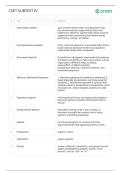
CSET SUBTEST IV
# Term Definition
1 Impromptu Speech spur of the moment with no preparation; less
structured and less supported by facts and
evidence to allow for spontaneity; ideas must be
supported with statements that demonstrate
pertinence, variety, and detail
2 Extemporaneous Speech short, informal speech on a provided topic that is
made without extensive time for preparation;
improvised rather than composed
3 Persuasive Speech focused form designed to persuade the audience
to believe something or take some action; can be
organized in different ways including
cause-effect, problem-solution,
comparison-contrast, assertion-reasons, and
motivated sequence
4 Monroe's Motivated Sequence 1. Attention (getting the audience's attention) 2.
Need (describe the problem and show need for
solution) 3. Satisfaction (present a solution that
satisfies need) 4. Visualization (visualize the result
of solution) 5. Action (request audience to take
action)
5 Expository Speech informative and does not express the speaker's
personal opinion; presents information that is
factual
6 Interpretative Speech intended to bring to life a text or piece of
literature through the creative use of voice,
gesture, and facial expression
7 Debate structured program or contest of formal
arguments that take opposing points of view
8 Proposition argues in favor
9 Opposition argues against
10 Diction accent, inflection, intonation, and speech-sound
quality employed by speaker; avoids "vocal
pauses" such as "um" or "er"
, CSET SUBTEST IV
# Term Definition
11 Enunciation ability to speak clearly and articulate each speech
sound without stumbling or saying the wrong
words
12 Volume loudness or softness of speech sounds
13 Rate pace, speed at which a speaker delivers words
14 Pitch high and low notes of music
15 Body language and gestures can be used to emphasize main points or add
humour
16 Eye contact maintain connection with the members of the
audience and gauge audience reaction during a
speech
17 Response to the audience involves speaker's awareness of nonverbal
signals that indicate something the audience
might want or need
18 Active Listening Skills paying close attention; knowing when to listen
and when to speak; knowing how to disagree
with a speaker; eliciting more creative responses;
how to respond to heckling; responding to
audiences' body language (are they familiar with
the topic?); responding to audience concerns
when speaking on a controversial issue (name
the elephant in the room)
19 The Camera Shot - long shot or establishing shot - close-up -
medium shot - low/high angle - reaction shot -
zoom - freeze frame - slow motion - soft, sharp,
deep focus - subjective shot - POV shot - special
effects
20 Camera Movement - stationary camera - fixed axis camera: pan or tilt
- crane shots - hand-held camera or steady-cam
21 Lighting - back-lighting, front-lighting, highlighting -
natural vs. artificial sources of lighting -
black/white contrast - harsh/soft, cold/warm
lighting - high key, low key lighting
# Term Definition
1 Impromptu Speech spur of the moment with no preparation; less
structured and less supported by facts and
evidence to allow for spontaneity; ideas must be
supported with statements that demonstrate
pertinence, variety, and detail
2 Extemporaneous Speech short, informal speech on a provided topic that is
made without extensive time for preparation;
improvised rather than composed
3 Persuasive Speech focused form designed to persuade the audience
to believe something or take some action; can be
organized in different ways including
cause-effect, problem-solution,
comparison-contrast, assertion-reasons, and
motivated sequence
4 Monroe's Motivated Sequence 1. Attention (getting the audience's attention) 2.
Need (describe the problem and show need for
solution) 3. Satisfaction (present a solution that
satisfies need) 4. Visualization (visualize the result
of solution) 5. Action (request audience to take
action)
5 Expository Speech informative and does not express the speaker's
personal opinion; presents information that is
factual
6 Interpretative Speech intended to bring to life a text or piece of
literature through the creative use of voice,
gesture, and facial expression
7 Debate structured program or contest of formal
arguments that take opposing points of view
8 Proposition argues in favor
9 Opposition argues against
10 Diction accent, inflection, intonation, and speech-sound
quality employed by speaker; avoids "vocal
pauses" such as "um" or "er"
, CSET SUBTEST IV
# Term Definition
11 Enunciation ability to speak clearly and articulate each speech
sound without stumbling or saying the wrong
words
12 Volume loudness or softness of speech sounds
13 Rate pace, speed at which a speaker delivers words
14 Pitch high and low notes of music
15 Body language and gestures can be used to emphasize main points or add
humour
16 Eye contact maintain connection with the members of the
audience and gauge audience reaction during a
speech
17 Response to the audience involves speaker's awareness of nonverbal
signals that indicate something the audience
might want or need
18 Active Listening Skills paying close attention; knowing when to listen
and when to speak; knowing how to disagree
with a speaker; eliciting more creative responses;
how to respond to heckling; responding to
audiences' body language (are they familiar with
the topic?); responding to audience concerns
when speaking on a controversial issue (name
the elephant in the room)
19 The Camera Shot - long shot or establishing shot - close-up -
medium shot - low/high angle - reaction shot -
zoom - freeze frame - slow motion - soft, sharp,
deep focus - subjective shot - POV shot - special
effects
20 Camera Movement - stationary camera - fixed axis camera: pan or tilt
- crane shots - hand-held camera or steady-cam
21 Lighting - back-lighting, front-lighting, highlighting -
natural vs. artificial sources of lighting -
black/white contrast - harsh/soft, cold/warm
lighting - high key, low key lighting

