

C190 WGU
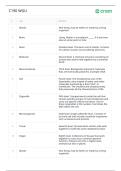
# Term Definition
1 Abiotic Non-living, may be within or made by a living
organism.
2 Biotic Living. Matter is considered ______ if it was ever
alive at some point in time
3 Atom Smallest level. The basic unit of matter. Consists
of a dense nucleus surrounded by electrons.
4 Molecule Second level. A chemical structure consisting of
at least two atoms held together by a chemical
bond.
5 Macromolecule Third level. Biologically important molecules
that are technically polymers. Example: DNA.
6 Cell Fourth level. The fundamental unit of life.
Essentially a tiny droplet of water and other
molecules enclosed by a fluid "skin" or
membrane. The smallest and simplest entity
that possesses all the characteristics of life.
7 Organelle Fifth level. Compartments inside the cell that
contain specific groups of macromolecules and
carry out specific cellular functions. One of
these organelles is the nucleus; it encloses the
DNA within the cell.
8 Microorganism Sixth level. Single-celled life form. Consists of
just one cell and include unicellular organisms
such as bacteria and protists.
9 Tissue Seventh level. Formed when similar cells work
together to fulfill the same detailed function.
10 Organ Eighth level. Collections of tissues that work
together to carry out a common general
function. Present not only in higher level
animals but also in plants.
11 Abiotic Non-living, may be within or made by a living
organism.
,C190 WGU
# Term Definition
12 Biotic Living. Matter is considered ______ if it was ever
alive at some point in time
13 Atom Smallest level. The basic unit of matter. Consists
of a dense nucleus surrounded by electrons.
14 Molecule Second level. A chemical structure consisting of
at least two atoms held together by a chemical
bond.
15 Macromolecule Third level. Biologically important molecules
that are technically polymers. Example: DNA.
16 Cell Fourth level. The fundamental unit of life.
Essentially a tiny droplet of water and other
molecules enclosed by a fluid "skin" or
membrane. The smallest and simplest entity
that possesses all the characteristics of life.
17 Organelle Fifth level. Compartments inside the cell that
contain specific groups of macromolecules and
carry out specific cellular functions. One of
these organelles is the nucleus; it encloses the
DNA within the cell.
18 Microorganism Sixth level. Single-celled life form. Consists of
just one cell and include unicellular organisms
such as bacteria and protists.
19 Tissue Seventh level. Formed when similar cells work
together to fulfill the same detailed function.
20 Organ Eighth level. Collections of tissues that work
together to carry out a common general
function. Present not only in higher level
animals but also in plants.
21 Organ System Ninth level. Consists of functionally related
organs. Mammals have many.
22 Organism Tenth Level. Individual living entities that
survive and reproduce as a unit. For example,
each tree in a forest.
, C190 WGU
# Term Definition
23 Population Eleventh level. Consists of all the individuals of a
species living within a specific area.
24 Community Twelfth level. Populations can interact with each
other in positive and negative ways, and
together they form this.
25 Ecosystem Thirteenth level. Consists of all the living things
in a particular area together with the abiotic, or
nonliving, parts of that environment.
26 Biosphere Fourteenth level. The highest level of
organization in living systems. The collection of
all ecosystems on Earth. Includes all habitable
zones on the planet, including land, soil, and
rocks to a great depth in the Earth's crust; water
and ice; and the atmosphere to a great height.
27 Emergent Properties Characteristics of a system that are not present
in any of its component parts.
28 Biology The scientific study of life and is the branch of
science that studies living organisms and the
way organisms interact with their
environments.
29 Homeostasis The ability or tendency of organisms and cells to
maintain stable internal conditions.
30 Nutrient Any matter an organism needs but cannot make
for itself.
31 Energy The capacity to do work or to make a change in
the location, temperature, or structure of
matter. Does not have mass and it does not take
up space, but it can be measured in terms of
what it does.
32 Growth An increase in size.
33 Development Structure and function change in an orderly way
as an organism passes through its life cycle. An
individual's pattern of _______ is partly
determined by genetic instructions.
# Term Definition
1 Abiotic Non-living, may be within or made by a living
organism.
2 Biotic Living. Matter is considered ______ if it was ever
alive at some point in time
3 Atom Smallest level. The basic unit of matter. Consists
of a dense nucleus surrounded by electrons.
4 Molecule Second level. A chemical structure consisting of
at least two atoms held together by a chemical
bond.
5 Macromolecule Third level. Biologically important molecules
that are technically polymers. Example: DNA.
6 Cell Fourth level. The fundamental unit of life.
Essentially a tiny droplet of water and other
molecules enclosed by a fluid "skin" or
membrane. The smallest and simplest entity
that possesses all the characteristics of life.
7 Organelle Fifth level. Compartments inside the cell that
contain specific groups of macromolecules and
carry out specific cellular functions. One of
these organelles is the nucleus; it encloses the
DNA within the cell.
8 Microorganism Sixth level. Single-celled life form. Consists of
just one cell and include unicellular organisms
such as bacteria and protists.
9 Tissue Seventh level. Formed when similar cells work
together to fulfill the same detailed function.
10 Organ Eighth level. Collections of tissues that work
together to carry out a common general
function. Present not only in higher level
animals but also in plants.
11 Abiotic Non-living, may be within or made by a living
organism.
,C190 WGU
# Term Definition
12 Biotic Living. Matter is considered ______ if it was ever
alive at some point in time
13 Atom Smallest level. The basic unit of matter. Consists
of a dense nucleus surrounded by electrons.
14 Molecule Second level. A chemical structure consisting of
at least two atoms held together by a chemical
bond.
15 Macromolecule Third level. Biologically important molecules
that are technically polymers. Example: DNA.
16 Cell Fourth level. The fundamental unit of life.
Essentially a tiny droplet of water and other
molecules enclosed by a fluid "skin" or
membrane. The smallest and simplest entity
that possesses all the characteristics of life.
17 Organelle Fifth level. Compartments inside the cell that
contain specific groups of macromolecules and
carry out specific cellular functions. One of
these organelles is the nucleus; it encloses the
DNA within the cell.
18 Microorganism Sixth level. Single-celled life form. Consists of
just one cell and include unicellular organisms
such as bacteria and protists.
19 Tissue Seventh level. Formed when similar cells work
together to fulfill the same detailed function.
20 Organ Eighth level. Collections of tissues that work
together to carry out a common general
function. Present not only in higher level
animals but also in plants.
21 Organ System Ninth level. Consists of functionally related
organs. Mammals have many.
22 Organism Tenth Level. Individual living entities that
survive and reproduce as a unit. For example,
each tree in a forest.
, C190 WGU
# Term Definition
23 Population Eleventh level. Consists of all the individuals of a
species living within a specific area.
24 Community Twelfth level. Populations can interact with each
other in positive and negative ways, and
together they form this.
25 Ecosystem Thirteenth level. Consists of all the living things
in a particular area together with the abiotic, or
nonliving, parts of that environment.
26 Biosphere Fourteenth level. The highest level of
organization in living systems. The collection of
all ecosystems on Earth. Includes all habitable
zones on the planet, including land, soil, and
rocks to a great depth in the Earth's crust; water
and ice; and the atmosphere to a great height.
27 Emergent Properties Characteristics of a system that are not present
in any of its component parts.
28 Biology The scientific study of life and is the branch of
science that studies living organisms and the
way organisms interact with their
environments.
29 Homeostasis The ability or tendency of organisms and cells to
maintain stable internal conditions.
30 Nutrient Any matter an organism needs but cannot make
for itself.
31 Energy The capacity to do work or to make a change in
the location, temperature, or structure of
matter. Does not have mass and it does not take
up space, but it can be measured in terms of
what it does.
32 Growth An increase in size.
33 Development Structure and function change in an orderly way
as an organism passes through its life cycle. An
individual's pattern of _______ is partly
determined by genetic instructions.

