

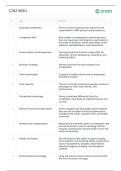
C202 WGU
# Term Definition
1 Employee handbooks Print or online materials that document the
organization's HRM policies and procedures.
2 Compliance Risk Risk related to employment-related decisions
that can have legal ramifications, particularly in
the areas of diversity, health and safety, union
relations, whistleblowers, and harassment.
3 Human Resource Management The organizational function responsible for
attracting, hiring, developing, rewarding, and
retaining talent.
4 Business Strategy Defines how the firm will compete in its
marketplace.
5 Talent philosophy A system of beliefs about how its employees
should be treated.
6 Total rewards The sum of all the rewards employees receive in
exchange for their time, efforts, and
performance.
7 Competitive advantage Doing something differently from the
competition that leads to outperformance and
success.
8 Indirect financial compensation All the tangible and financially valued rewards
that are not included in direct compensation,
including free meals, vacation time, and health
insurance.
9 Nonfinancial compensation Rewards and incentives given to employees that
are not financial in nature including intrinsic
rewards received from the job itself or from the
work environment.
10 Health and Safety The HR function that refers to topics ranging
from wellness, fire and food safety, ergonomics,
injury management, disaster preparedness,
industrial hygiene, bullying, and workplace
violence.
11 Human Resource strategy Links the entire human resource function with
the firm's business strategy.
,C202 WGU
# Term Definition
12 Direct financial compensation Compensation received in the form of salary,
wages, commissions, stock options, or bonuses.
13 Performance management The HR function that refers to aligning
individual employees' goals and behaviors with
organizational goals, strategies, appraising, and
evaluating past and current behavior and
performance, providing suggestions for
improvement.
14 Strategic Risk Risk related to talent strategy, company culture,
ethics, investments in people, and the
implementation of changes initiatives.
15 Staffing The HR function that refers to the process of
planning, acquiring, deploying, and retaining
employees that enables the organization to
meet its talent needs and execute its business
strategy.
16 Financial risk Risk related to an organization's workforce costs
and productivity directly through compensation,
benefits, turnover, overtime, and time-to-hire
and indirectly through errors, accidents, and
lost productions.
17 Operational Risk Risk related to the speed and the effectiveness
of talent acquisition, development of
employees' skills, and the identification and
retention of top performers.
18 the 6 functions of human Staffing, training and development,
resource management performance management, rewards and
benefits, health and safety,
employee-management relations.
19 Training and Development The HR function that refers to the growth of
employee capabilities through both formal and
informal activities; also includes career
planning, organizational development, and legal
compliance.
20 Rewards and benefits The HR function that refers to the sum of all of
the rewards employees receive in exchange for
their time, efforts, and performance.
,C202 WGU
# Term Definition
21 Employee-management relations The HR function that refers to industrial
relations, more commonly known as unionized
employee situation.
22 Code of ethics A Decision-making guide that describes the
highest value to which an organization aspires.
23 Fairness Ethical action treats all people equally, or at
least fairly, based on some defensible standard.
24 High-Performance work systems High involvement or high commitment
(HPWS) organizations.
25 4 types of organizational culture Entrepreneurial, bureaucratic, consensual,
competitive
26 Organizational culture the norms, values, and assumptions of
organizational members that guide members,
attitudes, and behaviors.
27 Corporate social responsibility Businesses showing concern for the common
good and valuing human dignity.
28 Stakeholder perspective Considering the interests and opinions of all
people, groups, organizations, or systems that
affect or could be affected by the organization's
actions.
29 Ethics The standards of more behaviors that define
socially acceptable behaviors that are right as
opposed to wrong.
30 Consensual culture The type of culture that emphasizes loyalty and
tradition and encourages employees to stay
with the organization for a long time;
promotional is generally from within the
company; examples include law firms and
military
, C202 WGU
# Term Definition
31 Bureaucratic Culture The type of culture that emphasizes formal
structures and the correct implementation of
organizational procedures, norms, and rules;
commonly associated with consistency and high
ethical standards; examples include pharmacies
and drug manufacturers.
32 5 types of ethical standards Utilitarian, rights, fairness, common good,
virtue
33 Utilitarian Standard The ethical action that best balances good over
harm.
34 Performance culture Focuses on hiring, retaining, developing,
motivation, and making work assignments
based on performance data and results.
35 Competitive culture The type of culture that emphasizes competitive
advantages and market superiority; commonly
associated with large amounts of stress;
examples include brokerage and currency
trading firms.
36 HRM metrics The measurement of those HRM activities that
contribute to business strategy execution and
the organization's financial performance
(Absence rate, cost per hire, job offer
acceptance rate)
37 Rights This ethical action is the one that best respects
and protects the moral rights of everyone
affected by the action, including the right to
privacy, to be told the truth, or to be safe.
38 Virtue This ethical action is consistent with certain
ideal virtues, including civility, compassion, and
benevolence,
39 Code of conduct Specifies expected and prohibited actions in the
workplace and gives examples of appropriate
behavior.
40 Entrepreneurial culture The type of culture that emphasizes creativity,
innovation, and risk taking; examples include
Google and Tesla
# Term Definition
1 Employee handbooks Print or online materials that document the
organization's HRM policies and procedures.
2 Compliance Risk Risk related to employment-related decisions
that can have legal ramifications, particularly in
the areas of diversity, health and safety, union
relations, whistleblowers, and harassment.
3 Human Resource Management The organizational function responsible for
attracting, hiring, developing, rewarding, and
retaining talent.
4 Business Strategy Defines how the firm will compete in its
marketplace.
5 Talent philosophy A system of beliefs about how its employees
should be treated.
6 Total rewards The sum of all the rewards employees receive in
exchange for their time, efforts, and
performance.
7 Competitive advantage Doing something differently from the
competition that leads to outperformance and
success.
8 Indirect financial compensation All the tangible and financially valued rewards
that are not included in direct compensation,
including free meals, vacation time, and health
insurance.
9 Nonfinancial compensation Rewards and incentives given to employees that
are not financial in nature including intrinsic
rewards received from the job itself or from the
work environment.
10 Health and Safety The HR function that refers to topics ranging
from wellness, fire and food safety, ergonomics,
injury management, disaster preparedness,
industrial hygiene, bullying, and workplace
violence.
11 Human Resource strategy Links the entire human resource function with
the firm's business strategy.
,C202 WGU
# Term Definition
12 Direct financial compensation Compensation received in the form of salary,
wages, commissions, stock options, or bonuses.
13 Performance management The HR function that refers to aligning
individual employees' goals and behaviors with
organizational goals, strategies, appraising, and
evaluating past and current behavior and
performance, providing suggestions for
improvement.
14 Strategic Risk Risk related to talent strategy, company culture,
ethics, investments in people, and the
implementation of changes initiatives.
15 Staffing The HR function that refers to the process of
planning, acquiring, deploying, and retaining
employees that enables the organization to
meet its talent needs and execute its business
strategy.
16 Financial risk Risk related to an organization's workforce costs
and productivity directly through compensation,
benefits, turnover, overtime, and time-to-hire
and indirectly through errors, accidents, and
lost productions.
17 Operational Risk Risk related to the speed and the effectiveness
of talent acquisition, development of
employees' skills, and the identification and
retention of top performers.
18 the 6 functions of human Staffing, training and development,
resource management performance management, rewards and
benefits, health and safety,
employee-management relations.
19 Training and Development The HR function that refers to the growth of
employee capabilities through both formal and
informal activities; also includes career
planning, organizational development, and legal
compliance.
20 Rewards and benefits The HR function that refers to the sum of all of
the rewards employees receive in exchange for
their time, efforts, and performance.
,C202 WGU
# Term Definition
21 Employee-management relations The HR function that refers to industrial
relations, more commonly known as unionized
employee situation.
22 Code of ethics A Decision-making guide that describes the
highest value to which an organization aspires.
23 Fairness Ethical action treats all people equally, or at
least fairly, based on some defensible standard.
24 High-Performance work systems High involvement or high commitment
(HPWS) organizations.
25 4 types of organizational culture Entrepreneurial, bureaucratic, consensual,
competitive
26 Organizational culture the norms, values, and assumptions of
organizational members that guide members,
attitudes, and behaviors.
27 Corporate social responsibility Businesses showing concern for the common
good and valuing human dignity.
28 Stakeholder perspective Considering the interests and opinions of all
people, groups, organizations, or systems that
affect or could be affected by the organization's
actions.
29 Ethics The standards of more behaviors that define
socially acceptable behaviors that are right as
opposed to wrong.
30 Consensual culture The type of culture that emphasizes loyalty and
tradition and encourages employees to stay
with the organization for a long time;
promotional is generally from within the
company; examples include law firms and
military
, C202 WGU
# Term Definition
31 Bureaucratic Culture The type of culture that emphasizes formal
structures and the correct implementation of
organizational procedures, norms, and rules;
commonly associated with consistency and high
ethical standards; examples include pharmacies
and drug manufacturers.
32 5 types of ethical standards Utilitarian, rights, fairness, common good,
virtue
33 Utilitarian Standard The ethical action that best balances good over
harm.
34 Performance culture Focuses on hiring, retaining, developing,
motivation, and making work assignments
based on performance data and results.
35 Competitive culture The type of culture that emphasizes competitive
advantages and market superiority; commonly
associated with large amounts of stress;
examples include brokerage and currency
trading firms.
36 HRM metrics The measurement of those HRM activities that
contribute to business strategy execution and
the organization's financial performance
(Absence rate, cost per hire, job offer
acceptance rate)
37 Rights This ethical action is the one that best respects
and protects the moral rights of everyone
affected by the action, including the right to
privacy, to be told the truth, or to be safe.
38 Virtue This ethical action is consistent with certain
ideal virtues, including civility, compassion, and
benevolence,
39 Code of conduct Specifies expected and prohibited actions in the
workplace and gives examples of appropriate
behavior.
40 Entrepreneurial culture The type of culture that emphasizes creativity,
innovation, and risk taking; examples include
Google and Tesla

