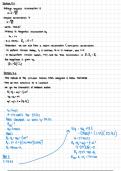
Section 9 . 4
acceleration is
average angular
AW
2 = 2 =
At
acceleration is
angular
du
C =
dt
?
units :
rads/s
related to tangential acceleration by
at = ra
is a vector + = x
·
:
remember we can also have a radial acceleration (centripetal acceleration .
in uniform circular motion , It is constant ,
so w is constant ,
and d = 0
in nonuniform circular motion , 970 , and the total acceleration is a= ++
the magnitude is
given by
al =
a + a ?
Section 9 6 .
the radius of the circular motion links angular linear variables
now we limit ourselves to a :
constant
we
get the kinematics of rotational motion
22t
2
Of 0 =
+
Wot +
&t
Wf =
Wo +
wr =
wj + 2a(0f 8) -
Vo Om/S =
d =
1 43.
rad/s for 25 95 .
then constant w until +f = 59 5s .
Otot :?
Wo = O rad/s
Wp =
Wo +d t
>
Part I -
Oradls +
1 43
. 25 95
.
Of 0 : +
Wot + Tat ?
W = 37 rad /S
:
Of 0 =
+
0 +
t 1 43 raals
. (25 9s)
.
Of O Not + at ?
= +
Of = 480 rad = 0
,
=
0 +
(37)(36) + 0
Or =
1244 rad =
02
Part 2: O
tot
= 0
.
+
0 = 1724 rad
+ 33 65
=
.
, Section 10 . V = ru
rotational Kinetic
energy is
·
givenby Em rw = Emr
Kr =
E (mrz) wa
if we have a
rigid body ,
all points in
object/body have same w
if we compare Kr to K+ ( = mvc
we see that Emjr ; acts like a rotational mass .
we define this to be the moment of inertia
Emir;
2
I :
then we
get Kr =
z Iw
EX : inner 2 washers : V = 5 cm
middle 2 washers : V = 15cm
outer 2 washers : v= 25cm
I = 2 (0 0219
. 0 .
05m
+ 2 (0 02 kg
. 0 .
15m
kg) (0 25)
<
+ 2 (0 02
.
.
I 0 0035
=
.
lgm2
b .
I =
2 (0 02kg) (0 15)
. .
2 0 02
19 0 25m)
+
.
.
I = 0 0034
.
lgm2
C . W = 5 new/s
W = 5 veu/2it rad
= lo radls
5/I rev
Ki :I w2 = 2 (0 00035
.
kgm2) (31 4 raals).
Ki = 1
735a
.
F Mr=
Section 10 2 .
for a more
general object moment
·
,
of inertia is I =
fr2dm
to do this integral ,
we need mass density
if object is rotating around its center of mass, we can
use a formula for moment of inertia .
acceleration is
average angular
AW
2 = 2 =
At
acceleration is
angular
du
C =
dt
?
units :
rads/s
related to tangential acceleration by
at = ra
is a vector + = x
·
:
remember we can also have a radial acceleration (centripetal acceleration .
in uniform circular motion , It is constant ,
so w is constant ,
and d = 0
in nonuniform circular motion , 970 , and the total acceleration is a= ++
the magnitude is
given by
al =
a + a ?
Section 9 6 .
the radius of the circular motion links angular linear variables
now we limit ourselves to a :
constant
we
get the kinematics of rotational motion
22t
2
Of 0 =
+
Wot +
&t
Wf =
Wo +
wr =
wj + 2a(0f 8) -
Vo Om/S =
d =
1 43.
rad/s for 25 95 .
then constant w until +f = 59 5s .
Otot :?
Wo = O rad/s
Wp =
Wo +d t
>
Part I -
Oradls +
1 43
. 25 95
.
Of 0 : +
Wot + Tat ?
W = 37 rad /S
:
Of 0 =
+
0 +
t 1 43 raals
. (25 9s)
.
Of O Not + at ?
= +
Of = 480 rad = 0
,
=
0 +
(37)(36) + 0
Or =
1244 rad =
02
Part 2: O
tot
= 0
.
+
0 = 1724 rad
+ 33 65
=
.
, Section 10 . V = ru
rotational Kinetic
energy is
·
givenby Em rw = Emr
Kr =
E (mrz) wa
if we have a
rigid body ,
all points in
object/body have same w
if we compare Kr to K+ ( = mvc
we see that Emjr ; acts like a rotational mass .
we define this to be the moment of inertia
Emir;
2
I :
then we
get Kr =
z Iw
EX : inner 2 washers : V = 5 cm
middle 2 washers : V = 15cm
outer 2 washers : v= 25cm
I = 2 (0 0219
. 0 .
05m
+ 2 (0 02 kg
. 0 .
15m
kg) (0 25)
<
+ 2 (0 02
.
.
I 0 0035
=
.
lgm2
b .
I =
2 (0 02kg) (0 15)
. .
2 0 02
19 0 25m)
+
.
.
I = 0 0034
.
lgm2
C . W = 5 new/s
W = 5 veu/2it rad
= lo radls
5/I rev
Ki :I w2 = 2 (0 00035
.
kgm2) (31 4 raals).
Ki = 1
735a
.
F Mr=
Section 10 2 .
for a more
general object moment
·
,
of inertia is I =
fr2dm
to do this integral ,
we need mass density
if object is rotating around its center of mass, we can
use a formula for moment of inertia .