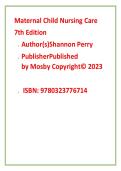
Maternal Child Nursing Care
7th Edition
Author(s)Shannon Perry
PublisherPublished
by Mosby Copyright© 2023
ISBN: 9780323776714
,TEST BANK
Below is a 20-question, publication-ready NCLEX-style test
bank aligned with:
PART 1: MATERNITY NURSING
UNIT 1: Introduction to Maternity Nursing
Topic: 21st-Century Maternity Nursing
Subtopics:
Advances in care of mothers and infants
Reduction of health disparities
Contemporary issues and trends
Trends in nursing practice
🩺 MATERNITY NURSING TEST BANK (20 QUESTIONS)
Question 1 (MCQ)
A nurse is discussing modern trends in maternity care. Which
statement best reflects a key advance in 21st-century maternity
nursing?
A. Increased use of routine episiotomy
B. Emphasis on family-centered and patient-centered care
,C. Elimination of electronic fetal monitoring
D. Reduction in interprofessional collaboration
Correct Answer: B
Rationale:
Modern maternity care prioritizes family-centered,
individualized care, respecting patient autonomy and
preferences.
Incorrect Options:
A: Episiotomies are no longer routine
C: EFM is still widely used
D: Collaboration has increased, not decreased
Nursing Process: Implementation
Clinical Judgment: Recognize cues
Difficulty: Easy
Bloom’s Level: Understanding
Question 2 (SATA)
Which interventions reflect efforts to reduce maternal health
disparities?
Select all that apply:
A. Providing culturally competent care
B. Limiting interpreter services
C. Expanding access to prenatal care
, D. Addressing social determinants of health
E. Ignoring socioeconomic barriers
Correct Answers: A, C, D
Rationale:
Reducing disparities involves equitable access, cultural
competence, and addressing social determinants.
Incorrect Options:
B: Interpreter services are essential
E: Barriers must be addressed, not ignored
Nursing Process: Planning
Clinical Judgment: Prioritize hypotheses
Difficulty: Moderate
Bloom’s Level: Applying
Question 3 (NGN – Case-Based)
A 22-year-old pregnant patient from a rural area presents late
for prenatal care. The nurse identifies barriers to care.
Which factor is MOST likely contributing?
A. High health literacy
B. Limited transportation access
C. Overuse of healthcare services
D. Excess provider availability
Correct Answer: B
7th Edition
Author(s)Shannon Perry
PublisherPublished
by Mosby Copyright© 2023
ISBN: 9780323776714
,TEST BANK
Below is a 20-question, publication-ready NCLEX-style test
bank aligned with:
PART 1: MATERNITY NURSING
UNIT 1: Introduction to Maternity Nursing
Topic: 21st-Century Maternity Nursing
Subtopics:
Advances in care of mothers and infants
Reduction of health disparities
Contemporary issues and trends
Trends in nursing practice
🩺 MATERNITY NURSING TEST BANK (20 QUESTIONS)
Question 1 (MCQ)
A nurse is discussing modern trends in maternity care. Which
statement best reflects a key advance in 21st-century maternity
nursing?
A. Increased use of routine episiotomy
B. Emphasis on family-centered and patient-centered care
,C. Elimination of electronic fetal monitoring
D. Reduction in interprofessional collaboration
Correct Answer: B
Rationale:
Modern maternity care prioritizes family-centered,
individualized care, respecting patient autonomy and
preferences.
Incorrect Options:
A: Episiotomies are no longer routine
C: EFM is still widely used
D: Collaboration has increased, not decreased
Nursing Process: Implementation
Clinical Judgment: Recognize cues
Difficulty: Easy
Bloom’s Level: Understanding
Question 2 (SATA)
Which interventions reflect efforts to reduce maternal health
disparities?
Select all that apply:
A. Providing culturally competent care
B. Limiting interpreter services
C. Expanding access to prenatal care
, D. Addressing social determinants of health
E. Ignoring socioeconomic barriers
Correct Answers: A, C, D
Rationale:
Reducing disparities involves equitable access, cultural
competence, and addressing social determinants.
Incorrect Options:
B: Interpreter services are essential
E: Barriers must be addressed, not ignored
Nursing Process: Planning
Clinical Judgment: Prioritize hypotheses
Difficulty: Moderate
Bloom’s Level: Applying
Question 3 (NGN – Case-Based)
A 22-year-old pregnant patient from a rural area presents late
for prenatal care. The nurse identifies barriers to care.
Which factor is MOST likely contributing?
A. High health literacy
B. Limited transportation access
C. Overuse of healthcare services
D. Excess provider availability
Correct Answer: B