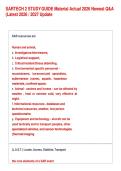
SARTECH 2 STUDY GUIDE Material Actual 2026 Newest Q&A
(Latest Update
SAR resources are
Human and animal,
a. Investigators/Interviewers,
b. Logistical support,
c. Critical Incident/Stress debriefing,
d. Environmental specific personnel -
mountaineers, ice/snow/cold specialists,
subterranean (caves), aquatic, hazardous
materials, confined space.
e. Animal - canines and horses - can be affected by
weather , heat or extreme cold, very effective at
night.
f. Informational resources - databases and
technical resources, weather, lost person
questionnaire.
g. Equipment and technology - aircraft can be
used tactically and to transport peoples, other
specialized vehicles, and sensor technologies
(thermal imaging
(L.A.S.T.) Locate, Access, Stabilize, Transport
the core elements of a SAR event
,(S.T.O.P.) Stay/Stop, Think, Observe, Plan
Mental steps of managing an emergency
CERT (Citizen Corps)
Volunteers, trained civilians to assist disaster impacted communities.
Supported and coordinated by FEMA.
FEMA's CERT program
Trains people in neighborhoods, the workplace, and schools in basic disaster
response skills and helps them take a more active role in
emergency preparedness.
,The CERT program teaches
a. citizens what immediate services to expect after a
major disaster
b. about their responsibilities for mitigation and
preparedness
c. training in needed life-saving skills with
emphasis on decision-making, rescuer safety,
and doing the greatest good for the greatest
number
d. organization of teams so that they are an
extension of first responder services
All SAR is
Local
LOCAL SAR
First line of defense, they have the legal responsibility to start the search and
are accountable for the search (in KANSAS the Sheriff has the local
authority to initiate the search)
, STATE SAR
after local resources are exhausted, state resources may be called in. It is the
responsibility of the local agency to initiate this call. The local agency might
also call on the state if they do not have the resources available (ex.
helicopter) to accomplish search goals.
FEDERAL SAR
Last line of resources to be called upon only after state resources are
exhausted.
5 stages of a SAR incident
a. Awareness
b. Initial Action - uncertainty phase, alert phase, distress phase
c. Planning - computer or manual methods of operational planning
d. Operation - find, assist and rescue
e. Conclusion - no one in distress, SAR is concluded, search is called off
SAR management maintains
control and keeps it focused.
(Latest Update
SAR resources are
Human and animal,
a. Investigators/Interviewers,
b. Logistical support,
c. Critical Incident/Stress debriefing,
d. Environmental specific personnel -
mountaineers, ice/snow/cold specialists,
subterranean (caves), aquatic, hazardous
materials, confined space.
e. Animal - canines and horses - can be affected by
weather , heat or extreme cold, very effective at
night.
f. Informational resources - databases and
technical resources, weather, lost person
questionnaire.
g. Equipment and technology - aircraft can be
used tactically and to transport peoples, other
specialized vehicles, and sensor technologies
(thermal imaging
(L.A.S.T.) Locate, Access, Stabilize, Transport
the core elements of a SAR event
,(S.T.O.P.) Stay/Stop, Think, Observe, Plan
Mental steps of managing an emergency
CERT (Citizen Corps)
Volunteers, trained civilians to assist disaster impacted communities.
Supported and coordinated by FEMA.
FEMA's CERT program
Trains people in neighborhoods, the workplace, and schools in basic disaster
response skills and helps them take a more active role in
emergency preparedness.
,The CERT program teaches
a. citizens what immediate services to expect after a
major disaster
b. about their responsibilities for mitigation and
preparedness
c. training in needed life-saving skills with
emphasis on decision-making, rescuer safety,
and doing the greatest good for the greatest
number
d. organization of teams so that they are an
extension of first responder services
All SAR is
Local
LOCAL SAR
First line of defense, they have the legal responsibility to start the search and
are accountable for the search (in KANSAS the Sheriff has the local
authority to initiate the search)
, STATE SAR
after local resources are exhausted, state resources may be called in. It is the
responsibility of the local agency to initiate this call. The local agency might
also call on the state if they do not have the resources available (ex.
helicopter) to accomplish search goals.
FEDERAL SAR
Last line of resources to be called upon only after state resources are
exhausted.
5 stages of a SAR incident
a. Awareness
b. Initial Action - uncertainty phase, alert phase, distress phase
c. Planning - computer or manual methods of operational planning
d. Operation - find, assist and rescue
e. Conclusion - no one in distress, SAR is concluded, search is called off
SAR management maintains
control and keeps it focused.