

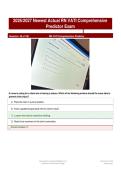
2026/2027 Newest Actual RN VATI Comprehensive
Predictor Exam
Practice Exam · 167 Questions · With Rationales
Question: 38 of 180 RN VATI Comprehensive Predictor
A nurse is caring for a client who is having a seizure. Which of the following actions should the nurse take to
prevent client injury?
A. Place the client in a prone position.
B. Insert a padded tongue blade into the client's mouth.
C. Loosen the client's restrictive clothing.
D. Restrict the movement of the client's extremities.
Correct Answer: C
Downloaded by: Want to earn $1,500
Distribution of this document is illegal extra per year?
, classmerit.com — The Marketplace to Buy and Sell Study Materials
RN VATI Comprehensive Predictor
During a seizure, loosen restrictive clothing to prevent injury and allow free breathing. Never place the client prone (aspiration risk),
never insert anything into the mouth (broken teeth/injury risk), and never restrain extremities (fracture risk). Position the client on their
side, protect the head, and time the seizure.
An assistive personnel tells the nurse that several client measurements were obtained with morning vital
signs. Which of the following clients should the nurse plan to assess first?
A. A 6-year-old child who has glomerulonephritis and a blood pressure of 130/73 mm Hg
B. A 2-year-old child who has Kawasaki disease and a temperature of 39°C (102.2°F)
C. A 4-year-old child who has a closed-head injury and a heart rate of 60/min
D. An 8-year-old child who has type I diabetes mellitus and a respiratory rate of 26/min
Correct Answer: A
A BP of 130/73 in a 6-year-old with glomerulonephritis is significantly elevated (hypertensive) and represents the most urgent
finding. Hypertension in glomerulonephritis can rapidly progress to hypertensive crisis or encephalopathy, requiring immediate
assessment and intervention.
Downloaded by: Want to earn $1,500
Distribution of this document is illegal extra per year?
,classmerit.com — The Marketplace to Buy and Sell Study Materials
RN VATI Comprehensive Predictor
Downloaded by: Want to earn $1,500
Distribution of this document is illegal extra per year?
, classmerit.com — The Marketplace to Buy and Sell Study Materials
RN VATI Comprehensive Predictor
A nurse is creating a plan of care for a client who requires suture removal. Which of the following actions
A. Pull the visible part of the suture through the underlying tissue.
B. Cleanse the wound with sterile water prior to removing the sutures.
C. Cut the sutures as close to the skin as possible.
D. Remove the sutures in a consecutive order.
Correct Answer: B
Cleansing the wound with sterile water (or saline) prior to suture removal reduces the risk of infection by removing crust and debris.
Never pull the external portion through tissue (introduces bacteria). Sutures are cut close to the knot on one side. Every other
suture is typically removed first to maintain wound integrity.
should the nurse plan to take?
Downloaded by: Want to earn $1,500
Distribution of this document is illegal extra per year?
Predictor Exam
Practice Exam · 167 Questions · With Rationales
Question: 38 of 180 RN VATI Comprehensive Predictor
A nurse is caring for a client who is having a seizure. Which of the following actions should the nurse take to
prevent client injury?
A. Place the client in a prone position.
B. Insert a padded tongue blade into the client's mouth.
C. Loosen the client's restrictive clothing.
D. Restrict the movement of the client's extremities.
Correct Answer: C
Downloaded by: Want to earn $1,500
Distribution of this document is illegal extra per year?
, classmerit.com — The Marketplace to Buy and Sell Study Materials
RN VATI Comprehensive Predictor
During a seizure, loosen restrictive clothing to prevent injury and allow free breathing. Never place the client prone (aspiration risk),
never insert anything into the mouth (broken teeth/injury risk), and never restrain extremities (fracture risk). Position the client on their
side, protect the head, and time the seizure.
An assistive personnel tells the nurse that several client measurements were obtained with morning vital
signs. Which of the following clients should the nurse plan to assess first?
A. A 6-year-old child who has glomerulonephritis and a blood pressure of 130/73 mm Hg
B. A 2-year-old child who has Kawasaki disease and a temperature of 39°C (102.2°F)
C. A 4-year-old child who has a closed-head injury and a heart rate of 60/min
D. An 8-year-old child who has type I diabetes mellitus and a respiratory rate of 26/min
Correct Answer: A
A BP of 130/73 in a 6-year-old with glomerulonephritis is significantly elevated (hypertensive) and represents the most urgent
finding. Hypertension in glomerulonephritis can rapidly progress to hypertensive crisis or encephalopathy, requiring immediate
assessment and intervention.
Downloaded by: Want to earn $1,500
Distribution of this document is illegal extra per year?
,classmerit.com — The Marketplace to Buy and Sell Study Materials
RN VATI Comprehensive Predictor
Downloaded by: Want to earn $1,500
Distribution of this document is illegal extra per year?
, classmerit.com — The Marketplace to Buy and Sell Study Materials
RN VATI Comprehensive Predictor
A nurse is creating a plan of care for a client who requires suture removal. Which of the following actions
A. Pull the visible part of the suture through the underlying tissue.
B. Cleanse the wound with sterile water prior to removing the sutures.
C. Cut the sutures as close to the skin as possible.
D. Remove the sutures in a consecutive order.
Correct Answer: B
Cleansing the wound with sterile water (or saline) prior to suture removal reduces the risk of infection by removing crust and debris.
Never pull the external portion through tissue (introduces bacteria). Sutures are cut close to the knot on one side. Every other
suture is typically removed first to maintain wound integrity.
should the nurse plan to take?
Downloaded by: Want to earn $1,500
Distribution of this document is illegal extra per year?

