

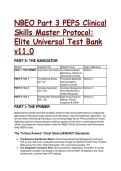
NBEO Part 3 PEPS Clinical
Skills Master Protocol:
Elite Universal Test Bank
v11.0
PART 0: THE NAVIGATOR
Section Cognitive Tier Subject Focus Page / Reference
PART I: THE PRIMER Axiomatic Frameworks Foundational Board Section I
Mechanics, Rubrics &
Assessment Criteria
PART II: Tier 1 Foundational Syntax Procedural Baselines, Section II
(Q1–10) Instrumentation,
Hygiene & Limits
PART II: Tier 2 Complex Application Anomaly Management, Section III
(Q11–20) Axis Adjustments &
Artifact Resolution
PART II: Tier 3 Grandmaster Synthesis High-Acuity Decision Section IV
(Q21–30) Making, Clinical
Judgment & SOAP
PART I: THE PRIMER
Mastering this specific test bank translates directly to elite clinical performance by bridging the
gap between theoretical ocular anatomy and high-stakes, real-world optometric application. You
are not merely memorizing techniques; you are being forged into an A-level practitioner whose
diagnostic precision ensures absolute resilience against clinical errors, compromised infection
control, and diagnostic miscalculations under the NBEO Patient Encounters and Performance
Skills (PEPS) rubric.
The "Critical Axioms" Cheat Sheet (2026/2027 Standards)
● The Blueprint Distribution Matrix: Clinical Assessment and Management command
54% of your total score, evaluated exclusively through the electronic SOAP note. Physical
Skills account for 22%, Patient Education 13%, and Communication 11%.
● The Astigmatic Correction Rule: During Goldmann Applanation Tonometry, if corneal
astigmatism exceeds 3.00 Diopters, the biprism red line MUST be aligned to the minus
cylinder axis to prevent false IOP readings.
, ● The Asepsis Threshold: CDC-compliant handwashing initiates the sterile clinical
timeline. Any subsequent physical contact with non-sterile personal items (hair, face)
requires an immediate, total repeat of the hand hygiene sequence. Handshakes are
strictly prohibited.
● The 4-Attempt Failure Limit: Candidates are granted a maximum of four attempts per
procedural item. A failure on the fourth attempt mandates immediate cessation of that skill
to preserve Standardized Patient (SP) safety and testing flow.
● Retroillumination Physics: During Dilated Biomicroscopy, evaluating the crystalline lens
via retroillumination requires the slit lamp light source to be set to maximum illumination,
isolating opacities against the fundus reflex.
PART II: THE ELITE TEST BANK
Tier 1: Foundational Syntax & Application
Q1: During the initial phase of a Patient Encounter Station, a candidate completes their
mandatory handwashing and proceeds to introduce themselves to the Standardized Patient
(SP). As the SP explains their chief complaint, the candidate reflexively brushes a strand of hair
away from their face. Based on the stringent PEPS infection control standards, which immediate
action is MANDATORY? A) The candidate must inform the SP of the breach, apologize, and
document the contamination error in the final electronic SOAP note. B) The examiner must
immediately fail the candidate for the encounter due to a critical patient safety violation. C) The
candidate must immediately halt the examination, return to the sink, and repeat the entire
CDC-compliant handwashing protocol. D) The candidate may proceed with the physical
examination provided they utilize non-latex examination gloves before touching the ocular
adnexa.
● The Answer: C (The candidate must immediately halt the examination, return to the sink,
and repeat the entire CDC-compliant handwashing protocol.)
● Distractor Analysis:
○ A is incorrect: Documentation within the SOAP note does not mitigate the physical
introduction of fomites into the clinical field, and the rubric requires proactive
physical correction, not passive documentation.
○ B is incorrect: While an infection control violation occurred, the PEPS protocol
requires immediate re-washing, not an automatic failure of the entire 15-minute
station unless the candidate refuses to correct the breach and endangers the
patient.
○ D is incorrect: Examination gloves are not a substitute for baseline hand hygiene
following facial contamination in standard optometric assessments, and utilizing
them without re-washing violates the CDC handwashing guidelines.
The Mentor's Analysis: Infection control is not a static checkbox; it is a continuous, dynamic
state of clinical awareness. When facing a loss of asepsis, the immediate priority is mechanical
decontamination to restore the sterile timeline. By utilizing proactive protocol resetting, you
bypass the common trap of compounding a minor technical reflex into a catastrophic patient
safety failure. Professional/Academic Intuition: The sterile timeline is absolute; any
physical contact with the face or hair post-handwashing nullifies prior asepsis and
mandates an immediate, complete reset.
Q2: A candidate is preparing to perform Goldmann Applanation Tonometry on a Standardized
, Patient. The overview information indicates the SP's habitual prescription is -2.00 -3.75 x 045.
Based on the biophysical parameters of applanation and the PEPS rubric, which specific
adjustment to the tonometer biprism is MOST ACCURATE before assessing the eye? A) The
biprism must be rotated so the white graduation mark aligns with the 180-degree axis to
compensate for with-the-rule astigmatism. B) The biprism must be rotated so the red line aligns
with the 45-degree axis on the mounting scale. C) The biprism requires no adjustment as the
spherical equivalent is less than 4.00 Diopters, rendering the corneal toricity clinically
insignificant. D) The biprism must be rotated so the red line aligns with the 135-degree axis to
applanate the steepest meridian of the cornea.
● The Answer: B (The biprism must be rotated so the red line aligns with the 45-degree
axis on the mounting scale.)
● Distractor Analysis:
○ A is incorrect: The white graduation mark is the default position for spherical or
low-astigmatic corneas, not a corrective setting for high cylinder.
○ C is incorrect: The threshold for tonometer adjustment is based purely on total
cylinder exceeding 3.00 Diopters, rendering the spherical equivalent completely
irrelevant to the physics of the tear meniscus.
○ D is incorrect: The red line must be aligned directly with the minus cylinder axis (45
degrees), not 90 degrees away from it, to ensure the elliptical flattening is
standardized into a measurable circle.
The Mentor's Analysis: High corneal toricity distorts the applanated tear meniscus from a
circle into an ellipse, artificially skewing the intraocular pressure (IOP) reading. When facing
astigmatism greater than 3.00 Diopters, the immediate priority is biprism recalibration. By
utilizing the minus cylinder axis alignment, you bypass the common trap of underestimating IOP
in steep meridians, which could lead to missed glaucoma diagnoses. Professional/Academic
Intuition: Always align the red line of the applanation biprism to the exact minus cylinder
axis when toricity exceeds three diopters.
Q3: During the Anterior Segment Skills Station, the candidate is required to evaluate the
anterior chamber angle depth prior to dilation. Which slit-lamp configuration and anatomical
target are MOST APPROPRIATE to correctly execute the Van Herick technique according to
the evaluation form? A) A wide parallelepiped beam focused directly on the central cornea with
the illumination system offset by 30 degrees. B) An optic section focused on the limbus with the
illumination system offset by 60 degrees to cast a shadow on the iris. C) An optic section
focused on the extreme temporal cornea with the illumination system offset by 60 degrees. D) A
wide conical beam focused through the pupil using maximum illumination and magnification to
evaluate the trabecular meshwork directly.
● The Answer: C (An optic section focused on the extreme temporal cornea with the
illumination system offset by 60 degrees.)
● Distractor Analysis:
○ A is incorrect: A wide parallelepiped cannot create the precise corneal optical
cross-section required to accurately compare against the aqueous shadow gap.
○ B is incorrect: Focusing on the opaque scleral limbus entirely obscures the corneal
thickness metric, which is the necessary denominator for the Van Herick ratio.
○ D is incorrect: A conical beam is utilized exclusively for detecting anterior chamber
cells and flare, not assessing anatomical angle depth prior to mydriasis.
The Mentor's Analysis: Assessing the anterior chamber angle is the ultimate prerequisite
before administering any mydriatic agent. When facing angle estimation, the immediate priority
is creating a distinct geometric ratio between the corneal thickness and the aqueous shadow. By
Skills Master Protocol:
Elite Universal Test Bank
v11.0
PART 0: THE NAVIGATOR
Section Cognitive Tier Subject Focus Page / Reference
PART I: THE PRIMER Axiomatic Frameworks Foundational Board Section I
Mechanics, Rubrics &
Assessment Criteria
PART II: Tier 1 Foundational Syntax Procedural Baselines, Section II
(Q1–10) Instrumentation,
Hygiene & Limits
PART II: Tier 2 Complex Application Anomaly Management, Section III
(Q11–20) Axis Adjustments &
Artifact Resolution
PART II: Tier 3 Grandmaster Synthesis High-Acuity Decision Section IV
(Q21–30) Making, Clinical
Judgment & SOAP
PART I: THE PRIMER
Mastering this specific test bank translates directly to elite clinical performance by bridging the
gap between theoretical ocular anatomy and high-stakes, real-world optometric application. You
are not merely memorizing techniques; you are being forged into an A-level practitioner whose
diagnostic precision ensures absolute resilience against clinical errors, compromised infection
control, and diagnostic miscalculations under the NBEO Patient Encounters and Performance
Skills (PEPS) rubric.
The "Critical Axioms" Cheat Sheet (2026/2027 Standards)
● The Blueprint Distribution Matrix: Clinical Assessment and Management command
54% of your total score, evaluated exclusively through the electronic SOAP note. Physical
Skills account for 22%, Patient Education 13%, and Communication 11%.
● The Astigmatic Correction Rule: During Goldmann Applanation Tonometry, if corneal
astigmatism exceeds 3.00 Diopters, the biprism red line MUST be aligned to the minus
cylinder axis to prevent false IOP readings.
, ● The Asepsis Threshold: CDC-compliant handwashing initiates the sterile clinical
timeline. Any subsequent physical contact with non-sterile personal items (hair, face)
requires an immediate, total repeat of the hand hygiene sequence. Handshakes are
strictly prohibited.
● The 4-Attempt Failure Limit: Candidates are granted a maximum of four attempts per
procedural item. A failure on the fourth attempt mandates immediate cessation of that skill
to preserve Standardized Patient (SP) safety and testing flow.
● Retroillumination Physics: During Dilated Biomicroscopy, evaluating the crystalline lens
via retroillumination requires the slit lamp light source to be set to maximum illumination,
isolating opacities against the fundus reflex.
PART II: THE ELITE TEST BANK
Tier 1: Foundational Syntax & Application
Q1: During the initial phase of a Patient Encounter Station, a candidate completes their
mandatory handwashing and proceeds to introduce themselves to the Standardized Patient
(SP). As the SP explains their chief complaint, the candidate reflexively brushes a strand of hair
away from their face. Based on the stringent PEPS infection control standards, which immediate
action is MANDATORY? A) The candidate must inform the SP of the breach, apologize, and
document the contamination error in the final electronic SOAP note. B) The examiner must
immediately fail the candidate for the encounter due to a critical patient safety violation. C) The
candidate must immediately halt the examination, return to the sink, and repeat the entire
CDC-compliant handwashing protocol. D) The candidate may proceed with the physical
examination provided they utilize non-latex examination gloves before touching the ocular
adnexa.
● The Answer: C (The candidate must immediately halt the examination, return to the sink,
and repeat the entire CDC-compliant handwashing protocol.)
● Distractor Analysis:
○ A is incorrect: Documentation within the SOAP note does not mitigate the physical
introduction of fomites into the clinical field, and the rubric requires proactive
physical correction, not passive documentation.
○ B is incorrect: While an infection control violation occurred, the PEPS protocol
requires immediate re-washing, not an automatic failure of the entire 15-minute
station unless the candidate refuses to correct the breach and endangers the
patient.
○ D is incorrect: Examination gloves are not a substitute for baseline hand hygiene
following facial contamination in standard optometric assessments, and utilizing
them without re-washing violates the CDC handwashing guidelines.
The Mentor's Analysis: Infection control is not a static checkbox; it is a continuous, dynamic
state of clinical awareness. When facing a loss of asepsis, the immediate priority is mechanical
decontamination to restore the sterile timeline. By utilizing proactive protocol resetting, you
bypass the common trap of compounding a minor technical reflex into a catastrophic patient
safety failure. Professional/Academic Intuition: The sterile timeline is absolute; any
physical contact with the face or hair post-handwashing nullifies prior asepsis and
mandates an immediate, complete reset.
Q2: A candidate is preparing to perform Goldmann Applanation Tonometry on a Standardized
, Patient. The overview information indicates the SP's habitual prescription is -2.00 -3.75 x 045.
Based on the biophysical parameters of applanation and the PEPS rubric, which specific
adjustment to the tonometer biprism is MOST ACCURATE before assessing the eye? A) The
biprism must be rotated so the white graduation mark aligns with the 180-degree axis to
compensate for with-the-rule astigmatism. B) The biprism must be rotated so the red line aligns
with the 45-degree axis on the mounting scale. C) The biprism requires no adjustment as the
spherical equivalent is less than 4.00 Diopters, rendering the corneal toricity clinically
insignificant. D) The biprism must be rotated so the red line aligns with the 135-degree axis to
applanate the steepest meridian of the cornea.
● The Answer: B (The biprism must be rotated so the red line aligns with the 45-degree
axis on the mounting scale.)
● Distractor Analysis:
○ A is incorrect: The white graduation mark is the default position for spherical or
low-astigmatic corneas, not a corrective setting for high cylinder.
○ C is incorrect: The threshold for tonometer adjustment is based purely on total
cylinder exceeding 3.00 Diopters, rendering the spherical equivalent completely
irrelevant to the physics of the tear meniscus.
○ D is incorrect: The red line must be aligned directly with the minus cylinder axis (45
degrees), not 90 degrees away from it, to ensure the elliptical flattening is
standardized into a measurable circle.
The Mentor's Analysis: High corneal toricity distorts the applanated tear meniscus from a
circle into an ellipse, artificially skewing the intraocular pressure (IOP) reading. When facing
astigmatism greater than 3.00 Diopters, the immediate priority is biprism recalibration. By
utilizing the minus cylinder axis alignment, you bypass the common trap of underestimating IOP
in steep meridians, which could lead to missed glaucoma diagnoses. Professional/Academic
Intuition: Always align the red line of the applanation biprism to the exact minus cylinder
axis when toricity exceeds three diopters.
Q3: During the Anterior Segment Skills Station, the candidate is required to evaluate the
anterior chamber angle depth prior to dilation. Which slit-lamp configuration and anatomical
target are MOST APPROPRIATE to correctly execute the Van Herick technique according to
the evaluation form? A) A wide parallelepiped beam focused directly on the central cornea with
the illumination system offset by 30 degrees. B) An optic section focused on the limbus with the
illumination system offset by 60 degrees to cast a shadow on the iris. C) An optic section
focused on the extreme temporal cornea with the illumination system offset by 60 degrees. D) A
wide conical beam focused through the pupil using maximum illumination and magnification to
evaluate the trabecular meshwork directly.
● The Answer: C (An optic section focused on the extreme temporal cornea with the
illumination system offset by 60 degrees.)
● Distractor Analysis:
○ A is incorrect: A wide parallelepiped cannot create the precise corneal optical
cross-section required to accurately compare against the aqueous shadow gap.
○ B is incorrect: Focusing on the opaque scleral limbus entirely obscures the corneal
thickness metric, which is the necessary denominator for the Van Herick ratio.
○ D is incorrect: A conical beam is utilized exclusively for detecting anterior chamber
cells and flare, not assessing anatomical angle depth prior to mydriasis.
The Mentor's Analysis: Assessing the anterior chamber angle is the ultimate prerequisite
before administering any mydriatic agent. When facing angle estimation, the immediate priority
is creating a distinct geometric ratio between the corneal thickness and the aqueous shadow. By

