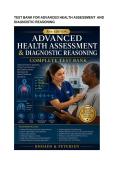
TEST BANK FOR ADVANCED HEALTH ASSESSMENT AND
DIAGNOSTIC REASONING
.
,TABLE OF CONTENTS
Part I: Strategies for Effective Health Assessment
Chapter 1: Interview and History-Taking Strategies ........................................ 1
Chapter 2: Physical Examination Strategies ................................................. 12
Chapter 3: Documentation and Clinical Reasoning ........................................ 25
Chapter 4: Cultural and Spiritual Assessment ............................................... 36
Chapter 5: Nutritional Assessment ............................................................. 49
Part II: Advanced Assessment of Systemic Disorders
Chapter 6: Mental Health Disorders ............................................................ 61
Chapter 7: Integumentary Disorders
Chapter 8: Eye Disorders
Chapter 9: Ear Disorders
Chapter 10: Nose, Sinus, Mouth, and Throat Disorders
Chapter 11: Respiratory Disorders
Chapter 12: Cardiovascular Disorders
Chapter 13: Endocrine Disorders
Chapter 14: Gastrointestinal Disorders
Chapter 15: Male Genitourinary Disorders
Chapter 16: Female Genitourinary Disorders
Chapter 17: Musculoskeletal Disorders
Chapter 18: Neurologic Disorders
Part III: Advanced Clinical Assessment and Diagnostic Reasoning
Chapter 19: Differential Diagnosis and Clinical Decision-Making
Chapter 20: Comprehensive Clinical Reasoning and Advanced Practice Application
Features Included in This Test Bank
,• Advanced NP Board-Certification Style Questions
• NCLEX-Style Multiple-Choice Questions
• Clinical Case Scenarios
• Differential Diagnosis Exercises
• Subjective and Objective Assessment Integration
• Advanced Physical Examination Applications
• Evidence-Based Clinical Reasoning
• Detailed Rationales for Correct and Incorrect Answers
• Health Promotion and Disease Prevention Concepts
• Primary Care and Advanced Practice Focus
• Examination Preparation for Nurse Practitioner Certification
Advanced Health Assessment and Diagnostic Reasoning, 5th Edition
Rhoads & Petersen
Complete Test Bank
Chapter 1: Interview and History-Taking Strategies
Advanced Practice Exam
Question 1
A family nurse practitioner is obtaining a health history from a 52-year-old patient presenting
with fatigue. Which opening statement best facilitates a patient-centered interview?
A. "Tell me everything that is wrong with you."
B. "What brings you in today?"
C. "Do you think your symptoms are caused by stress?"
D. "Let's begin with your medication list."
Correct Answer: B
,Rationale:
Beginning with an open-ended invitation allows the patient to identify the chief concern and
establish priorities for the encounter. Patient-centered interviewing improves information
gathering and strengthens the therapeutic relationship.
Why Not the Other Options?
A. Too broad and may overwhelm the patient.
C. Introduces provider bias and may prematurely influence the patient's response.
D. Medication history is important but should not precede exploration of the chief complaint.
Keywords:
Patient-centered interview, chief complaint, open-ended questions, therapeutic communication,
health history
Question 2
A patient states, "I've had chest pain for three days." Which follow-up question best evaluates
symptom quality?
A. "When did it start?"
B. "How severe is the pain on a scale of 0 to 10?"
C. "Can you describe what the pain feels like?"
D. "What medications have you taken?"
Correct Answer: C
Rationale:
Symptom quality refers to the patient's description of the sensation, such as burning, crushing,
stabbing, pressure, or aching. Understanding quality helps narrow the differential diagnosis.
Why Not the Other Options?
A. Assesses onset.
B. Assesses severity.
D. Evaluates management efforts rather than symptom quality.
Keywords:
Symptom analysis, OLDCARTS, pain assessment, quality of symptoms, differential diagnosis
Question 3
,While interviewing a patient, the nurse practitioner observes that the patient avoids eye
contact, fidgets continuously, and speaks softly. These observations should be documented as:
A. Objective findings
B. Subjective findings
C. Diagnostic conclusions
D. Review of systems findings
Correct Answer: A
Rationale:
Observable behaviors are objective findings because they are directly observed by the clinician
rather than reported by the patient.
Why Not the Other Options?
B. Subjective data are information reported by the patient.
C. Behaviors alone do not establish a diagnosis.
D. Review of systems consists primarily of patient-reported symptoms.
Keywords:
Objective data, nonverbal communication, behavioral observation, assessment findings
Question 4
A patient reports abdominal pain. Which symptom-analysis component is assessed by asking,
"What makes the pain worse?"
A. Severity
B. Timing
C. Aggravating factors
D. Quality
Correct Answer: C
Rationale:
Aggravating factors identify activities, positions, foods, or conditions that increase symptom
intensity and help refine diagnostic reasoning.
Why Not the Other Options?
A. Severity measures intensity.
B. Timing examines onset, duration, and frequency.
,D. Quality describes the nature of the symptom.
Keywords:
Aggravating factors, symptom analysis, abdominal pain, history taking, diagnostic reasoning
Question 5 – Clinical Case Scenario
A 60-year-old man presents with progressive dyspnea. History reveals a 45-pack-year smoking
history and chronic productive cough. Which diagnosis should be highest on the initial
differential diagnosis list?
A. Acute appendicitis
B. Chronic obstructive pulmonary disease
C. Migraine headache
D. Acute otitis media
Correct Answer: B
Rationale:
Long-term tobacco exposure, chronic cough, sputum production, and progressive shortness of
breath strongly suggest COPD.
Why Not the Other Options?
A. Presents with abdominal findings.
C. Does not explain respiratory symptoms.
D. Ear infections are unrelated to chronic pulmonary complaints.
Keywords:
COPD, smoking history, dyspnea, chronic cough, differential diagnosis
Question 6
When collecting a history, which source is considered the most reliable whenever possible?
A. Previous medical records
B. Family members
C. The patient
D. Emergency personnel
Correct Answer: C
,Rationale:
The patient is generally considered the primary and most reliable source of information when
cognitively intact and able to communicate effectively.
Why Not the Other Options?
A. Records may be incomplete or outdated.
B. Family members provide supplemental information.
D. EMS reports are useful but not primary sources.
Keywords:
Primary source, health history, patient interview, reliability of data
Question 7
A nurse practitioner summarizes information at the end of an interview. The primary purpose is
to:
A. Shorten documentation time
B. Verify understanding and accuracy
C. Establish billing requirements
D. End the interview quickly
Correct Answer: B
Rationale:
Summarization allows clarification of information, identification of misunderstandings, and
confirmation that the clinician accurately understood the patient's concerns.
Why Not the Other Options?
A. Documentation requirements remain unchanged.
C. Billing is not the primary purpose.
D. The goal is improved communication, not efficiency.
Keywords:
Summarization, communication, patient interview, validation, history-taking
Question 8
A patient says, "I think I'm having heart failure because my father had it." Which response
demonstrates appropriate diagnostic reasoning?
,A. "You probably have heart failure."
B. "Let's discuss your symptoms and medical history before drawing conclusions."
C. "Your father had it, so you likely have it too."
D. "Heart failure is uncommon."
Correct Answer: B
Rationale:
Diagnostic reasoning requires systematic data collection before establishing or excluding
diagnoses.
Why Not the Other Options?
A. Premature conclusion.
C. Family history alone is insufficient.
D. May be inaccurate and dismissive.
Keywords:
Diagnostic reasoning, family history, clinical judgment, differential diagnosis
Question 9
Which interviewing technique is most likely to encourage elaboration?
A. "Tell me more about that."
B. "Yes or no?"
C. "Do you smoke?"
D. "Have you ever been hospitalized?"
Correct Answer: A
Rationale:
Facilitation encourages the patient to continue discussing important concerns and often yields
richer clinical information.
Why Not the Other Options?
B, C, D. Closed-ended questions limit responses.
Keywords:
Facilitation, therapeutic communication, open-ended questions, patient-centered care
, Question 10
A patient's chief complaint is best defined as:
A. The diagnosis established during the visit
B. The primary reason the patient seeks care
C. The most serious illness in the family history
D. The clinician's major concern
Correct Answer: B
Rationale:
The chief complaint is the reason for the visit as stated by the patient and serves as the focus of
further assessment.
Why Not the Other Options?
A. Diagnosis occurs later.
C. Family history is separate.
D. The complaint belongs to the patient, not the clinician.
Keywords:
Chief complaint, health history, patient concerns, assessment process
Question 11
A nurse practitioner is obtaining a history from a 70-year-old patient who reports dizziness.
Which question best evaluates the symptom's severity?
A. "When did the dizziness begin?"
B. "Can you rate how severe the dizziness is on a scale of 0 to 10?"
C. "What does the dizziness feel like?"
D. "How often does the dizziness occur?"
Correct Answer: B
Rationale:
Severity assessment helps determine symptom intensity and its impact on function.
Understanding severity assists with prioritization of care and clinical decision-making.
Why Not the Other Options?
A. Evaluates onset.
DIAGNOSTIC REASONING
.
,TABLE OF CONTENTS
Part I: Strategies for Effective Health Assessment
Chapter 1: Interview and History-Taking Strategies ........................................ 1
Chapter 2: Physical Examination Strategies ................................................. 12
Chapter 3: Documentation and Clinical Reasoning ........................................ 25
Chapter 4: Cultural and Spiritual Assessment ............................................... 36
Chapter 5: Nutritional Assessment ............................................................. 49
Part II: Advanced Assessment of Systemic Disorders
Chapter 6: Mental Health Disorders ............................................................ 61
Chapter 7: Integumentary Disorders
Chapter 8: Eye Disorders
Chapter 9: Ear Disorders
Chapter 10: Nose, Sinus, Mouth, and Throat Disorders
Chapter 11: Respiratory Disorders
Chapter 12: Cardiovascular Disorders
Chapter 13: Endocrine Disorders
Chapter 14: Gastrointestinal Disorders
Chapter 15: Male Genitourinary Disorders
Chapter 16: Female Genitourinary Disorders
Chapter 17: Musculoskeletal Disorders
Chapter 18: Neurologic Disorders
Part III: Advanced Clinical Assessment and Diagnostic Reasoning
Chapter 19: Differential Diagnosis and Clinical Decision-Making
Chapter 20: Comprehensive Clinical Reasoning and Advanced Practice Application
Features Included in This Test Bank
,• Advanced NP Board-Certification Style Questions
• NCLEX-Style Multiple-Choice Questions
• Clinical Case Scenarios
• Differential Diagnosis Exercises
• Subjective and Objective Assessment Integration
• Advanced Physical Examination Applications
• Evidence-Based Clinical Reasoning
• Detailed Rationales for Correct and Incorrect Answers
• Health Promotion and Disease Prevention Concepts
• Primary Care and Advanced Practice Focus
• Examination Preparation for Nurse Practitioner Certification
Advanced Health Assessment and Diagnostic Reasoning, 5th Edition
Rhoads & Petersen
Complete Test Bank
Chapter 1: Interview and History-Taking Strategies
Advanced Practice Exam
Question 1
A family nurse practitioner is obtaining a health history from a 52-year-old patient presenting
with fatigue. Which opening statement best facilitates a patient-centered interview?
A. "Tell me everything that is wrong with you."
B. "What brings you in today?"
C. "Do you think your symptoms are caused by stress?"
D. "Let's begin with your medication list."
Correct Answer: B
,Rationale:
Beginning with an open-ended invitation allows the patient to identify the chief concern and
establish priorities for the encounter. Patient-centered interviewing improves information
gathering and strengthens the therapeutic relationship.
Why Not the Other Options?
A. Too broad and may overwhelm the patient.
C. Introduces provider bias and may prematurely influence the patient's response.
D. Medication history is important but should not precede exploration of the chief complaint.
Keywords:
Patient-centered interview, chief complaint, open-ended questions, therapeutic communication,
health history
Question 2
A patient states, "I've had chest pain for three days." Which follow-up question best evaluates
symptom quality?
A. "When did it start?"
B. "How severe is the pain on a scale of 0 to 10?"
C. "Can you describe what the pain feels like?"
D. "What medications have you taken?"
Correct Answer: C
Rationale:
Symptom quality refers to the patient's description of the sensation, such as burning, crushing,
stabbing, pressure, or aching. Understanding quality helps narrow the differential diagnosis.
Why Not the Other Options?
A. Assesses onset.
B. Assesses severity.
D. Evaluates management efforts rather than symptom quality.
Keywords:
Symptom analysis, OLDCARTS, pain assessment, quality of symptoms, differential diagnosis
Question 3
,While interviewing a patient, the nurse practitioner observes that the patient avoids eye
contact, fidgets continuously, and speaks softly. These observations should be documented as:
A. Objective findings
B. Subjective findings
C. Diagnostic conclusions
D. Review of systems findings
Correct Answer: A
Rationale:
Observable behaviors are objective findings because they are directly observed by the clinician
rather than reported by the patient.
Why Not the Other Options?
B. Subjective data are information reported by the patient.
C. Behaviors alone do not establish a diagnosis.
D. Review of systems consists primarily of patient-reported symptoms.
Keywords:
Objective data, nonverbal communication, behavioral observation, assessment findings
Question 4
A patient reports abdominal pain. Which symptom-analysis component is assessed by asking,
"What makes the pain worse?"
A. Severity
B. Timing
C. Aggravating factors
D. Quality
Correct Answer: C
Rationale:
Aggravating factors identify activities, positions, foods, or conditions that increase symptom
intensity and help refine diagnostic reasoning.
Why Not the Other Options?
A. Severity measures intensity.
B. Timing examines onset, duration, and frequency.
,D. Quality describes the nature of the symptom.
Keywords:
Aggravating factors, symptom analysis, abdominal pain, history taking, diagnostic reasoning
Question 5 – Clinical Case Scenario
A 60-year-old man presents with progressive dyspnea. History reveals a 45-pack-year smoking
history and chronic productive cough. Which diagnosis should be highest on the initial
differential diagnosis list?
A. Acute appendicitis
B. Chronic obstructive pulmonary disease
C. Migraine headache
D. Acute otitis media
Correct Answer: B
Rationale:
Long-term tobacco exposure, chronic cough, sputum production, and progressive shortness of
breath strongly suggest COPD.
Why Not the Other Options?
A. Presents with abdominal findings.
C. Does not explain respiratory symptoms.
D. Ear infections are unrelated to chronic pulmonary complaints.
Keywords:
COPD, smoking history, dyspnea, chronic cough, differential diagnosis
Question 6
When collecting a history, which source is considered the most reliable whenever possible?
A. Previous medical records
B. Family members
C. The patient
D. Emergency personnel
Correct Answer: C
,Rationale:
The patient is generally considered the primary and most reliable source of information when
cognitively intact and able to communicate effectively.
Why Not the Other Options?
A. Records may be incomplete or outdated.
B. Family members provide supplemental information.
D. EMS reports are useful but not primary sources.
Keywords:
Primary source, health history, patient interview, reliability of data
Question 7
A nurse practitioner summarizes information at the end of an interview. The primary purpose is
to:
A. Shorten documentation time
B. Verify understanding and accuracy
C. Establish billing requirements
D. End the interview quickly
Correct Answer: B
Rationale:
Summarization allows clarification of information, identification of misunderstandings, and
confirmation that the clinician accurately understood the patient's concerns.
Why Not the Other Options?
A. Documentation requirements remain unchanged.
C. Billing is not the primary purpose.
D. The goal is improved communication, not efficiency.
Keywords:
Summarization, communication, patient interview, validation, history-taking
Question 8
A patient says, "I think I'm having heart failure because my father had it." Which response
demonstrates appropriate diagnostic reasoning?
,A. "You probably have heart failure."
B. "Let's discuss your symptoms and medical history before drawing conclusions."
C. "Your father had it, so you likely have it too."
D. "Heart failure is uncommon."
Correct Answer: B
Rationale:
Diagnostic reasoning requires systematic data collection before establishing or excluding
diagnoses.
Why Not the Other Options?
A. Premature conclusion.
C. Family history alone is insufficient.
D. May be inaccurate and dismissive.
Keywords:
Diagnostic reasoning, family history, clinical judgment, differential diagnosis
Question 9
Which interviewing technique is most likely to encourage elaboration?
A. "Tell me more about that."
B. "Yes or no?"
C. "Do you smoke?"
D. "Have you ever been hospitalized?"
Correct Answer: A
Rationale:
Facilitation encourages the patient to continue discussing important concerns and often yields
richer clinical information.
Why Not the Other Options?
B, C, D. Closed-ended questions limit responses.
Keywords:
Facilitation, therapeutic communication, open-ended questions, patient-centered care
, Question 10
A patient's chief complaint is best defined as:
A. The diagnosis established during the visit
B. The primary reason the patient seeks care
C. The most serious illness in the family history
D. The clinician's major concern
Correct Answer: B
Rationale:
The chief complaint is the reason for the visit as stated by the patient and serves as the focus of
further assessment.
Why Not the Other Options?
A. Diagnosis occurs later.
C. Family history is separate.
D. The complaint belongs to the patient, not the clinician.
Keywords:
Chief complaint, health history, patient concerns, assessment process
Question 11
A nurse practitioner is obtaining a history from a 70-year-old patient who reports dizziness.
Which question best evaluates the symptom's severity?
A. "When did the dizziness begin?"
B. "Can you rate how severe the dizziness is on a scale of 0 to 10?"
C. "What does the dizziness feel like?"
D. "How often does the dizziness occur?"
Correct Answer: B
Rationale:
Severity assessment helps determine symptom intensity and its impact on function.
Understanding severity assists with prioritization of care and clinical decision-making.
Why Not the Other Options?
A. Evaluates onset.