

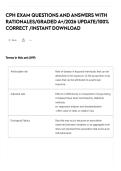
CPH EXAM QUESTIONS AND ANSWERS WITH
RATIONALES/GRADED A+/2026 UPDATE/100%
CORRECT /INSTANT DOWNLOAD
Save
Terms in this set (499)
Attributable risk Rate of disease in exposed individuals that can be
attributed to the exposure. Or the proportion of all
cases that can be attributed to a particular
exposure.
Adjusted rate Effects of differences in composition of pops being
compared have been minimized by statistical
methods.
ex: regression analysis and strandardization
-often used on rates or relative risks
Ecological Fallacy Bias that may occur because an association
observed between variables or an aggregate level
does not represent the association that exists at an
individual level
, Confidence Interval 95% confident that the true value of a variable is
contained within the interval.
-used to account for sampling variability
-it is a point estimate +_ margin of error, where the
point estimate is the best estimate of teh unknown
parameter and the margin of error is the product of
the confidence level and the standard error.
if a 95% CI for the differences in mean does not
include 0 (the null value) then there is eveidence of
a statistically significant difference at sigma=0.05
Clinical Trial Phases 1. Safety and Pharmacologic profiles
2. pilot efficacy studies
3. extensive clinical trials
4. after the FDA approves, look at specific effects
to establish incidence of adverse reactions, etc.
longterm use effects.
interpretation of studies temporality: cause precedes effect
Specificity: important in assessing the possibility of
biases.
Consistency: several studies showing similar results.
homogeneity statistically.
Confounders -non-causal association between exposure and
outcome as a result of a third variable.
-distortion of effect by other factors
-must be related to exposure AND outcome
-not an intermediate variable on causal pathway
RATIONALES/GRADED A+/2026 UPDATE/100%
CORRECT /INSTANT DOWNLOAD
Save
Terms in this set (499)
Attributable risk Rate of disease in exposed individuals that can be
attributed to the exposure. Or the proportion of all
cases that can be attributed to a particular
exposure.
Adjusted rate Effects of differences in composition of pops being
compared have been minimized by statistical
methods.
ex: regression analysis and strandardization
-often used on rates or relative risks
Ecological Fallacy Bias that may occur because an association
observed between variables or an aggregate level
does not represent the association that exists at an
individual level
, Confidence Interval 95% confident that the true value of a variable is
contained within the interval.
-used to account for sampling variability
-it is a point estimate +_ margin of error, where the
point estimate is the best estimate of teh unknown
parameter and the margin of error is the product of
the confidence level and the standard error.
if a 95% CI for the differences in mean does not
include 0 (the null value) then there is eveidence of
a statistically significant difference at sigma=0.05
Clinical Trial Phases 1. Safety and Pharmacologic profiles
2. pilot efficacy studies
3. extensive clinical trials
4. after the FDA approves, look at specific effects
to establish incidence of adverse reactions, etc.
longterm use effects.
interpretation of studies temporality: cause precedes effect
Specificity: important in assessing the possibility of
biases.
Consistency: several studies showing similar results.
homogeneity statistically.
Confounders -non-causal association between exposure and
outcome as a result of a third variable.
-distortion of effect by other factors
-must be related to exposure AND outcome
-not an intermediate variable on causal pathway

