

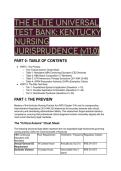
THE ELITE UNIVERSAL
TEST BANK: KENTUCKY
NURSING
JURISPRUDENCE (v11.0)
PART 0: TABLE OF CONTENTS
● PART I: The Preview
○ The "Critical Axioms" Cheat Sheet
○ Table 1: Mandatory KBN Continuing Education (CE) Directives
○ Table 2: KBN Board Composition (17 Members)
○ Table 3: LPN Intravenous Therapy Exclusions (201 KAR 20:490)
○ Table 4: APRN Prescriptive Authority (CAPA) Exemption Criteria
● PART II: The Elite Test Bank
○ Tier 1: Foundational Syntax & Application (Questions 1–10)
○ Tier 2: Complex Application & Simulation (Questions 11–20)
○ Tier 3: Grandmaster Synthesis (Questions 21–30)
PART I: THE PREVIEW
Mastery of the Kentucky Nursing Practice Act (KRS Chapter 314) and its corresponding
Administrative Regulations (201 KAR 20) determines the boundary between elite clinical
autonomy and devastating administrative liability. This assessment forges absolute statutory
competence, ensuring that professional clinical judgment remains irreversibly aligned with the
most current Kentucky legal mandates.
The "Critical Axioms" Cheat Sheet
The following structured data tables represent the non-negotiable legal frameworks governing
nursing practice within the Commonwealth of Kentucky.
KBN Continuing Hour Requirement Timeframe / Frequency Regulatory Citation
Education (CE)
Mandates
Annual General CE 14 Contact Hours Annually (by Oct 31) KRS 314.073
Requirement
Domestic Violence 3 Contact Hours Once (within first 3 KRS 314.073
years)
,KBN Continuing Hour Requirement Timeframe / Frequency Regulatory Citation
Education (CE)
Mandates
Pediatric Abusive 1.5 Contact Hours Once (within first 3 KRS 314.073(6)
Head Trauma years)
Suicide Prevention 2 Contact Hours One-time requirement 201 KAR 20:215
Implicit Bias 1.5 Contact Hours One-time requirement 201 KAR 20:215
Alzheimer's Disease / 1 Contact Hour One-time requirement KRS 314.073(7)
Dementia
APRN Pharmacology 5 Contact Hours Annually (3 hrs must be KRS 314.073(8)
Requirement in pain
management/addiction
if DEA registered)
KBN Board Composition (17 Representation Quota Statutory Role Focus
Appointed Members)
Registered Nurses (RN) 10 Members 3 Clinical, 1 Admin, 4
Educators, 2 Long-Term Care
Advanced Practice 3 Members 3 Clinical Practice (Must
Registered Nurses (APRN) include at least 1 CRNA)
Licensed Practical Nurses 2 Members 2 Clinical Practice
(LPN)
Citizens at Large 2 Members Public representatives with no
financial ties to healthcare
LPN Intravenous Therapy Absolute Exclusions Regulatory Prohibition Rationale
(201 KAR 20:490)
Procedural Sedation / Anesthesia Decreased consciousness requires
independent RN airway assessment.
Antineoplastic Agents (Chemotherapy) High toxicity and extravasation risk demand
independent RN management.
Arterial Lines / Implanted Arterial Ports Hemodynamic instability risk exceeds
dependent scope.
Central Venous Device (Hemodynamic Complex hemodynamic data interpretation is an
Monitoring) independent RN function.
Tissue Plasminogen Activators Prohibited for systemic use; allowed only to
declot a central venous device.
APRN Prescriptive Authority (CAPA) Exemption Mandatory Requirements for Exemption
Criteria
CAPA-NS (Non-Scheduled Legend Drugs) Notification to KBN after 4 years of prescribing.
CAPA-CS (Controlled Substances - SB 94) 4 years of prescribing CS, active DEA
registration, active KASPER master account,
fee payment, license in good standing.
First-Year APRN CAPA-CS Restrictions Quarterly documented meetings with
collaborating physician to review reverse
, APRN Prescriptive Authority (CAPA) Exemption Mandatory Requirements for Exemption
Criteria
KASPER reports.
PART II: THE ELITE TEST BANK
Tier 1: Foundational Syntax & Application
Q1: A Registered Nurse receives a final judgment for a Driving Under the Influence (DUI)
misdemeanor. Based on the principles of the Kentucky Nursing Laws regarding mandatory
reporting, which action/conclusion is the MOST ACCURATE? A) The licensee must report the
conviction prior to their next annual license renewal to avoid disciplinary action. B) The licensee
must report the conviction within 90 days of the final judgment, as DUIs are considered severe
traffic violations. C) The licensee must report the conviction in writing to the KBN within 30 days
of the entry of the final judgment. D) The licensee is exempt from reporting the conviction, as
traffic-related misdemeanors fall outside KBN jurisdiction.
● The Answer: C (The licensee must report the conviction in writing to the KBN within 30
days of the entry of the final judgment.)
● Distractor Analysis:
○ A is incorrect: Delaying the report until the annual license renewal constitutes a
failure to report, which is a secondary violation of the law.
○ B is incorrect: While 90 days was a legacy reporting standard, recent statutory
updates (KRS 314.109) explicitly reduced the reporting window to 30 days.
○ D is incorrect: Standard traffic violations are exempt, but a DUI is specifically
classified as a reportable misdemeanor under KBN guidelines.
The Mentor's Analysis: The regulatory board demands real-time transparency regarding
off-duty conduct that suggests impaired judgment. A DUI directly impacts the presumption of
clinical safety. By utilizing the 30-Day Reporting Mandate, the practitioner bypasses the
common trap of assuming legacy timelines or traffic exemptions apply. Professional/Academic
Intuition: Criminal convictions and out-of-state discipline operate on a strict 30-day
reporting clock.
Q2: A nursing graduate is issued a Provisional License (RNA) while awaiting NCLEX-RN
results. The candidate is subsequently unsuccessful on their second NCLEX attempt. Based on
the principles of KBN provisional licensure, which action/conclusion is the MOST ACCURATE?
A) The provisional license remains valid until the standard six-month expiration date. B) The
individual may continue to work provided their supervising RN physically co-signs all patient
documentation. C) The provisional license is immediately voided, and the individual must cease
practicing in a licensed nursing position. D) The provisional license is administratively converted
to a State Registered Nurse Aide (SRNA) certification to maintain facility staffing.
● The Answer: C (The provisional license is immediately voided, and the individual must
cease practicing in a licensed nursing position.)
● Distractor Analysis:
○ A is incorrect: The six-month expiration rule is superseded the moment a second
failure is registered by the board.
○ B is incorrect: Direct supervision is required during valid provisional licensure, but
cannot override a legally voided license.
○ D is incorrect: Licensure classes do not automatically downgrade. SRNA
certification requires an entirely separate credentialing process.
TEST BANK: KENTUCKY
NURSING
JURISPRUDENCE (v11.0)
PART 0: TABLE OF CONTENTS
● PART I: The Preview
○ The "Critical Axioms" Cheat Sheet
○ Table 1: Mandatory KBN Continuing Education (CE) Directives
○ Table 2: KBN Board Composition (17 Members)
○ Table 3: LPN Intravenous Therapy Exclusions (201 KAR 20:490)
○ Table 4: APRN Prescriptive Authority (CAPA) Exemption Criteria
● PART II: The Elite Test Bank
○ Tier 1: Foundational Syntax & Application (Questions 1–10)
○ Tier 2: Complex Application & Simulation (Questions 11–20)
○ Tier 3: Grandmaster Synthesis (Questions 21–30)
PART I: THE PREVIEW
Mastery of the Kentucky Nursing Practice Act (KRS Chapter 314) and its corresponding
Administrative Regulations (201 KAR 20) determines the boundary between elite clinical
autonomy and devastating administrative liability. This assessment forges absolute statutory
competence, ensuring that professional clinical judgment remains irreversibly aligned with the
most current Kentucky legal mandates.
The "Critical Axioms" Cheat Sheet
The following structured data tables represent the non-negotiable legal frameworks governing
nursing practice within the Commonwealth of Kentucky.
KBN Continuing Hour Requirement Timeframe / Frequency Regulatory Citation
Education (CE)
Mandates
Annual General CE 14 Contact Hours Annually (by Oct 31) KRS 314.073
Requirement
Domestic Violence 3 Contact Hours Once (within first 3 KRS 314.073
years)
,KBN Continuing Hour Requirement Timeframe / Frequency Regulatory Citation
Education (CE)
Mandates
Pediatric Abusive 1.5 Contact Hours Once (within first 3 KRS 314.073(6)
Head Trauma years)
Suicide Prevention 2 Contact Hours One-time requirement 201 KAR 20:215
Implicit Bias 1.5 Contact Hours One-time requirement 201 KAR 20:215
Alzheimer's Disease / 1 Contact Hour One-time requirement KRS 314.073(7)
Dementia
APRN Pharmacology 5 Contact Hours Annually (3 hrs must be KRS 314.073(8)
Requirement in pain
management/addiction
if DEA registered)
KBN Board Composition (17 Representation Quota Statutory Role Focus
Appointed Members)
Registered Nurses (RN) 10 Members 3 Clinical, 1 Admin, 4
Educators, 2 Long-Term Care
Advanced Practice 3 Members 3 Clinical Practice (Must
Registered Nurses (APRN) include at least 1 CRNA)
Licensed Practical Nurses 2 Members 2 Clinical Practice
(LPN)
Citizens at Large 2 Members Public representatives with no
financial ties to healthcare
LPN Intravenous Therapy Absolute Exclusions Regulatory Prohibition Rationale
(201 KAR 20:490)
Procedural Sedation / Anesthesia Decreased consciousness requires
independent RN airway assessment.
Antineoplastic Agents (Chemotherapy) High toxicity and extravasation risk demand
independent RN management.
Arterial Lines / Implanted Arterial Ports Hemodynamic instability risk exceeds
dependent scope.
Central Venous Device (Hemodynamic Complex hemodynamic data interpretation is an
Monitoring) independent RN function.
Tissue Plasminogen Activators Prohibited for systemic use; allowed only to
declot a central venous device.
APRN Prescriptive Authority (CAPA) Exemption Mandatory Requirements for Exemption
Criteria
CAPA-NS (Non-Scheduled Legend Drugs) Notification to KBN after 4 years of prescribing.
CAPA-CS (Controlled Substances - SB 94) 4 years of prescribing CS, active DEA
registration, active KASPER master account,
fee payment, license in good standing.
First-Year APRN CAPA-CS Restrictions Quarterly documented meetings with
collaborating physician to review reverse
, APRN Prescriptive Authority (CAPA) Exemption Mandatory Requirements for Exemption
Criteria
KASPER reports.
PART II: THE ELITE TEST BANK
Tier 1: Foundational Syntax & Application
Q1: A Registered Nurse receives a final judgment for a Driving Under the Influence (DUI)
misdemeanor. Based on the principles of the Kentucky Nursing Laws regarding mandatory
reporting, which action/conclusion is the MOST ACCURATE? A) The licensee must report the
conviction prior to their next annual license renewal to avoid disciplinary action. B) The licensee
must report the conviction within 90 days of the final judgment, as DUIs are considered severe
traffic violations. C) The licensee must report the conviction in writing to the KBN within 30 days
of the entry of the final judgment. D) The licensee is exempt from reporting the conviction, as
traffic-related misdemeanors fall outside KBN jurisdiction.
● The Answer: C (The licensee must report the conviction in writing to the KBN within 30
days of the entry of the final judgment.)
● Distractor Analysis:
○ A is incorrect: Delaying the report until the annual license renewal constitutes a
failure to report, which is a secondary violation of the law.
○ B is incorrect: While 90 days was a legacy reporting standard, recent statutory
updates (KRS 314.109) explicitly reduced the reporting window to 30 days.
○ D is incorrect: Standard traffic violations are exempt, but a DUI is specifically
classified as a reportable misdemeanor under KBN guidelines.
The Mentor's Analysis: The regulatory board demands real-time transparency regarding
off-duty conduct that suggests impaired judgment. A DUI directly impacts the presumption of
clinical safety. By utilizing the 30-Day Reporting Mandate, the practitioner bypasses the
common trap of assuming legacy timelines or traffic exemptions apply. Professional/Academic
Intuition: Criminal convictions and out-of-state discipline operate on a strict 30-day
reporting clock.
Q2: A nursing graduate is issued a Provisional License (RNA) while awaiting NCLEX-RN
results. The candidate is subsequently unsuccessful on their second NCLEX attempt. Based on
the principles of KBN provisional licensure, which action/conclusion is the MOST ACCURATE?
A) The provisional license remains valid until the standard six-month expiration date. B) The
individual may continue to work provided their supervising RN physically co-signs all patient
documentation. C) The provisional license is immediately voided, and the individual must cease
practicing in a licensed nursing position. D) The provisional license is administratively converted
to a State Registered Nurse Aide (SRNA) certification to maintain facility staffing.
● The Answer: C (The provisional license is immediately voided, and the individual must
cease practicing in a licensed nursing position.)
● Distractor Analysis:
○ A is incorrect: The six-month expiration rule is superseded the moment a second
failure is registered by the board.
○ B is incorrect: Direct supervision is required during valid provisional licensure, but
cannot override a legally voided license.
○ D is incorrect: Licensure classes do not automatically downgrade. SRNA
certification requires an entirely separate credentialing process.

