

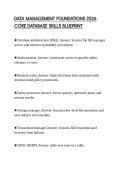
DATA MANAGEMENT FOUNDATIONS 2026
CORE DATABASE SKILLS BLUEPRINT
◉ Database administrator (DBA). Answer: Secures the DB, manages
access, and enforces availability procedures.
◉ Authorization. Answer: Limits user access to specific tables,
columns, or rows.
◉ Business rules. Answer: Rules that keep data consistent with
structural and policy constraints.
◉ Query processor. Answer: Parses queries, optimizes plans, and
returns results.
◉ Storage manager. Answer: Executes low-level file operations and
uses indexes to locate data.
◉ Transaction manager. Answer: Ensures ACID execution and
recovery from failures.
◉ CRUD: INSERT. Answer: Adds new rows to a table.
,◉ CRUD: SELECT. Answer: Retrieves data from a table.
◉ CRUD: UPDATE. Answer: Modifies existing rows in a table.
◉ CRUD: DELETE. Answer: Removes rows from a table.
◉ CREATE TABLE. Answer: Defines a new table with columns and
data types.
◉ DROP TABLE. Answer: Deletes a table and all its rows.
◉ ALTER TABLE. Answer: Adds, drops, or modifies columns or
constraints of a table.
◉ INT. Answer: Data type for integers.
◉ DECIMAL(M,D). Answer: Data type for fixed-precision numbers.
◉ VARCHAR(N). Answer: Data type for variable-length text up to N
chars.
◉ DATE. Answer: Data type for year, month, day.
, ◉ Tuple. Answer: Ordered list of values; order matters.
◉ Table. Answer: Set of rows with a fixed tuple of columns; rows
have no inherent order.
◉ Row (record, tuple). Answer: Unordered tuple of values matching
the table's columns.
◉ Column (field, attribute). Answer: Named data element with a
data type.
◉ SQL sublanguages. Answer: DDL, DQL, DML, DCL, DTL.
◉ DDL. Answer: Defines database structures.
◉ DQL. Answer: Retrieves data (e.g., SELECT).
◉ DML. Answer: Inserts, updates, deletes data.
◉ DCL. Answer: Controls user access to data.
CORE DATABASE SKILLS BLUEPRINT
◉ Database administrator (DBA). Answer: Secures the DB, manages
access, and enforces availability procedures.
◉ Authorization. Answer: Limits user access to specific tables,
columns, or rows.
◉ Business rules. Answer: Rules that keep data consistent with
structural and policy constraints.
◉ Query processor. Answer: Parses queries, optimizes plans, and
returns results.
◉ Storage manager. Answer: Executes low-level file operations and
uses indexes to locate data.
◉ Transaction manager. Answer: Ensures ACID execution and
recovery from failures.
◉ CRUD: INSERT. Answer: Adds new rows to a table.
,◉ CRUD: SELECT. Answer: Retrieves data from a table.
◉ CRUD: UPDATE. Answer: Modifies existing rows in a table.
◉ CRUD: DELETE. Answer: Removes rows from a table.
◉ CREATE TABLE. Answer: Defines a new table with columns and
data types.
◉ DROP TABLE. Answer: Deletes a table and all its rows.
◉ ALTER TABLE. Answer: Adds, drops, or modifies columns or
constraints of a table.
◉ INT. Answer: Data type for integers.
◉ DECIMAL(M,D). Answer: Data type for fixed-precision numbers.
◉ VARCHAR(N). Answer: Data type for variable-length text up to N
chars.
◉ DATE. Answer: Data type for year, month, day.
, ◉ Tuple. Answer: Ordered list of values; order matters.
◉ Table. Answer: Set of rows with a fixed tuple of columns; rows
have no inherent order.
◉ Row (record, tuple). Answer: Unordered tuple of values matching
the table's columns.
◉ Column (field, attribute). Answer: Named data element with a
data type.
◉ SQL sublanguages. Answer: DDL, DQL, DML, DCL, DTL.
◉ DDL. Answer: Defines database structures.
◉ DQL. Answer: Retrieves data (e.g., SELECT).
◉ DML. Answer: Inserts, updates, deletes data.
◉ DCL. Answer: Controls user access to data.


