

Google Cloud Professional Data Engineer Study Guide 2026/2027 | Data Architecture, BigQuery & ML Pipelines Concept Review | Updated 2026/2027 | Page 1 | Passing Score: 70%
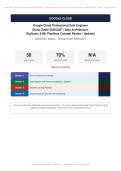
GOOGLE CLOUD
Google Cloud Professional Data Engineer
Study Guide 2026/2027 | Data Architecture,
BigQuery & ML Pipelines Concept Review | Updated
2026/2027 Edition · Official Exam 2026/2027
50 70% N/A
QUESTIONS PASSING SCORE RECERTIFICATION
TABLE OF CONTENTS
Section 1 Data Architecture and Design Q1-Q13
Section 2 Data Ingestion and Processing (BigQuery, Dataflow) Q14-Q26
Section 3 Machine Learning Pipelines Q27-Q39
Section 4 Data Governance, Security, and Compliance Q40-Q50
Instructions: Select the single best answer for each question. This exam is designed for Google Cloud Professional Data
Engineer certification preparation. Passing score: 70% (35 questions correct).
Google Cloud Data Engineer — 2026/2027 | Passing Score: 70% | Page 1 of 28
, SECTION 1 | Data Architecture and Design | Q1-Q13 | Google Cloud Data Engineer 2026/2027
Q1 Question 1 of 50
A retail company needs to design a data platform on Google Cloud that processes both
real-time clickstream data and nightly batch sales reports. The data engineering team must
choose an architecture that handles both streaming and batch workloads efficiently. Google
recommends which approach for this unified processing requirement?
A. Build separate pipelines using Dataflow for streaming and Dataproc for batch
B. Implement the Lambda architecture with separate speed and batch layers
C. Use a unified Dataflow pipeline that supports both streaming and batch with the same
codebase
D. Store all data in Cloud SQL and run periodic ETL jobs with Cloud Functions
Correct Answer: C
Rationale:
Google recommends the unified Dataflow approach (based on the Beam model) that handles both
streaming and batch processing with the same codebase, avoiding the complexity and data duplication of
maintaining separate Lambda layers. The Lambda architecture requires maintaining two independent
codepaths and reconciling results, which increases operational overhead.
Q2 Question 2 of 50
A financial services firm stores transaction data in Cloud Spanner and needs to replicate it
across three continents for low-latency reads and disaster recovery. The database
administrator must ensure strong consistency across all regions. Cloud Spanner provides
which capability that makes this possible?
A. Eventual consistency with multi-master replication across regions
B. Synchronous replication with external consistency across regions using TrueTime
C. Asynchronous replication with conflict resolution at the application layer
D. Sharded MongoDB clusters deployed across multiple regions
Correct Answer: B
Rationale:
Cloud Spanner uses Google's TrueTime technology to provide external consistency (the strongest
consistency model) across regions with synchronous replication, ensuring all reads see the latest writes
regardless of region. Eventual consistency models, like those used in some NoSQL databases, cannot
guarantee that reads immediately reflect the latest writes.
Google Cloud Data Engineer — 2026/2027 | Passing Score: 70% | Page 2 of 28
, Q3 Question 3 of 50
A healthcare analytics company needs to store 10 TB of patient imaging data that is
accessed infrequently but must be retrievable within 12 hours when needed. Cost
optimization is the primary concern. The data architect should choose which storage class?
A. Cloud Storage Standard class
B. Cloud Storage Nearline class
C. Cloud Storage Coldline class
D. Cloud Storage Archive class
Correct Answer: C
Rationale:
Archive class is the lowest-cost storage tier designed for data accessed less than once a year, with a
12-hour retrieval time that meets the requirement. Coldline has a lower retrieval time (minutes) but higher
storage cost, and Nearline is for data accessed once per month. Standard is the most expensive for
infrequently accessed data.
Q4 Question 4 of 50
A data engineer is designing a star schema for a BigQuery data warehouse that will support
analytical queries across sales, products, and regions. The fact table will contain 500 million
rows updated daily. Dimension tables are relatively small and change slowly. The engineer
should use which modeling technique for the dimension tables?
A. Type 1 SCD (overwrite) for all dimensions
B. Type 2 SCD (add new row with versioning) for dimensions that require historical
tracking
C. Snowflake schema normalization to reduce redundancy
D. Denormalize all dimensions into the fact table as a single wide table
Correct Answer: B
Rationale:
Type 2 SCD preserves historical records by adding new rows with effective dates when dimension
attributes change, which is essential for accurate historical analysis. Type 1 overwrites lose history,
snowflake normalization increases join complexity and query cost, and full denormalization creates
massive redundancy that increases storage and maintenance costs.
Google Cloud Data Engineer — 2026/2027 | Passing Score: 70% | Page 3 of 28
GOOGLE CLOUD
Google Cloud Professional Data Engineer
Study Guide 2026/2027 | Data Architecture,
BigQuery & ML Pipelines Concept Review | Updated
2026/2027 Edition · Official Exam 2026/2027
50 70% N/A
QUESTIONS PASSING SCORE RECERTIFICATION
TABLE OF CONTENTS
Section 1 Data Architecture and Design Q1-Q13
Section 2 Data Ingestion and Processing (BigQuery, Dataflow) Q14-Q26
Section 3 Machine Learning Pipelines Q27-Q39
Section 4 Data Governance, Security, and Compliance Q40-Q50
Instructions: Select the single best answer for each question. This exam is designed for Google Cloud Professional Data
Engineer certification preparation. Passing score: 70% (35 questions correct).
Google Cloud Data Engineer — 2026/2027 | Passing Score: 70% | Page 1 of 28
, SECTION 1 | Data Architecture and Design | Q1-Q13 | Google Cloud Data Engineer 2026/2027
Q1 Question 1 of 50
A retail company needs to design a data platform on Google Cloud that processes both
real-time clickstream data and nightly batch sales reports. The data engineering team must
choose an architecture that handles both streaming and batch workloads efficiently. Google
recommends which approach for this unified processing requirement?
A. Build separate pipelines using Dataflow for streaming and Dataproc for batch
B. Implement the Lambda architecture with separate speed and batch layers
C. Use a unified Dataflow pipeline that supports both streaming and batch with the same
codebase
D. Store all data in Cloud SQL and run periodic ETL jobs with Cloud Functions
Correct Answer: C
Rationale:
Google recommends the unified Dataflow approach (based on the Beam model) that handles both
streaming and batch processing with the same codebase, avoiding the complexity and data duplication of
maintaining separate Lambda layers. The Lambda architecture requires maintaining two independent
codepaths and reconciling results, which increases operational overhead.
Q2 Question 2 of 50
A financial services firm stores transaction data in Cloud Spanner and needs to replicate it
across three continents for low-latency reads and disaster recovery. The database
administrator must ensure strong consistency across all regions. Cloud Spanner provides
which capability that makes this possible?
A. Eventual consistency with multi-master replication across regions
B. Synchronous replication with external consistency across regions using TrueTime
C. Asynchronous replication with conflict resolution at the application layer
D. Sharded MongoDB clusters deployed across multiple regions
Correct Answer: B
Rationale:
Cloud Spanner uses Google's TrueTime technology to provide external consistency (the strongest
consistency model) across regions with synchronous replication, ensuring all reads see the latest writes
regardless of region. Eventual consistency models, like those used in some NoSQL databases, cannot
guarantee that reads immediately reflect the latest writes.
Google Cloud Data Engineer — 2026/2027 | Passing Score: 70% | Page 2 of 28
, Q3 Question 3 of 50
A healthcare analytics company needs to store 10 TB of patient imaging data that is
accessed infrequently but must be retrievable within 12 hours when needed. Cost
optimization is the primary concern. The data architect should choose which storage class?
A. Cloud Storage Standard class
B. Cloud Storage Nearline class
C. Cloud Storage Coldline class
D. Cloud Storage Archive class
Correct Answer: C
Rationale:
Archive class is the lowest-cost storage tier designed for data accessed less than once a year, with a
12-hour retrieval time that meets the requirement. Coldline has a lower retrieval time (minutes) but higher
storage cost, and Nearline is for data accessed once per month. Standard is the most expensive for
infrequently accessed data.
Q4 Question 4 of 50
A data engineer is designing a star schema for a BigQuery data warehouse that will support
analytical queries across sales, products, and regions. The fact table will contain 500 million
rows updated daily. Dimension tables are relatively small and change slowly. The engineer
should use which modeling technique for the dimension tables?
A. Type 1 SCD (overwrite) for all dimensions
B. Type 2 SCD (add new row with versioning) for dimensions that require historical
tracking
C. Snowflake schema normalization to reduce redundancy
D. Denormalize all dimensions into the fact table as a single wide table
Correct Answer: B
Rationale:
Type 2 SCD preserves historical records by adding new rows with effective dates when dimension
attributes change, which is essential for accurate historical analysis. Type 1 overwrites lose history,
snowflake normalization increases join complexity and query cost, and full denormalization creates
massive redundancy that increases storage and maintenance costs.
Google Cloud Data Engineer — 2026/2027 | Passing Score: 70% | Page 3 of 28

