

OpenStax Biology 2e Instructor Answer Guide
Biology 2e
Unit 5: Biological Diversity
Chapter 28: Invertebrates
Visual Connection Questions
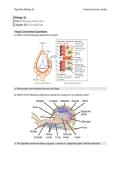
1. Which of the following statements is false?
b. Pinacocytes can transform into any cell type.
2. Which of the following statements about the anatomy of a mollusk is false?
d. The digestive system includes a gizzard, a stomach, a digestive gland, and the intestine.
, OpenStax Biology 2e Instructor Answer Guide
3. Which of the following statements about insects is false?
c. The trachea is part of the digestive system.
Review Questions
4. Mesohyl contains:
b. a collagen-like gel and suspended cells for various functions
5. The large central opening in the Parazoan body is called the:
d. osculum
6. Most sponge body plans are slight variations on a simple tube-within-a-tube design. Which of
the following is a key limitation of sponge body plans?
b. The reliance on osmosis/diffusion requires a design that maximizes the surface area to
volume ratio of the sponge.
7. Cnidocytes are found in _____.
d. phylum Cnidaria
8. Cubozoans are ________.
b. medusoids
9. While collecting specimens, a marine biologist finds a sessile Cnidarian. The medusas that
bud from it swim by contracting a ring of muscle in their bells. To which class does this
specimen belong?
c. Class Scyphozoa
10. Which group of flatworms are primarily ectoparasites of fish?
a. monogeneans
Biology 2e
Unit 5: Biological Diversity
Chapter 28: Invertebrates
Visual Connection Questions
1. Which of the following statements is false?
b. Pinacocytes can transform into any cell type.
2. Which of the following statements about the anatomy of a mollusk is false?
d. The digestive system includes a gizzard, a stomach, a digestive gland, and the intestine.
, OpenStax Biology 2e Instructor Answer Guide
3. Which of the following statements about insects is false?
c. The trachea is part of the digestive system.
Review Questions
4. Mesohyl contains:
b. a collagen-like gel and suspended cells for various functions
5. The large central opening in the Parazoan body is called the:
d. osculum
6. Most sponge body plans are slight variations on a simple tube-within-a-tube design. Which of
the following is a key limitation of sponge body plans?
b. The reliance on osmosis/diffusion requires a design that maximizes the surface area to
volume ratio of the sponge.
7. Cnidocytes are found in _____.
d. phylum Cnidaria
8. Cubozoans are ________.
b. medusoids
9. While collecting specimens, a marine biologist finds a sessile Cnidarian. The medusas that
bud from it swim by contracting a ring of muscle in their bells. To which class does this
specimen belong?
c. Class Scyphozoa
10. Which group of flatworms are primarily ectoparasites of fish?
a. monogeneans

