

OpenStax Biology 2e Instructor Answer Guide
Biology 2e
Unit 6: Plant Structure and Function
Chapter 30: Plant Form and Physiology
Visual Connection Questions
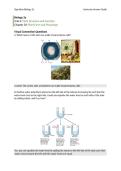
1. Which layers of the stem are made of parenchyma cells?
A and B. The cortex, pith, and phloem are made of parenchyma cells.
2. Positive water potential is placed on the left side of the tube by increasing Ψp such that the
water level rises on the right side. Could you equalize the water level on each side of the tube
by adding solute, and if so, how?
Yes, you can equalize the water level by adding the solute to the left side of the tube such that
water moves toward the left until the water levels are equal.
, OpenStax Biology 2e Instructor Answer Guide
3. Which of the following statements is false?
b. Negative water potential draws water into the root hairs. Cohesion and adhesion draw water
up the phloem. Transpiration draws water from the leaf.
Review Questions
4. Plant regions of continuous growth are made up of ________.
c. meristematic tissue
5. Which of the following is the major site of photosynthesis?
b. ground tissue
6. Stem regions at which leaves are attached are called ________.
c. nodes
7. Which of the following cell types forms most of the inside of a plant?
d. parenchyma cells
8. Tracheids, vessel elements, sieve-tube cells, and companion cells are components of
________.
a. vascular tissue
9. The primary growth of a plant is due to the action of the ________.
c. apical meristem
Biology 2e
Unit 6: Plant Structure and Function
Chapter 30: Plant Form and Physiology
Visual Connection Questions
1. Which layers of the stem are made of parenchyma cells?
A and B. The cortex, pith, and phloem are made of parenchyma cells.
2. Positive water potential is placed on the left side of the tube by increasing Ψp such that the
water level rises on the right side. Could you equalize the water level on each side of the tube
by adding solute, and if so, how?
Yes, you can equalize the water level by adding the solute to the left side of the tube such that
water moves toward the left until the water levels are equal.
, OpenStax Biology 2e Instructor Answer Guide
3. Which of the following statements is false?
b. Negative water potential draws water into the root hairs. Cohesion and adhesion draw water
up the phloem. Transpiration draws water from the leaf.
Review Questions
4. Plant regions of continuous growth are made up of ________.
c. meristematic tissue
5. Which of the following is the major site of photosynthesis?
b. ground tissue
6. Stem regions at which leaves are attached are called ________.
c. nodes
7. Which of the following cell types forms most of the inside of a plant?
d. parenchyma cells
8. Tracheids, vessel elements, sieve-tube cells, and companion cells are components of
________.
a. vascular tissue
9. The primary growth of a plant is due to the action of the ________.
c. apical meristem

