

ENVS Test 1
Study online at https://quizlet.com/_a4845w
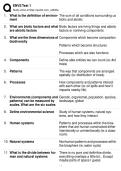
1. What is the definition of environ- The sum of all conditions surrounding us
ment biotic and abiotic
2. What are biotic factors and what Biotic factors are living things and abiotic
are abiotic factors factors or nonliving components
3. What are the three dimensions of Components which become composition
biodiversity
Patterns which become structures
Processes which are also functions
4. Components Define able entities we can count (ie: #of
trees)
5. Patterns The way that components are arranged
spatially (ie: distribution of trees)
6. Processes How components and patterns interact
with each other (ie: oil spills and how it
impacts nearby life)
7. Environments (components and Genetic, organismal, population, species,
patterns) can be measured by landscape, global
scales. What are the six scales
8. Define environmental science Study of human systems, natural sys-
tems, and how they interact
9. Human systems Patterns and processes within the bios-
phere that are human constructed either
intentionally or unintentionally (ie: a class-
room)
10. Natural systems Nonhuman patterns and processes within
the biosphere (ie: water cycle)
11. What is the divide between hu- There is no pure and definitive divide,
man and natural systems everything overlaps a little bit... Except
maybe parts of space I guess
1/6
, ENVS Test 1
Study online at https://quizlet.com/_a4845w
12. Interactions Ways in which different systems impact
and affect each other
13. What's the difference between Environmentalists are more social ac-
an environmental scientist and tivists and environmental scientist study
an environmentalist the environment
14. How do we determine what is On a scale of the vertical being human
conservation biology, ecology, focuses up to bio focuses in on the hori-
and environmental science zontal being theory and application (envi-
ronmental science is human focused and
its theoretical and applicable)
15. What is biodiversity Biodiversity is a variety in life in one area
16. What is the importance of bio- Intrinsic value, economic value, ecologi-
diversity, what are the five main cal value, recreational value, and cultural
values value
17. Define endemic infection of a specific area
18. What are the three habitat types 1. Dry, warm, low elevation
2. Cooler, intermediate elevation
3. Wet, cold, high elevations
19. When did the Holocene end 1970s/1990s
20. What are the systems on earth Both human and planet systems are ex-
doing ponentially getting higher
21. What is the tipping point the point at which a series of small
changes or incidents becomes significant
enough to cause a larger, more important
change. (Ie: coral reefs)
22. What is happening over time We are consuming more than we are pro-
with our consumption ducing as time goes on
23.
2/6
Study online at https://quizlet.com/_a4845w
1. What is the definition of environ- The sum of all conditions surrounding us
ment biotic and abiotic
2. What are biotic factors and what Biotic factors are living things and abiotic
are abiotic factors factors or nonliving components
3. What are the three dimensions of Components which become composition
biodiversity
Patterns which become structures
Processes which are also functions
4. Components Define able entities we can count (ie: #of
trees)
5. Patterns The way that components are arranged
spatially (ie: distribution of trees)
6. Processes How components and patterns interact
with each other (ie: oil spills and how it
impacts nearby life)
7. Environments (components and Genetic, organismal, population, species,
patterns) can be measured by landscape, global
scales. What are the six scales
8. Define environmental science Study of human systems, natural sys-
tems, and how they interact
9. Human systems Patterns and processes within the bios-
phere that are human constructed either
intentionally or unintentionally (ie: a class-
room)
10. Natural systems Nonhuman patterns and processes within
the biosphere (ie: water cycle)
11. What is the divide between hu- There is no pure and definitive divide,
man and natural systems everything overlaps a little bit... Except
maybe parts of space I guess
1/6
, ENVS Test 1
Study online at https://quizlet.com/_a4845w
12. Interactions Ways in which different systems impact
and affect each other
13. What's the difference between Environmentalists are more social ac-
an environmental scientist and tivists and environmental scientist study
an environmentalist the environment
14. How do we determine what is On a scale of the vertical being human
conservation biology, ecology, focuses up to bio focuses in on the hori-
and environmental science zontal being theory and application (envi-
ronmental science is human focused and
its theoretical and applicable)
15. What is biodiversity Biodiversity is a variety in life in one area
16. What is the importance of bio- Intrinsic value, economic value, ecologi-
diversity, what are the five main cal value, recreational value, and cultural
values value
17. Define endemic infection of a specific area
18. What are the three habitat types 1. Dry, warm, low elevation
2. Cooler, intermediate elevation
3. Wet, cold, high elevations
19. When did the Holocene end 1970s/1990s
20. What are the systems on earth Both human and planet systems are ex-
doing ponentially getting higher
21. What is the tipping point the point at which a series of small
changes or incidents becomes significant
enough to cause a larger, more important
change. (Ie: coral reefs)
22. What is happening over time We are consuming more than we are pro-
with our consumption ducing as time goes on
23.
2/6

