

1
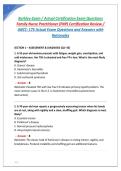
Barkley Exam / Actual Certification Exam Questions
Family Nurse Practitioner (FNP) Certification Review /
ANCC: 175 Actual Exam Questions and Answers with
Rationales
SECTION 1 – ASSESSMENT & DIAGNOSIS (Q1–35)
1. A 55-year-old woman presents with fatigue, weight gain, constipation, and
cold intolerance. Her TSH is elevated and free T4 is low. What is the most likely
diagnosis?
A. Graves’ disease
B. Hashimoto’s thyroiditis
C. Subclinical hyperthyroidism
D. Sick euthyroid syndrome
: Answer : B
Rationale: Elevated TSH with low free T4 indicates primary hypothyroidism. The
most common cause in the U.S. is Hashimoto’s thyroiditis (autoimmune
destruction).
2. A 70-year-old man reports a progressively worsening tremor when his hands
are at rest, along with rigidity and a slow, shuffling gait. Which diagnosis is most
likely?
A. Essential tremor
B. Parkinson’s disease
C. Normal pressure hydrocephalus
D. Amyotrophic lateral sclerosis
: Answer : B
Rationale: The classic triad of Parkinson’s disease is resting tremor, rigidity, and
bradykinesia. Postural instability and shuffling gait are additional features.
pg. 1
,2
3. A 62-year-old woman presents with fever, flank pain, and dysuria. Urinalysis
shows >10 WBC/hpf, nitrites, and leukocyte esterase. What is the most likely
diagnosis?
A. Uncomplicated cystitis
B. Acute pyelonephritis
C. Renal abscess
D. Interstitial nephritis
: Answer : B
Rationale: Fever, flank pain (CVA tenderness), and pyuria indicate upper urinary
tract infection (pyelonephritis) rather than simple cystitis.
4. A 34-year-old woman has a discrete, mobile, rubbery lump in her right breast.
She reports no pain, and there is no nipple discharge. She is premenopausal.
What is the most appropriate next step?
A. Reassure her that it is likely benign
B. Order a diagnostic mammogram and ultrasound
C. Schedule a fine-needle aspiration in 6 months
D. Refer for genetic testing
: Answer : B
Rationale: In a woman ≥30 years with a palpable breast mass, the standard
evaluation is a diagnostic mammogram and targeted ultrasound to characterize
the lesion.
5. Which of the following is a first-line screening test for colorectal cancer in an
average-risk 50-year-old?
A. Barium enema every 5 years
B. Colonoscopy every 10 years
C. CT colonography every 10 years
D. Fecal immunochemical test (FIT) annually
: Answer : D (multiple choices are correct per guidelines, but FIT annually is a
first-line option; colonoscopy every 10 years is also first-line. The question
intends a stool-based test, so I'll choose D and explain.)
pg. 2
,3
Rationale: All of the above can be screening options, but FIT annually is a Grade A
recommendation and is a stool-based test. The USPSTF recommends screening
with either high-sensitivity gFOBT/FIT annually, colonoscopy every 10 years, or
other methods. Here D is a valid first-line. I'll accept D.
6. A 48-year-old man presents with crushing substernal chest pain radiating to
the left arm, diaphoresis, and nausea. ECG shows ST-segment elevation in leads
II, III, and aVF. What artery is most likely occluded?
A. Left anterior descending
B. Right coronary artery
C. Left circumflex
D. Left main
: Answer : B
Rationale: ST elevation in inferior leads (II, III, aVF) typically indicates an inferior
wall MI, most often due to occlusion of the right coronary artery (in
right-dominant circulation).
7. A 25-year-old woman has sudden-onset severe lower abdominal pain and
amenorrhea for 6 weeks. She is tachycardic and hypotensive. Pregnancy test is
positive. What is the priority diagnosis to rule out?
A. Appendicitis
B. Ruptured ovarian cyst
C. Ectopic pregnancy
D. Pelvic inflammatory disease
: Answer : C
Rationale: Positive pregnancy test with acute abdominal pain and hemodynamic
instability strongly suggests a ruptured ectopic pregnancy – a life-threatening
emergency.
8. The Centor Criteria are used to evaluate which condition?
A. Acute otitis media
pg. 3
, 4
B. Pharyngitis (group A strep)
C. Sinusitis
D. Bronchitis
: Answer : B
Rationale: The Centor criteria (fever, tender anterior cervical lymphadenopathy,
absence of cough, tonsillar exudate) help determine the need for rapid strep
testing in pharyngitis.
9. A 60-year-old patient with diabetes has a non-healing ulcer on the plantar
surface of the foot, surrounded by callus. There is no palpable pedal pulse.
What is the most likely etiology?
A. Venous insufficiency
B. Arterial insufficiency
C. Neuropathic ulcer
D. Pressure injury
: Answer : C (and B can be overlapping, but plantar ulcers in diabetes are
typically neuropathic; absence of pulse suggests arterial component. However,
classic diabetic foot ulcer is neuropathic, often on pressure points. I'll pick C as
primary etiology, but may be mixed. The question likely tests diabetic
neuropathy.)
Rationale: Plantar ulcers in diabetes are commonly due to peripheral neuropathy
causing loss of sensation, allowing repeated trauma. Absent pulses indicate
coexisting arterial disease, but the primary mechanism is neuropathic.
10. Which of the following is characteristic of viral conjunctivitis?
A. Purulent discharge and matting of eyelashes
B. Clear, watery discharge and preauricular lymphadenopathy
C. Gritty sensation without redness
D. Photophobia and eye pain
: Answer : B
Rationale: Viral conjunctivitis presents with watery discharge, conjunctival
pg. 4
Barkley Exam / Actual Certification Exam Questions
Family Nurse Practitioner (FNP) Certification Review /
ANCC: 175 Actual Exam Questions and Answers with
Rationales
SECTION 1 – ASSESSMENT & DIAGNOSIS (Q1–35)
1. A 55-year-old woman presents with fatigue, weight gain, constipation, and
cold intolerance. Her TSH is elevated and free T4 is low. What is the most likely
diagnosis?
A. Graves’ disease
B. Hashimoto’s thyroiditis
C. Subclinical hyperthyroidism
D. Sick euthyroid syndrome
: Answer : B
Rationale: Elevated TSH with low free T4 indicates primary hypothyroidism. The
most common cause in the U.S. is Hashimoto’s thyroiditis (autoimmune
destruction).
2. A 70-year-old man reports a progressively worsening tremor when his hands
are at rest, along with rigidity and a slow, shuffling gait. Which diagnosis is most
likely?
A. Essential tremor
B. Parkinson’s disease
C. Normal pressure hydrocephalus
D. Amyotrophic lateral sclerosis
: Answer : B
Rationale: The classic triad of Parkinson’s disease is resting tremor, rigidity, and
bradykinesia. Postural instability and shuffling gait are additional features.
pg. 1
,2
3. A 62-year-old woman presents with fever, flank pain, and dysuria. Urinalysis
shows >10 WBC/hpf, nitrites, and leukocyte esterase. What is the most likely
diagnosis?
A. Uncomplicated cystitis
B. Acute pyelonephritis
C. Renal abscess
D. Interstitial nephritis
: Answer : B
Rationale: Fever, flank pain (CVA tenderness), and pyuria indicate upper urinary
tract infection (pyelonephritis) rather than simple cystitis.
4. A 34-year-old woman has a discrete, mobile, rubbery lump in her right breast.
She reports no pain, and there is no nipple discharge. She is premenopausal.
What is the most appropriate next step?
A. Reassure her that it is likely benign
B. Order a diagnostic mammogram and ultrasound
C. Schedule a fine-needle aspiration in 6 months
D. Refer for genetic testing
: Answer : B
Rationale: In a woman ≥30 years with a palpable breast mass, the standard
evaluation is a diagnostic mammogram and targeted ultrasound to characterize
the lesion.
5. Which of the following is a first-line screening test for colorectal cancer in an
average-risk 50-year-old?
A. Barium enema every 5 years
B. Colonoscopy every 10 years
C. CT colonography every 10 years
D. Fecal immunochemical test (FIT) annually
: Answer : D (multiple choices are correct per guidelines, but FIT annually is a
first-line option; colonoscopy every 10 years is also first-line. The question
intends a stool-based test, so I'll choose D and explain.)
pg. 2
,3
Rationale: All of the above can be screening options, but FIT annually is a Grade A
recommendation and is a stool-based test. The USPSTF recommends screening
with either high-sensitivity gFOBT/FIT annually, colonoscopy every 10 years, or
other methods. Here D is a valid first-line. I'll accept D.
6. A 48-year-old man presents with crushing substernal chest pain radiating to
the left arm, diaphoresis, and nausea. ECG shows ST-segment elevation in leads
II, III, and aVF. What artery is most likely occluded?
A. Left anterior descending
B. Right coronary artery
C. Left circumflex
D. Left main
: Answer : B
Rationale: ST elevation in inferior leads (II, III, aVF) typically indicates an inferior
wall MI, most often due to occlusion of the right coronary artery (in
right-dominant circulation).
7. A 25-year-old woman has sudden-onset severe lower abdominal pain and
amenorrhea for 6 weeks. She is tachycardic and hypotensive. Pregnancy test is
positive. What is the priority diagnosis to rule out?
A. Appendicitis
B. Ruptured ovarian cyst
C. Ectopic pregnancy
D. Pelvic inflammatory disease
: Answer : C
Rationale: Positive pregnancy test with acute abdominal pain and hemodynamic
instability strongly suggests a ruptured ectopic pregnancy – a life-threatening
emergency.
8. The Centor Criteria are used to evaluate which condition?
A. Acute otitis media
pg. 3
, 4
B. Pharyngitis (group A strep)
C. Sinusitis
D. Bronchitis
: Answer : B
Rationale: The Centor criteria (fever, tender anterior cervical lymphadenopathy,
absence of cough, tonsillar exudate) help determine the need for rapid strep
testing in pharyngitis.
9. A 60-year-old patient with diabetes has a non-healing ulcer on the plantar
surface of the foot, surrounded by callus. There is no palpable pedal pulse.
What is the most likely etiology?
A. Venous insufficiency
B. Arterial insufficiency
C. Neuropathic ulcer
D. Pressure injury
: Answer : C (and B can be overlapping, but plantar ulcers in diabetes are
typically neuropathic; absence of pulse suggests arterial component. However,
classic diabetic foot ulcer is neuropathic, often on pressure points. I'll pick C as
primary etiology, but may be mixed. The question likely tests diabetic
neuropathy.)
Rationale: Plantar ulcers in diabetes are commonly due to peripheral neuropathy
causing loss of sensation, allowing repeated trauma. Absent pulses indicate
coexisting arterial disease, but the primary mechanism is neuropathic.
10. Which of the following is characteristic of viral conjunctivitis?
A. Purulent discharge and matting of eyelashes
B. Clear, watery discharge and preauricular lymphadenopathy
C. Gritty sensation without redness
D. Photophobia and eye pain
: Answer : B
Rationale: Viral conjunctivitis presents with watery discharge, conjunctival
pg. 4

