

NAME 1
[Your Name]
Professor [Instructor's Name]
NSG C919: Advanced Nursing Pedagogy
Date 21 May 2026
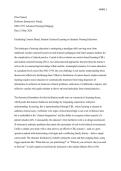
Facilitating Context-Based, Student-Centered Learning in Graduate Nursing Education
The landscape of nursing education is undergoing a paradigm shift, moving away from
traditional, teacher-centered lectures toward dynamic pedagogies that better prepare students for
the complexities of clinical practice. Central to this evolution are context-based learning (CBL)
and student-centered learning (SCL), two interconnected approaches that prioritize the learner’s
active role in constructing knowledge within realistic, meaningful scenarios. For nurse educators
in a graduate-level course like NSG C919, the core challenge is not merely understanding these
theories but effectively facilitating them. Effective facilitation of context-based, student-centered
learning requires nurse educators to systematically transition from being dispensers of
information to architects of immersive clinical problems, cultivators of collaborative inquiry, and
reflective coaches who guide students to derive universal principles from situated practice.
The theoretical foundation for this facilitation model rests on constructivist learning theory,
which posits that learners build new knowledge by integrating experiences with prior
understanding. In nursing, this is operationalized through CBL, where learning is situated in
authentic clinical cases. As Benner et al. argue, clinical knowledge is not a set of abstract rules
but is embedded in the “clinical imagination” and the ability to recognize salient aspects of a
patient situation (45). Consequently, the educator’s first facilitative role is to design and present
ill-structured, authentic problems that mimic the uncertainty of real-world clinical environments.
Unlike a simple case study with a clear answer, an effective CBL scenario—such as a post-
operative patient with deteriorating vital signs and a conflicting family history—lacks a single
correct path. The educator facilitates by initially setting the scene and then stepping back, using
trigger questions like “What data are you prioritizing?” or “What do you not know that you need
to find out?” to shift cognitive load from the instructor to the student (Hmelo-Silver 104).
[Your Name]
Professor [Instructor's Name]
NSG C919: Advanced Nursing Pedagogy
Date 21 May 2026
Facilitating Context-Based, Student-Centered Learning in Graduate Nursing Education
The landscape of nursing education is undergoing a paradigm shift, moving away from
traditional, teacher-centered lectures toward dynamic pedagogies that better prepare students for
the complexities of clinical practice. Central to this evolution are context-based learning (CBL)
and student-centered learning (SCL), two interconnected approaches that prioritize the learner’s
active role in constructing knowledge within realistic, meaningful scenarios. For nurse educators
in a graduate-level course like NSG C919, the core challenge is not merely understanding these
theories but effectively facilitating them. Effective facilitation of context-based, student-centered
learning requires nurse educators to systematically transition from being dispensers of
information to architects of immersive clinical problems, cultivators of collaborative inquiry, and
reflective coaches who guide students to derive universal principles from situated practice.
The theoretical foundation for this facilitation model rests on constructivist learning theory,
which posits that learners build new knowledge by integrating experiences with prior
understanding. In nursing, this is operationalized through CBL, where learning is situated in
authentic clinical cases. As Benner et al. argue, clinical knowledge is not a set of abstract rules
but is embedded in the “clinical imagination” and the ability to recognize salient aspects of a
patient situation (45). Consequently, the educator’s first facilitative role is to design and present
ill-structured, authentic problems that mimic the uncertainty of real-world clinical environments.
Unlike a simple case study with a clear answer, an effective CBL scenario—such as a post-
operative patient with deteriorating vital signs and a conflicting family history—lacks a single
correct path. The educator facilitates by initially setting the scene and then stepping back, using
trigger questions like “What data are you prioritizing?” or “What do you not know that you need
to find out?” to shift cognitive load from the instructor to the student (Hmelo-Silver 104).


