

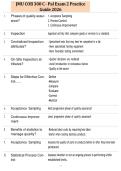
JMU COB 300 C - Pal Exam 2 Practice
Guide 2026
1. Phases of quality assur- 1. Acceptance Sampling
ance? 2. Process Control
3. Continuous Improvement
2. Inspection Appraisal activity that compares goods or services to a standard.
3. Centralized Inspection - Specialized tests that may best be completed in a lab
attributes? - More specialized testing equipment
- More favorable testing environment
4. On-Site Inspection at- - Quicker decisions are rendered
tributes? - Avoid introduction of extraneous factors
- Quality at the source
5. Steps for Effective Con- -Define
trol...... -Measure
-Compare
-Evaluate
-Correct
-Monitor
6. Acceptance Sampling Most progressive phase of quality assurance?
7. Continuous Improve- Least progressive phase of quality assurance?
ment
8. Benefits of statistics to -Reduces labor costs by requiring less labor
manage quality? -Useful when testing destroys products
9. Acceptance Sampling Assesses the quality of parts or products before or after they have been
produced.
10. Statistical Process Con- Assesses whether or not an ongoing process is performing within
trol established limits.
, JMU COB 300 C - Pal Exam 2 Practice
Guide 2026
- Determines whether a process is in or out of control.
11. Random Variations are
nearly impossible to control or correct.
12. Assignable Variations
are
easily identified as well
as controlled and
corrected.
13. Central Limit Theorem Sample means will be normally distributed no matter whatever distri-
(CLT) butions the samples follow.
14. 2 types of data? Variable & Attribute
15. Variable? A measure of a particular product characteristic (continuous).
16. Attribute? Counts items (discrete).
17. R chart and x-bar chart Variable
are charts?
18. P-chart & c-chart are Attribute
charts?
19. larger The the sample size, the narrower the sam-
pling distribution.
20. YES Should points outside of the control limits be investigated as signals
of non-random variation?
21. NOPE Is eliminating defects part of quality control?
, 22. To use Cp, the process Centered
must be........
23. Cpx If a process is not centered, use . It can be used for a centered
process as well as a non-centered process.
24. External failure Involves external stakeholders
25. Goals of process im- -Reduce waste
provement? -Achieve higher quality
-Increase customer satisfaction
26. What is an input into Identifying the cause of a problem
the effort to improve a
process?
27. A process is "centered" if is within design specification limits.
it.......... (In English: Is within LCL & UCL)
28. C-Charts Used to count defects in samples of constant size.
(count)
29. P-Charts Used to track a proportion defective (%)
30. >= At a minimum, Cp ___ 1
This means the process
is centered between LCL
and UCL.
31. >= At a minimum, Cpk __ 1
32. What is more accurate, Six sigma
six sigma or three sig-
ma?
Guide 2026
1. Phases of quality assur- 1. Acceptance Sampling
ance? 2. Process Control
3. Continuous Improvement
2. Inspection Appraisal activity that compares goods or services to a standard.
3. Centralized Inspection - Specialized tests that may best be completed in a lab
attributes? - More specialized testing equipment
- More favorable testing environment
4. On-Site Inspection at- - Quicker decisions are rendered
tributes? - Avoid introduction of extraneous factors
- Quality at the source
5. Steps for Effective Con- -Define
trol...... -Measure
-Compare
-Evaluate
-Correct
-Monitor
6. Acceptance Sampling Most progressive phase of quality assurance?
7. Continuous Improve- Least progressive phase of quality assurance?
ment
8. Benefits of statistics to -Reduces labor costs by requiring less labor
manage quality? -Useful when testing destroys products
9. Acceptance Sampling Assesses the quality of parts or products before or after they have been
produced.
10. Statistical Process Con- Assesses whether or not an ongoing process is performing within
trol established limits.
, JMU COB 300 C - Pal Exam 2 Practice
Guide 2026
- Determines whether a process is in or out of control.
11. Random Variations are
nearly impossible to control or correct.
12. Assignable Variations
are
easily identified as well
as controlled and
corrected.
13. Central Limit Theorem Sample means will be normally distributed no matter whatever distri-
(CLT) butions the samples follow.
14. 2 types of data? Variable & Attribute
15. Variable? A measure of a particular product characteristic (continuous).
16. Attribute? Counts items (discrete).
17. R chart and x-bar chart Variable
are charts?
18. P-chart & c-chart are Attribute
charts?
19. larger The the sample size, the narrower the sam-
pling distribution.
20. YES Should points outside of the control limits be investigated as signals
of non-random variation?
21. NOPE Is eliminating defects part of quality control?
, 22. To use Cp, the process Centered
must be........
23. Cpx If a process is not centered, use . It can be used for a centered
process as well as a non-centered process.
24. External failure Involves external stakeholders
25. Goals of process im- -Reduce waste
provement? -Achieve higher quality
-Increase customer satisfaction
26. What is an input into Identifying the cause of a problem
the effort to improve a
process?
27. A process is "centered" if is within design specification limits.
it.......... (In English: Is within LCL & UCL)
28. C-Charts Used to count defects in samples of constant size.
(count)
29. P-Charts Used to track a proportion defective (%)
30. >= At a minimum, Cp ___ 1
This means the process
is centered between LCL
and UCL.
31. >= At a minimum, Cpk __ 1
32. What is more accurate, Six sigma
six sigma or three sig-
ma?

