

Tectonics Processes and Hazards – Physical Geography Notes Paper 1
Location of Hazards
Structure of the Earth:
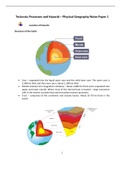
• Core – separated into the liquid outer core and the solid inner core. The outer core is
2,300 km thick and the inner core is about 1,200 km thick
• Mantle (mainly Ferro-magnetism silicates) – About 2,900 km thick and is separated into
upper and lower mantle. Where most of the internal heat is located – large convective
cells in the mantle circulate heat and drive plate tectonic processes
• Crust – comprises of the continents and oceanic basins. About 35-70 km thick in the
ocean.
1
,The Earth can also be separated into layers based on mechanical properties (liquid or solid):
• Lithosphere – comprised of the crust and solid portion of the upper mantle (divided into
plates)
• Asthenosphere – the lithosphere floats atop a semi-liquid layer known as the
asthenosphere
Oceanic and Continental crust:
1. Oceanic Crust
• The crust is 6-11 km thick
• Young, thin and dense
• The rocks are very young (not more than 200 million years old)
• Consists mostly of basalt
• About 3 g/cm3
2. Continental Crust
• The crust is 30-40 km thick
• Old, thick and light
• The rocks are old (some are 3.8 billion years old)
• Consists mostly of igneous rocks
• About 2.7 g/cm3
Plates Tectonic Theory
1. Alfred Wegner (continental drift)
• All continents were joined together in an ancient supercontinent called Pangaea
• Continents such as South America and Africa appear to fit together
• Rocks are similar on 2 sides of the Atlantic
• Fossils of a small fern, Glossopteris, are found across all the Southern continents
• Oil and coal reserves in Antarctica (there must have previously been plants and animals
– so different climate)
• Marsupials are only found in Australia (continent must have drifted for the species to
evolve and lead to isolation)
2. Arthur Holmes (convection currents)
• Holmes elaborated on the idea that the mantle undergoes thermal convection
2
, • This idea is based on the fact that as a substance is heated its density decreases and
rises to the surface
• This repeated process may result in the continents moving. Holmes suggested that this
thermal convection was like a conveyor belt and that the upwelling pressure could
break apart a continent and then force the broken continent in opposite directions
carried by the convection currents
3. Hugo Benioff (Subduction zones)
• By the late 1920s, seismologists were beginning to identify prominent earthquake zones
parallel to the trenches that typically were inclined from the horizontal by about 40-60
degrees and extended several hundred km into the earth
• These zones later became known as the Wadati-Benioff zones or simply Benioff zones
4. Harry Hess (sea floor spreading)
• Among the sea floor features that supported the sea floor spreading were: mid-ocean
ridges, deep sea trenches, island arcs, geomagnetic patterns and fault patterns
• Geomagnetic anomalies, at random intervals the Earth’s magnetic field reverses – this is
the evidence for continuous formation of new rocks at the ridges
• Sea floor spreading, mid-ocean ridges mark structurally weak zones where the ocean
floor was being ripped in two length wise along the ridge crest – new magma rises
through and erupts creating new oceanic crust
5. John Wilson (Wilson cycle)
• Continuous cycle
Ø Continental breakup
3
, Ø Ocean formation
Ø Ocean Subduction
Ø Ocean closure
• Stages in the cycle
Ø Uplift
Ø Rift-valleys
Ø Widening of basins
Ø Old rocks sink
Ø Ocean ‘shrinks’
Ø Oceanic crust subducted beneath continental crust
Volcano and Earthquake
Where are volcanoes usually found?
• Link between plate margins and volcanic activity
• Strong concentration of volcanic activity between destructive plate margins
• Volcanoes are also found in hot spot, e.g. Hawaii
4
Location of Hazards
Structure of the Earth:
• Core – separated into the liquid outer core and the solid inner core. The outer core is
2,300 km thick and the inner core is about 1,200 km thick
• Mantle (mainly Ferro-magnetism silicates) – About 2,900 km thick and is separated into
upper and lower mantle. Where most of the internal heat is located – large convective
cells in the mantle circulate heat and drive plate tectonic processes
• Crust – comprises of the continents and oceanic basins. About 35-70 km thick in the
ocean.
1
,The Earth can also be separated into layers based on mechanical properties (liquid or solid):
• Lithosphere – comprised of the crust and solid portion of the upper mantle (divided into
plates)
• Asthenosphere – the lithosphere floats atop a semi-liquid layer known as the
asthenosphere
Oceanic and Continental crust:
1. Oceanic Crust
• The crust is 6-11 km thick
• Young, thin and dense
• The rocks are very young (not more than 200 million years old)
• Consists mostly of basalt
• About 3 g/cm3
2. Continental Crust
• The crust is 30-40 km thick
• Old, thick and light
• The rocks are old (some are 3.8 billion years old)
• Consists mostly of igneous rocks
• About 2.7 g/cm3
Plates Tectonic Theory
1. Alfred Wegner (continental drift)
• All continents were joined together in an ancient supercontinent called Pangaea
• Continents such as South America and Africa appear to fit together
• Rocks are similar on 2 sides of the Atlantic
• Fossils of a small fern, Glossopteris, are found across all the Southern continents
• Oil and coal reserves in Antarctica (there must have previously been plants and animals
– so different climate)
• Marsupials are only found in Australia (continent must have drifted for the species to
evolve and lead to isolation)
2. Arthur Holmes (convection currents)
• Holmes elaborated on the idea that the mantle undergoes thermal convection
2
, • This idea is based on the fact that as a substance is heated its density decreases and
rises to the surface
• This repeated process may result in the continents moving. Holmes suggested that this
thermal convection was like a conveyor belt and that the upwelling pressure could
break apart a continent and then force the broken continent in opposite directions
carried by the convection currents
3. Hugo Benioff (Subduction zones)
• By the late 1920s, seismologists were beginning to identify prominent earthquake zones
parallel to the trenches that typically were inclined from the horizontal by about 40-60
degrees and extended several hundred km into the earth
• These zones later became known as the Wadati-Benioff zones or simply Benioff zones
4. Harry Hess (sea floor spreading)
• Among the sea floor features that supported the sea floor spreading were: mid-ocean
ridges, deep sea trenches, island arcs, geomagnetic patterns and fault patterns
• Geomagnetic anomalies, at random intervals the Earth’s magnetic field reverses – this is
the evidence for continuous formation of new rocks at the ridges
• Sea floor spreading, mid-ocean ridges mark structurally weak zones where the ocean
floor was being ripped in two length wise along the ridge crest – new magma rises
through and erupts creating new oceanic crust
5. John Wilson (Wilson cycle)
• Continuous cycle
Ø Continental breakup
3
, Ø Ocean formation
Ø Ocean Subduction
Ø Ocean closure
• Stages in the cycle
Ø Uplift
Ø Rift-valleys
Ø Widening of basins
Ø Old rocks sink
Ø Ocean ‘shrinks’
Ø Oceanic crust subducted beneath continental crust
Volcano and Earthquake
Where are volcanoes usually found?
• Link between plate margins and volcanic activity
• Strong concentration of volcanic activity between destructive plate margins
• Volcanoes are also found in hot spot, e.g. Hawaii
4


