

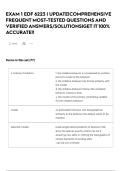
EXAM 1 EDF 6223 | UPDATE|COMPREHENSIVE
FREQUENT MOST-TESTED QUESTIONS AND
VERIFIED ANSWERS/SOLUTIONS|GET IT 100%
ACCURATE!!
Save
Terms in this set (77)
4 criteria of imitation 1. the imitative behavior is occasioned by another
person's model of the behavior
2. the imitative behavior has formal similarity with
the model
3. the imitative behavior follows the modeled
behavior closely in time
4. the model is the primary controlling variable
for the imitative behavior
model an antecedent stimulus with topographical
similarity to the behavior the analyst wants to be
imitated
planned models prearranged demonstrations of behavior that
show the learner exactly what to do, be it
acquiring new skills or refining the topography of
certain elements of existing skills
-can be live or filmed
,unplanned models occasion imitation in everyday social
environments
formal similarity occurs when the model's and the imitator's
behavior physically resemble each other and are
in the same mode
T/F: delayed behaviors replicating false, a close temporal relationships between the
the topography of a model are model's performance and the learner's behavior
imitative is an important feature of imitation
what is the most important property the controlling relation between a model's
defining imitation? demonstration and a learner's performance of
topographically similar behavior
when is a controlling relation when a model evokes a similar behavior without a
between the model's behavior and prior history of reinforcement
the imitator's behavior inferred?
T/F: an imitative behavior is a new true
behavior that follows a novel
antecedent event
imitation training a systematic, research-based set of steps for
teaching a non-imitative learner to imitate models
of noel behavior
imitation training protocol (1): attending to the model is a prerequisite skill for
assess, and teach if necessary, imitation training. assess the skills for a minimum
prerequisite skills for imitation of 3 sessions and begin training if assessment
training data shows adequate attending skills
, imitation training protocol (2): practitioners may need to select and use about
25 behaviors as models during imitation training.
including gross motor and fine motor movements
as models provides learners with opportunities to
develop more refined differentiation with their
imitative skills. initial training usually includes
models of the movement of body parts and the
manipulation of physical objects
imitation training protocol (3): the learner's response to the selected models
pretest should be pretested:
1. prepare the learner's attending behaviors for
the pretest
2. if using an object mode, place 1 in front of the
learner and 1 in front of yourself
3. say the learner's name to start, and when the
learner makes eye contact, say, "do this"
4. present the model
5. immediately praise each response that has
formal similarity to the model, and deliver
reinforcement ASAP
6. record the learner's response as correct,
incorrect, or as an approximation of the model
7. continue pretesting with the remaining models
FREQUENT MOST-TESTED QUESTIONS AND
VERIFIED ANSWERS/SOLUTIONS|GET IT 100%
ACCURATE!!
Save
Terms in this set (77)
4 criteria of imitation 1. the imitative behavior is occasioned by another
person's model of the behavior
2. the imitative behavior has formal similarity with
the model
3. the imitative behavior follows the modeled
behavior closely in time
4. the model is the primary controlling variable
for the imitative behavior
model an antecedent stimulus with topographical
similarity to the behavior the analyst wants to be
imitated
planned models prearranged demonstrations of behavior that
show the learner exactly what to do, be it
acquiring new skills or refining the topography of
certain elements of existing skills
-can be live or filmed
,unplanned models occasion imitation in everyday social
environments
formal similarity occurs when the model's and the imitator's
behavior physically resemble each other and are
in the same mode
T/F: delayed behaviors replicating false, a close temporal relationships between the
the topography of a model are model's performance and the learner's behavior
imitative is an important feature of imitation
what is the most important property the controlling relation between a model's
defining imitation? demonstration and a learner's performance of
topographically similar behavior
when is a controlling relation when a model evokes a similar behavior without a
between the model's behavior and prior history of reinforcement
the imitator's behavior inferred?
T/F: an imitative behavior is a new true
behavior that follows a novel
antecedent event
imitation training a systematic, research-based set of steps for
teaching a non-imitative learner to imitate models
of noel behavior
imitation training protocol (1): attending to the model is a prerequisite skill for
assess, and teach if necessary, imitation training. assess the skills for a minimum
prerequisite skills for imitation of 3 sessions and begin training if assessment
training data shows adequate attending skills
, imitation training protocol (2): practitioners may need to select and use about
25 behaviors as models during imitation training.
including gross motor and fine motor movements
as models provides learners with opportunities to
develop more refined differentiation with their
imitative skills. initial training usually includes
models of the movement of body parts and the
manipulation of physical objects
imitation training protocol (3): the learner's response to the selected models
pretest should be pretested:
1. prepare the learner's attending behaviors for
the pretest
2. if using an object mode, place 1 in front of the
learner and 1 in front of yourself
3. say the learner's name to start, and when the
learner makes eye contact, say, "do this"
4. present the model
5. immediately praise each response that has
formal similarity to the model, and deliver
reinforcement ASAP
6. record the learner's response as correct,
incorrect, or as an approximation of the model
7. continue pretesting with the remaining models

