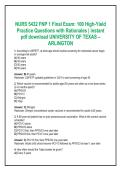
NURS 5432 FNP 1 Final Exam: 100 High-Yield
Practice Questions with Rationales | instant
pdf download UNIVERSITY OF TEXAS –
ARLINGTON
1. According to USPSTF, at what age should routine screening for colorectal cancer begin
in average-risk adults?
A) 40 years
B) 45 years
C) 50 years
D) 55 years
Answer: B) 45 years
Rationale: USPSTF updated guidelines in 2021 to start screening at age 45.
2. Which vaccine is recommended for adults aged 50 years and older as a two-dose series
(2–6 months apart)?
A) PPSV23
B) PCV13
C) Shingrix
D) Tdap
Answer: C) Shingrix
Rationale: Shingrix (recombinant zoster vaccine) is recommended for adults ≥50 years.
3. A 65-year-old patient has no prior pneumococcal vaccination. What is the correct vaccine
schedule?
A) PCV13 alone
B) PPSV23 alone
C) PCV13 first, then PPSV23 one year later
D) PPSV23 first, then PCV13 one year later
Answer: C) PCV13 first, then PPSV23 one year later
Rationale: Adults ≥65 should receive PCV13 followed by PPSV23 at least 1 year later.
4. How often should the Tdap booster be given?
A) Every 5 years
,B) Every 10 years
C) Once in a lifetime
D) Every 2 years
Answer: B) Every 10 years
Rationale: Tdap booster is recommended every 10 years for adults.
5. At what age does the USPSTF recommend biennial mammography screening for
average-risk women?
A) 40–49 years
B) 50–74 years
C) 75+ years
D) 30–39 years
Answer: B) 50–74 years
Rationale: Biennial screening is recommended for women aged 50–74.
6. Starting at what age is routine cervical cancer screening (Pap smear) recommended per
ACOG?
A) 18 years
B) 21 years
C) 25 years
D) 30 years
Answer: B) 21 years
Rationale: ACOG recommends initiating Pap screening at age 21 regardless of sexual
history.
7. Which oral contraceptive component is associated with a higher risk of venous
thromboembolism (VTE)?
A) Ethinyl estradiol 20 mcg
B) Norethindrone
C) Drospirenone
D) Levonorgestrel
Answer: C) Drospirenone
Rationale: Pills containing drospirenone have a higher VTE risk compared to levonorgestrel.
8. What is the recommended normal body mass index (BMI) range for older adults (≥65
years)?
A) 18.5–24.9
B) 20–25
, C) 23–30
D) 25–35
Answer: C) 23–30
Rationale: Slightly higher BMI (23–30) is associated with better outcomes in older adults.
9. A patient loses 8% of body weight unintentionally over 3 months. This indicates:
A) Normal aging
B) Malnutrition risk
C) Fluid retention
D) Muscle gain
Answer: B) Malnutrition risk
Rationale: >5% weight loss in 1 month or >10% in 6 months signals malnutrition risk.
10. According to USPSTF, screening for depression should be:
A) Only in high-risk patients
B) In all adults with adequate systems for follow-up
C) Only in patients over 65
D) Only in pregnant women
Answer: B) In all adults with adequate systems for follow-up
Rationale: USPSTF recommends universal depression screening with appropriate follow-
up.
11. The "Get Up and Go" test is used to assess:
A) Vision
B) Hearing
C) Fall risk
D) Cognition
Answer: C) Fall risk
Rationale: Time >12 seconds indicates increased fall risk in older adults.
12. What is the minimum interval between influenza vaccine doses in children aged 6
months–8 years receiving it for the first time?
A) 2 weeks
B) 4 weeks
C) 6 weeks
D) 8 weeks
Practice Questions with Rationales | instant
pdf download UNIVERSITY OF TEXAS –
ARLINGTON
1. According to USPSTF, at what age should routine screening for colorectal cancer begin
in average-risk adults?
A) 40 years
B) 45 years
C) 50 years
D) 55 years
Answer: B) 45 years
Rationale: USPSTF updated guidelines in 2021 to start screening at age 45.
2. Which vaccine is recommended for adults aged 50 years and older as a two-dose series
(2–6 months apart)?
A) PPSV23
B) PCV13
C) Shingrix
D) Tdap
Answer: C) Shingrix
Rationale: Shingrix (recombinant zoster vaccine) is recommended for adults ≥50 years.
3. A 65-year-old patient has no prior pneumococcal vaccination. What is the correct vaccine
schedule?
A) PCV13 alone
B) PPSV23 alone
C) PCV13 first, then PPSV23 one year later
D) PPSV23 first, then PCV13 one year later
Answer: C) PCV13 first, then PPSV23 one year later
Rationale: Adults ≥65 should receive PCV13 followed by PPSV23 at least 1 year later.
4. How often should the Tdap booster be given?
A) Every 5 years
,B) Every 10 years
C) Once in a lifetime
D) Every 2 years
Answer: B) Every 10 years
Rationale: Tdap booster is recommended every 10 years for adults.
5. At what age does the USPSTF recommend biennial mammography screening for
average-risk women?
A) 40–49 years
B) 50–74 years
C) 75+ years
D) 30–39 years
Answer: B) 50–74 years
Rationale: Biennial screening is recommended for women aged 50–74.
6. Starting at what age is routine cervical cancer screening (Pap smear) recommended per
ACOG?
A) 18 years
B) 21 years
C) 25 years
D) 30 years
Answer: B) 21 years
Rationale: ACOG recommends initiating Pap screening at age 21 regardless of sexual
history.
7. Which oral contraceptive component is associated with a higher risk of venous
thromboembolism (VTE)?
A) Ethinyl estradiol 20 mcg
B) Norethindrone
C) Drospirenone
D) Levonorgestrel
Answer: C) Drospirenone
Rationale: Pills containing drospirenone have a higher VTE risk compared to levonorgestrel.
8. What is the recommended normal body mass index (BMI) range for older adults (≥65
years)?
A) 18.5–24.9
B) 20–25
, C) 23–30
D) 25–35
Answer: C) 23–30
Rationale: Slightly higher BMI (23–30) is associated with better outcomes in older adults.
9. A patient loses 8% of body weight unintentionally over 3 months. This indicates:
A) Normal aging
B) Malnutrition risk
C) Fluid retention
D) Muscle gain
Answer: B) Malnutrition risk
Rationale: >5% weight loss in 1 month or >10% in 6 months signals malnutrition risk.
10. According to USPSTF, screening for depression should be:
A) Only in high-risk patients
B) In all adults with adequate systems for follow-up
C) Only in patients over 65
D) Only in pregnant women
Answer: B) In all adults with adequate systems for follow-up
Rationale: USPSTF recommends universal depression screening with appropriate follow-
up.
11. The "Get Up and Go" test is used to assess:
A) Vision
B) Hearing
C) Fall risk
D) Cognition
Answer: C) Fall risk
Rationale: Time >12 seconds indicates increased fall risk in older adults.
12. What is the minimum interval between influenza vaccine doses in children aged 6
months–8 years receiving it for the first time?
A) 2 weeks
B) 4 weeks
C) 6 weeks
D) 8 weeks