

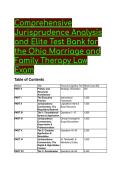
Comprehensive
Jurisprudence Analysis
and Elite Test Bank for
the Ohio Marriage and
Family Therapy Law
Exam
Table of Contents
Section Title Focus & Cognitive Tier Word Count Est.
PART 0 Preface and Strategic Orientation 450
Structural
Architecture
PART I The Executive Instructional 1,200
Preview Framework
PART II Jurisprudence Legislative Intent & 1,500
Commentary: The Board Structure
Regulatory Bedrock
PART III Tier 1: Foundational Questions 1–15 1,800
Syntax & Application
PART IV Jurisprudence Clinical Oversight & 1,500
Commentary: Scope Boundaries
Supervision &
Professionalism
PART V Tier 2: Complex Questions 16–35 2,200
Application &
Simulation
PART VI Jurisprudence AI, Telehealth, & 1,500
Commentary: The Mandatory Duties
Digital & High-Stakes
Frontier
PART VII Tier 3: Grandmaster Questions 36–60 3,400
,Section Title Focus & Cognitive Tier Word Count Est.
Synthesis
PART VIII Final Synthesis & Future-State 650
Actionable Jurisprudence
Recommendations
PART 0: Preface and Structural Architecture
The production of this document serves as the definitive jurisprudential roadmap for the Ohio
Marriage and Family Therapy (MFT) practitioner. In an era marked by rapid technological
integration—specifically Artificial Intelligence and expanded Teletherapy—and shifting legislative
priorities regarding parental rights (e.g., HB 172), the gap between standard practice and elite
compliance has widened significantly. This report does not merely list laws; it deconstructs the
mechanistic logic of the Ohio Counselor, Social Worker, and Marriage and Family Therapist
(CSWMFT) Board.
The report follows a strictly curated progression. We begin with the "Executive Preview,"
establishing the psychological and procedural stamina required for mastery. We then pivot to
three high-density "Jurisprudence Commentaries" that summarize the state of the law as of the
2025/2026 regulatory cycle. These commentaries provide the narrative tissue connecting the 60
Multiple-Choice Questions (MCQs) that constitute the core "Gauntlet." These questions are
designed to move the scholar from rote memorization of the Ohio Revised Code (ORC) to the
sophisticated synthesis required in paragraph-long, high-stakes clinical scenarios.
PART I: The Executive Preview
The transition from a graduate student to a licensed professional in Ohio is governed by the
ironclad boundaries of Chapter 4757. Mastering this test bank translates directly to elite
performance by replacing anxiety with an internalized framework of Board-aligned reflexes.
When a practitioner understands why the Board mandates a 45-day window for address
changes—to ensure the integrity of the "eLicense" communication conduit—they move from
compliance to clinical leadership.
The "Critical Axioms" Cheat Sheet (2025/2026 Edition)
Axiom Statute/Rule Core Requirement Strategic Implication
The 45-Day Rule OAC 4757-5-11 Mandatory notification Prevents "Default
of name or address Discipline" due to
changes. missed Board notices.
The 7-Year Vault OAC 4757-5-09 Records must be kept Protects against the
for exactly seven years"Legacy Liability" of
post-termination. late-appearing
complaints.
The "S" Standard OAC 4757-29-01 Training supervision Ensures that
requires 1 hour per 20 "Independent" status is
hours of work. earned, not just
time-served.
Site of Practice OAC 4757-5-13 Therapy occurs at the Mandates jurisdictional
, Axiom Statute/Rule Core Requirement Strategic Implication
client's physical checks for every
location. out-of-state session.
The Reporting Floor ORC 2151.421 "Reasonable cause to Removes the burden of
suspect" child abuse or"Proof" from the
neglect. therapist; failure is a
misdemeanor.
The Mentor's Analysis: The absolute mastery of these axioms is the difference between a
thriving practice and a suspended license. In Ohio, "Ignorance of the Law" is not a defense; it is
viewed by the Professional Standards Committee as a failure of professional competence.
Professional/Academic Intuition: Compliance is the highest form of clinical self-care.
PART II: Jurisprudence Commentary: The Regulatory
Bedrock
To understand the 21-member Board structure, one must understand the legislative intent
behind the 1984 creation of the Counselor and Social Worker Board, which expanded to include
MFTs in the early 2000s. The Board's primary mandate is not to advocate for the professional,
but to serve as a consumer protection agency for the citizens of Ohio. This distinction is vital:
the Board is the shield for the public, not the union for the therapist.
The MFT Professional Standards Committee (MFTPSC) is the specialized body that handles the
"niche purity" of the field. While the art and music therapists have recently been integrated into
the fold (2024), the MFTs maintain a distinct identity characterized by systems theory. As we
move into the 2026 cycle, the Board is increasingly focused on "Disciplinary Efficiency." In Fiscal
Year 2025 alone, the Board reviewed 1,245 complaints, leading to 228 investigations and 62
Consent Agreements. The common denominator in these cases was often a failure to
understand "Foundational Syntax"—the basic definitions of who can diagnose and how fees
must be disclosed.
PART III: Tier 1: Foundational Syntax & Application
(Questions 1–15)
Q1: A newly licensed Marriage and Family Therapist (MFT) is setting up a private practice.
According to Section 4757.12 of the Ohio Revised Code, they must provide each client with a
Professional Disclosure Statement (PDS). Which of the following data points is MANDATORY
for inclusion on the first page of this document? A) The therapist's previous five years of tax
returns to ensure financial transparency. B) The name and contact information of the therapist’s
undergraduate advisor. C) The formal professional education of the person performing the
services, including institutions, dates, and degrees received. D) A signed affidavit from the
therapist’s spouse confirming no conflicts of interest.
● The Answer: C (The formal professional education of the person performing the services,
including the institutions the person attended, the dates attended, and the degrees
received from them).
● Distractor Analysis: * A is incorrect: Financial transparency for clients involves a fee
schedule, not personal tax history.
○ B is incorrect: Undergraduate education is not part of the clinical credentialing
Jurisprudence Analysis
and Elite Test Bank for
the Ohio Marriage and
Family Therapy Law
Exam
Table of Contents
Section Title Focus & Cognitive Tier Word Count Est.
PART 0 Preface and Strategic Orientation 450
Structural
Architecture
PART I The Executive Instructional 1,200
Preview Framework
PART II Jurisprudence Legislative Intent & 1,500
Commentary: The Board Structure
Regulatory Bedrock
PART III Tier 1: Foundational Questions 1–15 1,800
Syntax & Application
PART IV Jurisprudence Clinical Oversight & 1,500
Commentary: Scope Boundaries
Supervision &
Professionalism
PART V Tier 2: Complex Questions 16–35 2,200
Application &
Simulation
PART VI Jurisprudence AI, Telehealth, & 1,500
Commentary: The Mandatory Duties
Digital & High-Stakes
Frontier
PART VII Tier 3: Grandmaster Questions 36–60 3,400
,Section Title Focus & Cognitive Tier Word Count Est.
Synthesis
PART VIII Final Synthesis & Future-State 650
Actionable Jurisprudence
Recommendations
PART 0: Preface and Structural Architecture
The production of this document serves as the definitive jurisprudential roadmap for the Ohio
Marriage and Family Therapy (MFT) practitioner. In an era marked by rapid technological
integration—specifically Artificial Intelligence and expanded Teletherapy—and shifting legislative
priorities regarding parental rights (e.g., HB 172), the gap between standard practice and elite
compliance has widened significantly. This report does not merely list laws; it deconstructs the
mechanistic logic of the Ohio Counselor, Social Worker, and Marriage and Family Therapist
(CSWMFT) Board.
The report follows a strictly curated progression. We begin with the "Executive Preview,"
establishing the psychological and procedural stamina required for mastery. We then pivot to
three high-density "Jurisprudence Commentaries" that summarize the state of the law as of the
2025/2026 regulatory cycle. These commentaries provide the narrative tissue connecting the 60
Multiple-Choice Questions (MCQs) that constitute the core "Gauntlet." These questions are
designed to move the scholar from rote memorization of the Ohio Revised Code (ORC) to the
sophisticated synthesis required in paragraph-long, high-stakes clinical scenarios.
PART I: The Executive Preview
The transition from a graduate student to a licensed professional in Ohio is governed by the
ironclad boundaries of Chapter 4757. Mastering this test bank translates directly to elite
performance by replacing anxiety with an internalized framework of Board-aligned reflexes.
When a practitioner understands why the Board mandates a 45-day window for address
changes—to ensure the integrity of the "eLicense" communication conduit—they move from
compliance to clinical leadership.
The "Critical Axioms" Cheat Sheet (2025/2026 Edition)
Axiom Statute/Rule Core Requirement Strategic Implication
The 45-Day Rule OAC 4757-5-11 Mandatory notification Prevents "Default
of name or address Discipline" due to
changes. missed Board notices.
The 7-Year Vault OAC 4757-5-09 Records must be kept Protects against the
for exactly seven years"Legacy Liability" of
post-termination. late-appearing
complaints.
The "S" Standard OAC 4757-29-01 Training supervision Ensures that
requires 1 hour per 20 "Independent" status is
hours of work. earned, not just
time-served.
Site of Practice OAC 4757-5-13 Therapy occurs at the Mandates jurisdictional
, Axiom Statute/Rule Core Requirement Strategic Implication
client's physical checks for every
location. out-of-state session.
The Reporting Floor ORC 2151.421 "Reasonable cause to Removes the burden of
suspect" child abuse or"Proof" from the
neglect. therapist; failure is a
misdemeanor.
The Mentor's Analysis: The absolute mastery of these axioms is the difference between a
thriving practice and a suspended license. In Ohio, "Ignorance of the Law" is not a defense; it is
viewed by the Professional Standards Committee as a failure of professional competence.
Professional/Academic Intuition: Compliance is the highest form of clinical self-care.
PART II: Jurisprudence Commentary: The Regulatory
Bedrock
To understand the 21-member Board structure, one must understand the legislative intent
behind the 1984 creation of the Counselor and Social Worker Board, which expanded to include
MFTs in the early 2000s. The Board's primary mandate is not to advocate for the professional,
but to serve as a consumer protection agency for the citizens of Ohio. This distinction is vital:
the Board is the shield for the public, not the union for the therapist.
The MFT Professional Standards Committee (MFTPSC) is the specialized body that handles the
"niche purity" of the field. While the art and music therapists have recently been integrated into
the fold (2024), the MFTs maintain a distinct identity characterized by systems theory. As we
move into the 2026 cycle, the Board is increasingly focused on "Disciplinary Efficiency." In Fiscal
Year 2025 alone, the Board reviewed 1,245 complaints, leading to 228 investigations and 62
Consent Agreements. The common denominator in these cases was often a failure to
understand "Foundational Syntax"—the basic definitions of who can diagnose and how fees
must be disclosed.
PART III: Tier 1: Foundational Syntax & Application
(Questions 1–15)
Q1: A newly licensed Marriage and Family Therapist (MFT) is setting up a private practice.
According to Section 4757.12 of the Ohio Revised Code, they must provide each client with a
Professional Disclosure Statement (PDS). Which of the following data points is MANDATORY
for inclusion on the first page of this document? A) The therapist's previous five years of tax
returns to ensure financial transparency. B) The name and contact information of the therapist’s
undergraduate advisor. C) The formal professional education of the person performing the
services, including institutions, dates, and degrees received. D) A signed affidavit from the
therapist’s spouse confirming no conflicts of interest.
● The Answer: C (The formal professional education of the person performing the services,
including the institutions the person attended, the dates attended, and the degrees
received from them).
● Distractor Analysis: * A is incorrect: Financial transparency for clients involves a fee
schedule, not personal tax history.
○ B is incorrect: Undergraduate education is not part of the clinical credentialing

