

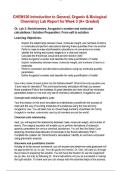
Week 3 of CHEM 120 (Introduction to General, Organic, and Biological Chemistry)
The experiment conducted in Week 3 of CHEM 120 (Introduction to General, Organic, and Biological Chemistry) focused on the identification, classification, and characterization of chemical products formed through selected reactions. The primary objective was to understand how chemical structure influences physical and chemical properties, particularly within the domains of general, organic, and biological chemistry. The products obtained during this experiment were analyzed based on observable characteristics such as color, state, odor, solubility, and reactivity. These characteristics provided essential clues regarding the composition and classification of each substance. In general chemistry, emphasis was placed on ionic and covalent compounds, observing how bonding type influences properties like melting point, conductivity, and solubility in water. The products formed demonstrated predictable trends consistent with theoretical expectations, reinforcing foundational principles such as electronegativity differences and intermolecular forces. In the organic chemistry component, the products were evaluated based on functional groups present within their molecular structures. Functional groups such as alcohols, carboxylic acids, aldehydes, and ketones significantly influenced the chemical behavior of the compounds. For instance, the presence of hydroxyl (-OH) groups contributed to increased polarity and hydrogen bonding, resulting in higher solubility in aqueous solutions. Conversely, nonpolar hydrocarbon chains exhibited limited solubility, highlighting the principle of “like dissolves like.” The reactions performed enabled the transformation of reactants into identifiable organic products, demonstrating mechanisms such as oxidation, substitution, or addition reactions. The biological chemistry aspect of the experiment involved compounds relevant to living systems, such as carbohydrates, proteins, or lipids. The products in this section were examined for biochemical functionality and structural complexity. For example, carbohydrate-based products were tested for the presence of reducing sugars, while protein-related compounds were assessed using colorimetric tests indicating peptide bonds. These analyses provided insight into how chemical structure determines biological function, a key concept in biochemistry. Throughout the experiment, product formation was confirmed through qualitative tests and comparison with known standards. Observations were recorded systematically, ensuring accuracy and reproducibility. The reliability of the results depended on careful measurement, controlled experimental conditions, and proper handling of reagents. Any deviations or unexpected outcomes were critically analyzed, considering possible sources of error such as contamination, incomplete reactions, or measurement inaccuracies. The significance of this experiment lies in its integration of concepts across multiple branches of chemistry. By examining the properties and behaviors of different products, students gain a comprehensive understanding of how chemical principles apply in real-world contexts. The ability to identify and describe products accurately is essential not only in laboratory settings but also in industries such as pharmaceuticals, environmental science, and food chemistry. Furthermore, this experiment enhanced essential laboratory skills, including observation, data recording, critical thinking, and scientific reasoning. Students learned to interpret results, draw logical conclusions, and communicate findings effectively in a structured lab report format. The detailed product description section serves as evidence of analytical ability and understanding of chemical concepts. In conclusion, the products obtained in Week 3 of CHEM 120 demonstrated clear relationships between structure, properties, and reactivity across general, organic, and biological chemistry. The experiment successfully reinforced theoretical knowledge through practical application, contributing to a deeper and more integrated understanding of chemistry as a discipline.
Información del documento
- Subido en
- 19 de abril de 2026
- Número de páginas
- 4
- Escrito en
- 2025/2026
- Tipo
- Examen
- Contiene
- Preguntas y respuestas

