

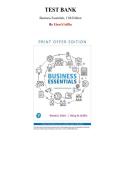
TEST BANK
Business Essentials, 13th Edition
By Ebert\Griffin
LU
XE
LI
BR
AR
Y
, TABLE OF CONTENT
PART 1: THE CONTEMPORARY BUSINESS WORLD
1. The US Business Environment
2. Understanding Business Ethics and Social Responsibility
3. Entrepreneurship, New Ventures, and Business Ownership
4. Understanding the Global Context of Business
PART 2: MANAGING THE BUSINESS
5. Managing the Business
6. Organizing the Business
LU
7. Operations Management and Quality
PART 3: PEOPLE IN ORGANIZATIONS
8. Employee Behavior and Motivation
XE
9. Leadership and Decision Making
10. Human Resource Management and Labor Relations
PART 4: PRINCIPLES OF MARKETING: BUILDING RELATIONSHIPS WITH
CUSTOMERS FOR COMPETITIVE ADVANTAGE
LI
11. Marketing Processes and Consumer Behavior
12. Developing and Pricing Products
13. Distributing and Promoting Products
BR
PART 5: MANAGING INFORMATION FOR BETTER BUSINESS DECISIONS
14. Information Technology (IT) for Business
15. The Role of Accountants and Accounting Information
AR
PART 6: THE FINANCIAL SYSTEM AND ISSUES IN FINANCIAL MANAGEMENT
16. Understanding Money and the Role of Banking
17. Managing Business Finances
Y
, kljhgfdsa
Business Essentials, 13e (Ebert/Griffin)
Chapter 1 The U.S. Business Environment
1) The customs, values, and demographic characteristics of the society in which an organization
functions are the principal elements of the political-legal environment.
Answer: FALSE
Explanation: These are the main considerations of the sociocultural environment. The political-
legal environment reflects the relationship between business and government, usually in the form
of government regulation of business.
Page Ref: 5
LU
Difficulty: Easy
Objective: 1.2
Learning Outcome: Compare and contrast different economic systems
Skill: Concept
2) Physical resources include the data and other information used by businesses.
XE
Answer: FALSE
Explanation: Physical resources are the tangible resources that organizations use to conduct their
business such as natural resources, raw materials, offices, storage and production facilities, parts
and supplies, computers and peripherals, and a variety of other equipment.
Page Ref: 8
Difficulty: Easy
LI
Objective: 1.3
Learning Outcome: Identify the different types of technologies used in business and describe
their uses
Skill: Concept
BR
3) Economic systems differ in how factors of production are used.
Answer: TRUE
Explanation: Different types of economic systems manage the factors of production differently.
In capitalism, for instance, they are managed by private individuals with capital resources, while
in a command economy the government manages the factors of production.
AR
Page Ref: 9
Difficulty: Easy
Objective: 1.3
Learning Outcome: Compare and contrast different economic systems
Skill: Concept
Y
LKJHGFDSA
, kljhgfdsa
4) The point at which the supply curve and the demand curve intersect is the market price.
Answer: TRUE
Explanation: When demand and supply curves are plotted on the same graph, the point at which
they intersect is the point at which demand matches supply, which determines the market price.
Page Ref: 12
Difficulty: Easy
AACSB: Analytic skills
Objective: 1.4
Learning Outcome: Discuss strategies for setting and adjusting prices
Skill: Concept
LU
5) Aggregate output refers to a company's annual production of goods or services.
Answer: FALSE
Explanation: Aggregate output is the total quantity of goods and services produced by an
economic system during a given period.
Page Ref: 17
XE
Difficulty: Moderate
Objective: 1.5
Learning Outcome: Explain how economic performance is monitored
Skill: Concept
6) The United States government manages the collection and spending of its revenues through
LI
monetary policy.
Answer: FALSE
Explanation: The United States government manages the collection and spending of its revenues
through fiscal policy.
BR
Page Ref: 23
Difficulty: Moderate
Objective: 1.5
Learning Outcome: Compare and contrast different economic systems
Skill: Concept
AR
7) The pursuit of profits is how a business differs from organizations such as most universities,
hospitals, and government agencies.
Answer: TRUE
Explanation: The pursuit of profits distinguishes a business from those organizations—such as
most universities, hospitals, and government agencies—that run in much the same way but that
generally don't seek profits.
Page Ref: 4
Y
Difficulty: Easy
Objective: 1.1
Learning Outcome: Explain the entrepreneurship process
Skill: Concept
LKJHGFDSA
Business Essentials, 13th Edition
By Ebert\Griffin
LU
XE
LI
BR
AR
Y
, TABLE OF CONTENT
PART 1: THE CONTEMPORARY BUSINESS WORLD
1. The US Business Environment
2. Understanding Business Ethics and Social Responsibility
3. Entrepreneurship, New Ventures, and Business Ownership
4. Understanding the Global Context of Business
PART 2: MANAGING THE BUSINESS
5. Managing the Business
6. Organizing the Business
LU
7. Operations Management and Quality
PART 3: PEOPLE IN ORGANIZATIONS
8. Employee Behavior and Motivation
XE
9. Leadership and Decision Making
10. Human Resource Management and Labor Relations
PART 4: PRINCIPLES OF MARKETING: BUILDING RELATIONSHIPS WITH
CUSTOMERS FOR COMPETITIVE ADVANTAGE
LI
11. Marketing Processes and Consumer Behavior
12. Developing and Pricing Products
13. Distributing and Promoting Products
BR
PART 5: MANAGING INFORMATION FOR BETTER BUSINESS DECISIONS
14. Information Technology (IT) for Business
15. The Role of Accountants and Accounting Information
AR
PART 6: THE FINANCIAL SYSTEM AND ISSUES IN FINANCIAL MANAGEMENT
16. Understanding Money and the Role of Banking
17. Managing Business Finances
Y
, kljhgfdsa
Business Essentials, 13e (Ebert/Griffin)
Chapter 1 The U.S. Business Environment
1) The customs, values, and demographic characteristics of the society in which an organization
functions are the principal elements of the political-legal environment.
Answer: FALSE
Explanation: These are the main considerations of the sociocultural environment. The political-
legal environment reflects the relationship between business and government, usually in the form
of government regulation of business.
Page Ref: 5
LU
Difficulty: Easy
Objective: 1.2
Learning Outcome: Compare and contrast different economic systems
Skill: Concept
2) Physical resources include the data and other information used by businesses.
XE
Answer: FALSE
Explanation: Physical resources are the tangible resources that organizations use to conduct their
business such as natural resources, raw materials, offices, storage and production facilities, parts
and supplies, computers and peripherals, and a variety of other equipment.
Page Ref: 8
Difficulty: Easy
LI
Objective: 1.3
Learning Outcome: Identify the different types of technologies used in business and describe
their uses
Skill: Concept
BR
3) Economic systems differ in how factors of production are used.
Answer: TRUE
Explanation: Different types of economic systems manage the factors of production differently.
In capitalism, for instance, they are managed by private individuals with capital resources, while
in a command economy the government manages the factors of production.
AR
Page Ref: 9
Difficulty: Easy
Objective: 1.3
Learning Outcome: Compare and contrast different economic systems
Skill: Concept
Y
LKJHGFDSA
, kljhgfdsa
4) The point at which the supply curve and the demand curve intersect is the market price.
Answer: TRUE
Explanation: When demand and supply curves are plotted on the same graph, the point at which
they intersect is the point at which demand matches supply, which determines the market price.
Page Ref: 12
Difficulty: Easy
AACSB: Analytic skills
Objective: 1.4
Learning Outcome: Discuss strategies for setting and adjusting prices
Skill: Concept
LU
5) Aggregate output refers to a company's annual production of goods or services.
Answer: FALSE
Explanation: Aggregate output is the total quantity of goods and services produced by an
economic system during a given period.
Page Ref: 17
XE
Difficulty: Moderate
Objective: 1.5
Learning Outcome: Explain how economic performance is monitored
Skill: Concept
6) The United States government manages the collection and spending of its revenues through
LI
monetary policy.
Answer: FALSE
Explanation: The United States government manages the collection and spending of its revenues
through fiscal policy.
BR
Page Ref: 23
Difficulty: Moderate
Objective: 1.5
Learning Outcome: Compare and contrast different economic systems
Skill: Concept
AR
7) The pursuit of profits is how a business differs from organizations such as most universities,
hospitals, and government agencies.
Answer: TRUE
Explanation: The pursuit of profits distinguishes a business from those organizations—such as
most universities, hospitals, and government agencies—that run in much the same way but that
generally don't seek profits.
Page Ref: 4
Y
Difficulty: Easy
Objective: 1.1
Learning Outcome: Explain the entrepreneurship process
Skill: Concept
LKJHGFDSA

