9706_w25_ms_23.pdf 9706_w25_ms_23.pdf 9706_w25_ms_23.pdf
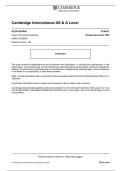
Cambridge International AS & A Level
ACCOUNTING 9706/23
Paper 2 Structured Questions October/November 2025
MARK SCHEME
Maximum Mark: 90
Published
This mark scheme is published as an aid to teachers and candidates, to indicate the requirements of the
examination. It shows the basis on which Examiners were instructed to award marks. It does not indicate the
details of the discussions that took place at an Examiners’ meeting before marking began, which would have
considered the acceptability of alternative answers.
Mark schemes should be read in conjunction with the question paper and the Principal Examiner Report f or
Teachers.
Cambridge International will not enter into discussions about these mark schemes.
Cambridge International is publishing the mark schemes f or the October/November 2025 series f or most
Cambridge IGCSE, Cambridge International A and AS Level components, and some Cambridge O Level
components.
This document consists of 15 printed pages.
© Cambridge University Press & Assessment 2025 [Turn over
9706_w25_ms_23.pdf 9706_w25_ms_23.pdf 9706_w25_ms_23.pdf
, 9706_w25_ms_23.pdf 9706_w25_ms_23.pdf 9706_w25_ms_23.pdf
9706/23 Cambridge International AS & A Level – Mark Scheme October/November
PUBLISHED 2025
Generic Marking Principles
These general marking principles must be applied by all examiners when marking candidate answers.
They should be applied alongside the specific content of the mark scheme or generic level
descriptions for a question. Each question paper and mark scheme will also comply with these
marking principles.
GENERIC MARKING PRINCIPLE 1:
Marks must be awarded in line with:
• the specific content of the mark scheme or the generic level descriptors for the question
• the specific skills defined in the mark scheme or in the generic level descriptors for the question
• the standard of response required by a candidate as exemplified by the standardisation scripts.
GENERIC MARKING PRINCIPLE 2:
Marks awarded are always whole marks (not half marks, or other fractions).
GENERIC MARKING PRINCIPLE 3:
Marks must be awarded positively:
• marks are awarded for correct/valid answers, as defined in the mark scheme. However, credit
is given for valid answers which go beyond the scope of the syllabus and mark scheme,
referring to your Team Leader as appropriate
• marks are awarded when candidates clearly demonstrate what they know and can do
• marks are not deducted for errors
• marks are not deducted for omissions
• answers should only be judged on the quality of spelling, punctuation and grammar when these
features are specifically assessed by the question as indicated by the mark scheme. The
meaning, however, should be unambiguous.
GENERIC MARKING PRINCIPLE 4:
Rules must be applied consistently, e.g. in situations where candidates have not followed
instructions or in the application of generic level descriptors.
GENERIC MARKING PRINCIPLE 5:
Marks should be awarded using the full range of marks defined in the mark scheme for the question
(however; the use of the full mark range may be limited according to the quality of the candidate
responses seen).
GENERIC MARKING PRINCIPLE 6:
Marks awarded are based solely on the requirements as defined in the mark scheme. Marks should
not be awarded with grade thresholds or grade descriptors in mind.
© Cambridge University Press & Assessment 2025 Page 2 of 15
9706_w25_ms_23.pdf 9706_w25_ms_23.pdf 9706_w25_ms_23.pdf
Cambridge International AS & A Level
ACCOUNTING 9706/23
Paper 2 Structured Questions October/November 2025
MARK SCHEME
Maximum Mark: 90
Published
This mark scheme is published as an aid to teachers and candidates, to indicate the requirements of the
examination. It shows the basis on which Examiners were instructed to award marks. It does not indicate the
details of the discussions that took place at an Examiners’ meeting before marking began, which would have
considered the acceptability of alternative answers.
Mark schemes should be read in conjunction with the question paper and the Principal Examiner Report f or
Teachers.
Cambridge International will not enter into discussions about these mark schemes.
Cambridge International is publishing the mark schemes f or the October/November 2025 series f or most
Cambridge IGCSE, Cambridge International A and AS Level components, and some Cambridge O Level
components.
This document consists of 15 printed pages.
© Cambridge University Press & Assessment 2025 [Turn over
9706_w25_ms_23.pdf 9706_w25_ms_23.pdf 9706_w25_ms_23.pdf
, 9706_w25_ms_23.pdf 9706_w25_ms_23.pdf 9706_w25_ms_23.pdf
9706/23 Cambridge International AS & A Level – Mark Scheme October/November
PUBLISHED 2025
Generic Marking Principles
These general marking principles must be applied by all examiners when marking candidate answers.
They should be applied alongside the specific content of the mark scheme or generic level
descriptions for a question. Each question paper and mark scheme will also comply with these
marking principles.
GENERIC MARKING PRINCIPLE 1:
Marks must be awarded in line with:
• the specific content of the mark scheme or the generic level descriptors for the question
• the specific skills defined in the mark scheme or in the generic level descriptors for the question
• the standard of response required by a candidate as exemplified by the standardisation scripts.
GENERIC MARKING PRINCIPLE 2:
Marks awarded are always whole marks (not half marks, or other fractions).
GENERIC MARKING PRINCIPLE 3:
Marks must be awarded positively:
• marks are awarded for correct/valid answers, as defined in the mark scheme. However, credit
is given for valid answers which go beyond the scope of the syllabus and mark scheme,
referring to your Team Leader as appropriate
• marks are awarded when candidates clearly demonstrate what they know and can do
• marks are not deducted for errors
• marks are not deducted for omissions
• answers should only be judged on the quality of spelling, punctuation and grammar when these
features are specifically assessed by the question as indicated by the mark scheme. The
meaning, however, should be unambiguous.
GENERIC MARKING PRINCIPLE 4:
Rules must be applied consistently, e.g. in situations where candidates have not followed
instructions or in the application of generic level descriptors.
GENERIC MARKING PRINCIPLE 5:
Marks should be awarded using the full range of marks defined in the mark scheme for the question
(however; the use of the full mark range may be limited according to the quality of the candidate
responses seen).
GENERIC MARKING PRINCIPLE 6:
Marks awarded are based solely on the requirements as defined in the mark scheme. Marks should
not be awarded with grade thresholds or grade descriptors in mind.
© Cambridge University Press & Assessment 2025 Page 2 of 15
9706_w25_ms_23.pdf 9706_w25_ms_23.pdf 9706_w25_ms_23.pdf