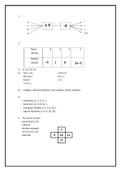
1.
-4
-4 1
6
5k-4
2.
-4 1 6 5k-4
3. 0, 3, 8, 15, 24.
3.1. 2a=1, a=1 1+0+c=0
3(1)+b=3 0+c=-1
3+b=3 c=-1
∴n2+n-1
3.2. Integers, rational numbers, real numbers, prime numbers.
4.
− Arithmetic (1; 2; 3; 4…)
− Geometric (2; 4; 8; 16…)
− Triangular Numbers (1; 3; 6; 10..)
− Square Numbers (1; 4; 9; 16; 25)
5. Yes, this is correct
6+14+20+12= 52
13x4=52
Another example:
3
3+ 9+11+17= 40
10x4=40 9 10 11
17
, OPM1503 Assignment 03
6. Adding the outer four numbers is four times the middle number.
13x4=52
5+7+21+19=52
7. Yes, I agree.
5+7+19+21=6+14+12+20=13x4=52
8.
Level 0 Visualization (Basic visualization or Recognition)
At this level pupils use visual perception and nonverbal thinking. They recognize
geometric figures by their shape and compare the figures with everyday things.
Activity-
Point out the oval:
Level 1 Analysis (Description)
At this level pupils (students) start analysing and naming properties of geometric
figures. They do not see relationships between properties, they think all
properties are important. They do not see a need for proof of facts discovered
empirically. They can measure, fold and cut paper and use geometric software.
Activities will include identifying properties. They don’t link the properties to the
shapes. Activities like making 3D shapes out of template nets is suitable for this
level.
Level 2 Abstraction (Informal deduction or Ordering or Relational)
At this level pupils or students perceive relationships between properties and
shapes. They create meaningful definitions. They can justify their reasoning. They
can draw logical maps and diagrams. They use sketches, grid paper, geometric.
Activities like sketching shapes on graph paper showing their properties is
suitable for the level.
BED 90103 Page 2 of 14
-4
-4 1
6
5k-4
2.
-4 1 6 5k-4
3. 0, 3, 8, 15, 24.
3.1. 2a=1, a=1 1+0+c=0
3(1)+b=3 0+c=-1
3+b=3 c=-1
∴n2+n-1
3.2. Integers, rational numbers, real numbers, prime numbers.
4.
− Arithmetic (1; 2; 3; 4…)
− Geometric (2; 4; 8; 16…)
− Triangular Numbers (1; 3; 6; 10..)
− Square Numbers (1; 4; 9; 16; 25)
5. Yes, this is correct
6+14+20+12= 52
13x4=52
Another example:
3
3+ 9+11+17= 40
10x4=40 9 10 11
17
, OPM1503 Assignment 03
6. Adding the outer four numbers is four times the middle number.
13x4=52
5+7+21+19=52
7. Yes, I agree.
5+7+19+21=6+14+12+20=13x4=52
8.
Level 0 Visualization (Basic visualization or Recognition)
At this level pupils use visual perception and nonverbal thinking. They recognize
geometric figures by their shape and compare the figures with everyday things.
Activity-
Point out the oval:
Level 1 Analysis (Description)
At this level pupils (students) start analysing and naming properties of geometric
figures. They do not see relationships between properties, they think all
properties are important. They do not see a need for proof of facts discovered
empirically. They can measure, fold and cut paper and use geometric software.
Activities will include identifying properties. They don’t link the properties to the
shapes. Activities like making 3D shapes out of template nets is suitable for this
level.
Level 2 Abstraction (Informal deduction or Ordering or Relational)
At this level pupils or students perceive relationships between properties and
shapes. They create meaningful definitions. They can justify their reasoning. They
can draw logical maps and diagrams. They use sketches, grid paper, geometric.
Activities like sketching shapes on graph paper showing their properties is
suitable for the level.
BED 90103 Page 2 of 14