

Metals
- What's the difference between chemical and physical change ?
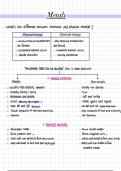
Physical change Chemical change
LI
No new chemical substances New chemical substances
are formed are formed
No chemical reaction occurs A chemical reaction Occurs
usually reversible usually irreversible
The periodic table can be divided into 2 main sections
W
physical properties V
Metals Non-metals
usually high density Group usually low density
usually Silvery/shiny Dull
Malleable and ductile soft and brittle
Solid Mercury Hg-liquid solids , and liquids
gases
High MP and BP Group I low BP and MP Giant Molecular
Good conductor of heat and electricity of heat and
Door conductor
electricity
sonorous Not sonorous
chemical properties
Forms Basic Oxides Forms Acidic oxides
Forms positive ions + Forms negative ions -
react with non-metals to form ionic bonds reacts with metals to form ionic bonds
react with acids to form salt and
hydrogen reacts with non-metals to form
covalent bonds
- What's the difference between chemical and physical change ?
Physical change Chemical change
LI
No new chemical substances New chemical substances
are formed are formed
No chemical reaction occurs A chemical reaction Occurs
usually reversible usually irreversible
The periodic table can be divided into 2 main sections
W
physical properties V
Metals Non-metals
usually high density Group usually low density
usually Silvery/shiny Dull
Malleable and ductile soft and brittle
Solid Mercury Hg-liquid solids , and liquids
gases
High MP and BP Group I low BP and MP Giant Molecular
Good conductor of heat and electricity of heat and
Door conductor
electricity
sonorous Not sonorous
chemical properties
Forms Basic Oxides Forms Acidic oxides
Forms positive ions + Forms negative ions -
react with non-metals to form ionic bonds reacts with metals to form ionic bonds
react with acids to form salt and
hydrogen reacts with non-metals to form
covalent bonds

