4/5/26, 7:19 PM NSG 3800 Exam 4 Review
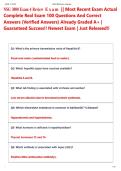
NSG 3800 Exam 4 Review E x a m || Most Recent Exam Actual
Complete Real Exam 100 Questions And Correct
Answers (Verified Answers) Already Graded A+ |
Guaranteed Success!! Newest Exam | Just Released!!
Q1: What is the primary transmission route of Hepatitis A?
Fecal-oral route (contaminated food or water).
Q2: Which hepatitis types have vaccines available?
Hepatitis A and B.
Q3: What lab finding is associated with cirrhosis and ascites?
Low serum albumin due to decreased protein synthesis.
Q4: Which electrolyte imbalance is common in Addison’s disease?
Hyponatremia and hyperkalemia.
Q5: What hormone is deficient in hypothyroidism?
Thyroid hormones T3 and T4.
Q6: Which antibody is associated with lupus (SLE)?
Positive ANA (antinuclear antibody).
/ 1/16
,4/5/26, 7:19 PM NSG 3800 Exam 4 Review
Q7: What is the hallmark sign of Hodgkin lymphoma?
Presence of Reed-Sternberg cells.
Q8: Which protein is found in urine in multiple myeloma?
Bence-Jones protein.
Q9: What CD4 count defines progression from HIV to AIDS?
CD4 count <200 cells/μL.
Q10: Which dietary change is needed for hyperparathyroidism?
Avoid high-calcium foods; encourage fluids and mobility.
Q11: A client with acute cholecystitis reports RUQ pain radiating to the shoulder
after eating. What is the likely cause?
Gallbladder inflammation triggered by fatty food intake.
Q12: A nurse notes tremors, weight loss, and exophthalmos in a patient. Which
disorder is suspected?
Hyperthyroidism (Graves’ disease).
Q13: A client with Addison’s disease is admitted with severe hypotension. What
is the priority action?
Administer IV corticosteroids and fluids to treat Addisonian crisis.
/ 2/16
, 4/5/26, 7:19 PM NSG 3800 Exam 4 Review
Q14: A client develops tetany after thyroidectomy. What is the cause?
Hypocalcemia from possible parathyroid removal.
Q15: A client with cirrhosis develops confusion and asterixis. What lab finding
explains this?
Elevated serum ammonia levels causing hepatic encephalopathy.
Q16: A client with SLE presents with pericarditis and proteinuria. What does this
indicate?
Systemic involvement of lupus affecting heart and kidneys.
Q17: A client receiving chemotherapy is neutropenic. Which precaution is most
important?
Protective isolation: no fresh fruit, flowers, or sick visitors.
Q18: A client with non-Hodgkin lymphoma is at risk for tumor lysis syndrome. Which
lab is expected?
Hyperkalemia, hyperphosphatemia, hyperuricemia.
Q19: A client with Cushing’s syndrome reports easy bruising and purple
striae. What is the cause?
Excess cortisol leading to protein breakdown and skin fragility.
Q20: A patient with HIV has white plaques in the mouth that bleed when scraped.
What is this?
Oral candidiasis (thrush), a common opportunistic infection.
/ 3/16