Tutorial 7. Uniform Open Channel Flow
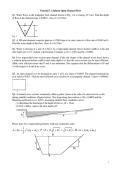
Q1. Water flows in the triangular steel channel shown in Fig. 1 at a velocity of 1 m/s. Find the depth
of flow if the channel slope is 0.0015. (Ans: d = 0.747m)
55o d
Fig. 1
Q2. A 500 mm diameter concrete pipe on a 1/500 slope is to carry water at a flow rate of 0.040 m3/s.
Find the water depth of the flow. (Ans: h = 0.152m)
Q3. Water is flowing at a rate of 4.5m3/s in a trapezoidal channel whose bottom width is 2.4m and
side slopes are 1:2 (1 vertical, 2 horizontal). Compute y0 if n = 0.012 and S0 = 0.0001.
Q4. For a trapezoidal cross-section open channel, if the side slopes of the channel m are fixed, derive
a relation between bottom width b and water depth h so that the cross-section can be most efficient.
(Hint: most efficient means that P and A are minimum. This requires that the differentiates of P and
A with respect to b and h are zero).
Q5. An open channel is to be designed to carry 1 m3/s at a slope of 0.0065. The channel material has
an n value of 0.011. Find the most efficient cross section for a rectangular channel. (Ans:b = 0.869m)
y
b
Q6. A channel cross section, commonly called a gutter, forms at the side of a street next to a curb
during rainfall conditions (Figure below). The slope along the roadway is S0 = 0.0005 and the
Manning coefficient is n = 0,015. Assuming uniform flow conditions occur:
(1) determine the discharge if the depth of flow is y0 = 12cm
(2) If Q = 80L/s, what is the flow depth y0?
Please note: for a trapezoidal geometry with non-symmetric sides,
1 2
A = by + y (m1 + m2 ) ; P = b + y ( 1 + m1 + 1 + m2 ) ; B = b + y(m1 + m2 )
2 2
2
B
1
1
y
m2
m1
b
1