

Written by students who passed Immediately available after payment Read online or as PDF Wrong document? Swap it for free 4,6 TrustPilot
logo-home
Exam (elaborations)

FIN 302 EXAM 2 QUESTIONS ANSWERED CORRECTLY LATEST UPDATE 2026

Rating
-
Sold
-
Pages
4
Grade
A+
Uploaded on
04-04-2026
Written in
2025/2026

FIN 302 EXAM 2 QUESTIONS ANSWERED CORRECTLY LATEST UPDATE 2026 NPV is the price of a zero coupon bond - Answers EAA (npv) - Answers choose b/w mutually exclusive projects with different lives payback period (most helpul?) - Answers an effective measure of investment risk. The project with a shortest payback period has less risk than with the project with longer payback period, often used when liquidity is an important criteria to choose a project, suitable for projects of small investments. downfalls of npv - Answers doesn't measure the project size, sensitivity to discount rates, doesn't include real options, requires that the investor know the exact discount rate, the size of each cash flow, and when each cash flow will occur, only useful for comparing projects at the same time; it does not fully build in opportunity cost, does not provide an overall picture of the gain or loss of executing a certain project ytm - Answers - the rate that makes the pv of the bonds cash flows equal the price of bond - the rate of return a bondholder earns is held to maturity, all coupon and principal payments are made, and cpn payments are reinvested at the same yield bond price - Answers P = PV(Annuity of N payments of CPN) + PV(Single cash flow from repayment of face value) ** pv of cash flows discounted at YTM = to bond price ** discount separately and add them up realized bond yields - Answers - return earned on a bond given the cash flows actually received - interest rate at which the pv of actual cash flows = bond price - allows investors to see what they actually earned on investments (evaluate performance) holding period return - Answers $100 fv bond cpn 10% semi annual - 6 months later, can sell for 97 and collect 5 -hpr: total value is 102, so 102/100 = 0.2 2% total for 6 months, so a year is (1.02)^2 = 1.0404 - realized return useful for comparing returns b/w investments for different periods of time {[(Income + (End of Period Value - Initial Value)] / Initial Value+ 1}1/t - 1 bond valuation - Answers Par: price = face value ; ytm = coupon rate Discount: price face value ; YTM coupon rate Premium: price face value ; YTM coupon rate bond price - interest rate - Answers inversely related - prices of long term bonds and lower coupon bonds change more - interest rate risk increases as maturity increases, but at a decreasing rate default risk - Answers risk that borrow may not make payments - default risk premium : yield on security with default risk - risk free rate bond option provisions - Answers callability- issuer can pay back loan before it matures putability- bondholder can demand payment before maturity (can force company to buy it back from you) convertability- bondholder can exchange the bond for stocks of the issuer primary markets - Answers raise capital sold: - government securities (auctioned) - corporate, federal agencies debt, municipal bonds, mortgage-baked securities (underwritten by investment banks) - equity (through public offering IPO) primary market example - Answers TSLA sells stock to investment bank Then they sell to investors Example of risk shifting "road show" secondary market - Answers ex: used car market - investors usually trade through brokers - brokers help trade w/out taking position (no inventory) - broker guarantees investors can pay and can deliver secondary market example - Answers Me → buy 10 shares (AAPL) → raymond james broker → stock market ← sell 10 shares (AAPL) ← Schwab how do brokers trade? - Answers 1. exchanges (traditional floor trading, electronic limit order book) - otc markets (dealers) - electronic communications network (direct trade among investors, nms) orders - Answers 1. limit order (max and min prices), limit time 2. market order (most simple), best available price, no restrictions 3. stop-loss order - can search for other broker - stop loss order - Answers 35 shares AAPL @ $135, if price per share hits that number, broker is automatically going to submit market order for 35 shares - different from limit order, bc if put 35 it would trade right away **still hold onto shares unless u hit price **protect urself from rapid price movements market marker - Answers dealer, quote bid and ask prices, holds inventory, provides a service (immediacy, liquidity) - price of liquidity: bid-ask spread (amount by which the ask price exceeds the bid price for an asset in the market.) trading costs - Answers explicit: commission (fee to broke)r implicit: bid ask spread buying on margin - Answers - investor borrows part of purchase price from broker -broker charges interest -securities are held as collateral by broker short sales - Answers - selling shares of a firm i don't own by borrowing the security, and replacing it later (dividends) - profit is made if short position is covered at a price lower than the one which it was established - bearish investment or as a hedge arbitrage - Answers a zero investment trading strategy that generates a sure profit 1. no initial investment 2. non neg cash flows at all times 3. positive cash flow at some times portfolio - Answers group of financial assets Think of it as a hybrid asset No arbitrage condition - Answers cannot be arbitrage opportunities, b/c ppl would trade to exploit it law of one price - Answers 2 securities have the same payoffs, buy low sell high replicating portfolio - Answers if portfolio has the same payoff as a security, the price of the security must be equal to the price of the portfolio dynamic hedging strategy - Answers if a self financing trading strategy has the same final payoff as a security, the price of the security must be equal to the cost of the strategy real world arbitrage strategies - Answers - mis pricing and convergence trades (index arbitrage, fixed income securities) - mergers and acquisitions - devaluations of currency - IPO stocks - Answers equity securities - certificates of ownership in a corporation common stock and preferred stock - Answers represent ownership interest - 2 most frequently used type of equity securities - dividend payments don't affect taxes and are not guaranteed but promised - limited liability so claims can't include stockholder's personal assets - viewed as perpetuities b/c no maturity date common stock - Answers - basic ownership claim - right to vote on electing board, setting capital budged, and mergers/acquisitions - right to firm's residual assets after creditors, preferred stockholders, and others intrinsic value - Answers the discounted value of the cash that can be taken out of a business during its remaining life (Po= vo = PV (all future cash flows) → dividends) limitations - Answers uncertainty in dividend forecasts, difficult to estimate growth rate, issue of non dividend paying stock pe ratio - Answers Price/share / earings/share → measuring $ paid per $ of earnings Po/Eo (backwards) does not equal Po/E1 (Forwards) problem: only incorporates one year's worth of earnings Growth (earnings) - Answers earning a high return on reinvested earnings b - reinvestment/retention rate (% of earnings not paid as dividends) dividends - dividend payout ratio growth rate: g = b x ROI ROE= roi within firm

Show more Read less
Institution
FIN 302
Course
FIN 302

Content preview

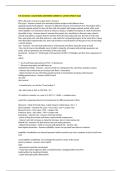
FIN 302 EXAM 2 QUESTIONS ANSWERED CORRECTLY LATEST UPDATE 2026

NPV is the price of a zero coupon bond - Answers
EAA (npv) - Answers choose b/w mutually exclusive projects with different lives
payback period (most helpul?) - Answers an effective measure of investment risk. The project with a
shortest payback period has less risk than with the project with longer payback period, often used
when liquidity is an important criteria to choose a project, suitable for projects of small investments.
downfalls of npv - Answers doesn't measure the project size, sensitivity to discount rates, doesn't
include real options, requires that the investor know the exact discount rate, the size of each cash
flow, and when each cash flow will occur, only useful for comparing projects at the same time; it does
not fully build in opportunity cost, does not provide an overall picture of the gain or loss of executing
a certain project
ytm - Answers - the rate that makes the pv of the bonds cash flows equal the price of bond
- the rate of return a bondholder earns is held to maturity, all coupon and principal payments are
made, and cpn payments are reinvested at the same yield
bond price - Answers P = PV(Annuity of N payments of CPN) + PV(Single cash flow from repayment of
face
value)

** pv of cash flows discounted at YTM = to bond price
** discount separately and add them up
realized bond yields - Answers - return earned on a bond given the cash flows actually received
- interest rate at which the pv of actual cash flows = bond price
- allows investors to see what they actually earned on investments (evaluate performance)
holding period return - Answers $100 fv bond
cpn 10%
semi annual

- 6 months later, can sell for 97 and collect 5

-hpr: total value is 102, so 102/100 = 0.2

2% total for 6 months, so a year is (1.02)^2 = 1.0404 -> realized return

useful for comparing returns b/w investments for different periods of time

{[(Income + (End of Period Value - Initial Value)] / Initial Value+ 1}1/t - 1
bond valuation - Answers Par: price = face value ; ytm = coupon rate
Discount: price < face value ; YTM > coupon rate
Premium: price > face value ; YTM < coupon rate
bond price - interest rate - Answers inversely related
- prices of long term bonds and lower coupon bonds change more
- interest rate risk increases as maturity increases, but at a decreasing rate
default risk - Answers risk that borrow may not make payments
- default risk premium : yield on security with default risk - risk free rate
bond option provisions - Answers callability- issuer can pay back loan before it matures

putability- bondholder can demand payment before maturity (can force company to buy it back from
you)

convertability- bondholder can exchange the bond for stocks of the issuer
primary markets - Answers raise capital
sold:
- government securities (auctioned)
- corporate, federal agencies debt, municipal bonds, mortgage-baked securities
(underwritten by investment banks)
- equity (through public offering IPO)

Written for

Institution
FIN 302
Course
FIN 302

Document information

Uploaded on
April 4, 2026
Number of pages
4
Written in
2025/2026
Type
Exam (elaborations)
Contains
Questions & answers

Subjects

$11.89
Get access to the full document:

Wrong document? Swap it for free Within 14 days of purchase and before downloading, you can choose a different document. You can simply spend the amount again.
Written by students who passed
Immediately available after payment
Read online or as PDF


Document also available in package deal

Thumbnail
Package deal
FIN 302 BUNDLED QUESTIONS ANSWERED CORRECTLY LATEST UPDATE 2026/2027
-
7 2026
$ 43.74 More info

Get to know the seller

Seller avatar
Reputation scores are based on the amount of documents a seller has sold for a fee and the reviews they have received for those documents. There are three levels: Bronze, Silver and Gold. The better the reputation, the more your can rely on the quality of the sellers work.
joshuawesonga22 Liberty University
View profile
Follow You need to be logged in order to follow users or courses
Sold
110
Member since
1 year
Number of followers
2
Documents
14773
Last sold
2 days ago
Tutor Wes

Hi there! I'm Tutor Wes, a dedicated tutor with a passion for sharing knowledge and helping others succeed academically. All my notes are carefully organized, detailed, and easy to understand. Whether you're preparing for exams, catching up on lectures, or looking for clear summaries, you'll find useful study materials here. Let’s succeed together!

3.4

12 reviews

5
4
4
1
3
4
2
2
1
1

Why students choose Stuvia

Created by fellow students, verified by reviews

Quality you can trust: written by students who passed their exams and reviewed by others who've used these notes.

Didn't get what you expected? Choose another document

No worries! You can immediately select a different document that better matches what you need.

Pay how you prefer, start learning right away

No subscription, no commitments. Pay the way you're used to via credit card or EFT and download your PDF document instantly.

Student with book image

“Bought, downloaded, and aced it. It really can be that simple.”

Alisha Student

Working on your references?

Create accurate citations in APA, MLA and Harvard with our free citation generator.

Working on your references?

Frequently asked questions
