

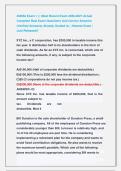
AWMA Exam 1 || Most Recent Exam 2026-2027 Actual
Complete Real Exam Questions And Correct Answers
(Verified Answers) Already Graded A+ | Newest Exam |
Just Released!!
XYZ Inc., a C corporation, has $200,000 in taxable income this
tax year. It distributes half to its shareholders in the form of
cash dividends. As far as XYZ Inc. is concerned, which one of
the following amounts, if any, is subject to the corporate
income tax?
A)$150,000 (Half of corporate dividends are deductible.)
B)$100,000 (This is $200,000 less the dividend distribution.)
C)$0 (C corporations do not pay income tax.)
D)$200,000 (None of the corporate dividends are deductible.) -
ANSWER -D)
Since XYZ Inc. has taxable income of $200,000, that is the
amount subject to
tax. Dividends are not
deductible. Mod 4
Bill Dunston is the sole shareholder of Dunston Press, a small
publishing company. All of the employees of Dunston Press are
considerably younger than Bill, turnover is relatively high, and
12 of his 20 employees are part time. He is considering
implementing a retirement plan for the company and wants to
avoid fixed contribution obligations. He also wants to receive
the maximum benefit possible. Which one of the following
plans would be most appropriate, considering Bill wants to
,maximize contributions on his behalf relative to those of the
other employees?
A)Cross-tested profit sharing plan
B)Salary reduction SEP plan
C)Age-weighted profit sharing plan
D)Money purchase pension plan - ANSWER -C) An age-
weighted profit sharing plan allocates contributions on the
basis of age, which would work to Bill's advantage since he is
the oldest employee. Money purchase plans and SARSEPs
require the same contribution percentage for all employees. A
crosstested profit sharing plan is used to allocate contributions
on the basis of compensation. Mod 4
With a profit sharing plan, the employer
A)need not make contributions each year, but must make
substantial and recurring contributions.
B)has a defined benefit plan.
C)must make contributions each year.
D)may contribute no more than 15% of covered payroll. -
ANSWER -A) One advantage of a profit sharing plan for the
employer is that the employer need not make contributions
each year. With a profit sharing plan, the employer may
contribute up to 25% of covered payroll. Mod 4
Which one of the following is NOT an allowable itemized
deduction in
,computing the alternative minimum
taxable income?
A)Investment interest expense
B)State and local income taxes
C)Qualified housing interest
D)Charitable contribution deduction - ANSWER -B) State and
local income taxes are not an allowable itemized deduction for
the AMT. Thus, clients in states with high income taxes (and
property taxes) are more likely to be affected by the AMT than
those in states with lower taxes. Remember that only $10,000 of
taxes may be deducted as an itemized deduction. Mod 5
Which one of the following statements is true with regard to
self-employment
taxes?
A)Net earnings from self-employment must be calculated
under the accrual
method of
accounting.
B)Self-employment tax is the government's way of
discouraging entrepreneurship and innovation.
C)Once the wage base has been exceeded, there is no self-
employment tax on the excess.
D)A taxpayer is allowed to deduct one-half of his or her self-
employment tax liability as an adjustment to income. -
ANSWER -D) A taxpayer may deduct one-half of his or her self-
, employment tax liability as an "above the line" deduction—an
adjustment to income. Mod 5
Which one of the following statements is incorrect regarding
investment interest
expense?
A)Interest paid or accrued to purchase or carry tax-exempt
investments is not deductible.
B)Investment interest expense is deductible up to the amount
of the net investment income.
C)Investment interest expense may only be deducted if the
taxpayer itemizes. D)Excess investment interest expense
cannot be carried forward into succeeding tax years. -
ANSWER -D) Net investment income is the taxpayer's
investment income—typically interest, nonqualified dividends,
and short-term capital gains. Investment interest is an itemized
deduction. Excess investment interest expense can be carried
forward into succeeding tax years. Mod 5
For a taxpayer with an AGI in excess of $150,000 for the prior tax
year ($75,000
if married filing separately), the estimated tax penalty
safe harbor is
A)90% of the current year's tax liability or 100% of the prior
year's tax liability.
B)110% of the current year's tax liability or 125% of the prior
year's tax liability.
Complete Real Exam Questions And Correct Answers
(Verified Answers) Already Graded A+ | Newest Exam |
Just Released!!
XYZ Inc., a C corporation, has $200,000 in taxable income this
tax year. It distributes half to its shareholders in the form of
cash dividends. As far as XYZ Inc. is concerned, which one of
the following amounts, if any, is subject to the corporate
income tax?
A)$150,000 (Half of corporate dividends are deductible.)
B)$100,000 (This is $200,000 less the dividend distribution.)
C)$0 (C corporations do not pay income tax.)
D)$200,000 (None of the corporate dividends are deductible.) -
ANSWER -D)
Since XYZ Inc. has taxable income of $200,000, that is the
amount subject to
tax. Dividends are not
deductible. Mod 4
Bill Dunston is the sole shareholder of Dunston Press, a small
publishing company. All of the employees of Dunston Press are
considerably younger than Bill, turnover is relatively high, and
12 of his 20 employees are part time. He is considering
implementing a retirement plan for the company and wants to
avoid fixed contribution obligations. He also wants to receive
the maximum benefit possible. Which one of the following
plans would be most appropriate, considering Bill wants to
,maximize contributions on his behalf relative to those of the
other employees?
A)Cross-tested profit sharing plan
B)Salary reduction SEP plan
C)Age-weighted profit sharing plan
D)Money purchase pension plan - ANSWER -C) An age-
weighted profit sharing plan allocates contributions on the
basis of age, which would work to Bill's advantage since he is
the oldest employee. Money purchase plans and SARSEPs
require the same contribution percentage for all employees. A
crosstested profit sharing plan is used to allocate contributions
on the basis of compensation. Mod 4
With a profit sharing plan, the employer
A)need not make contributions each year, but must make
substantial and recurring contributions.
B)has a defined benefit plan.
C)must make contributions each year.
D)may contribute no more than 15% of covered payroll. -
ANSWER -A) One advantage of a profit sharing plan for the
employer is that the employer need not make contributions
each year. With a profit sharing plan, the employer may
contribute up to 25% of covered payroll. Mod 4
Which one of the following is NOT an allowable itemized
deduction in
,computing the alternative minimum
taxable income?
A)Investment interest expense
B)State and local income taxes
C)Qualified housing interest
D)Charitable contribution deduction - ANSWER -B) State and
local income taxes are not an allowable itemized deduction for
the AMT. Thus, clients in states with high income taxes (and
property taxes) are more likely to be affected by the AMT than
those in states with lower taxes. Remember that only $10,000 of
taxes may be deducted as an itemized deduction. Mod 5
Which one of the following statements is true with regard to
self-employment
taxes?
A)Net earnings from self-employment must be calculated
under the accrual
method of
accounting.
B)Self-employment tax is the government's way of
discouraging entrepreneurship and innovation.
C)Once the wage base has been exceeded, there is no self-
employment tax on the excess.
D)A taxpayer is allowed to deduct one-half of his or her self-
employment tax liability as an adjustment to income. -
ANSWER -D) A taxpayer may deduct one-half of his or her self-
, employment tax liability as an "above the line" deduction—an
adjustment to income. Mod 5
Which one of the following statements is incorrect regarding
investment interest
expense?
A)Interest paid or accrued to purchase or carry tax-exempt
investments is not deductible.
B)Investment interest expense is deductible up to the amount
of the net investment income.
C)Investment interest expense may only be deducted if the
taxpayer itemizes. D)Excess investment interest expense
cannot be carried forward into succeeding tax years. -
ANSWER -D) Net investment income is the taxpayer's
investment income—typically interest, nonqualified dividends,
and short-term capital gains. Investment interest is an itemized
deduction. Excess investment interest expense can be carried
forward into succeeding tax years. Mod 5
For a taxpayer with an AGI in excess of $150,000 for the prior tax
year ($75,000
if married filing separately), the estimated tax penalty
safe harbor is
A)90% of the current year's tax liability or 100% of the prior
year's tax liability.
B)110% of the current year's tax liability or 125% of the prior
year's tax liability.

