PHIL 347 Critical Thinking Week 3 Checkpoint Quiz practice exam questions and answers new complete exam docs
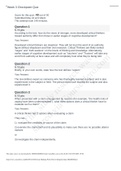
Week 3 Checkpoint Quiz Score for this quiz: 48 out of 50 Submitted May 24 at 6:04pm This attempt took 149 minutes. Question 1 5 / 5 pts According to the text, how do the views of stronger, more developed critical thinkers toward authority differ from those in earlier stages of cognitive development? Your Answer: Developed critical thinkers are skeptical. They will not trust the word of an authority figure without skepticism and their own research. Critical Thinkers are likely ranked "sages" and "truth-seekers" on the levels of thinking and knowledge. Alternatively, earlier stages of cognitive development such as "touchers" and "Trusters" will take any word from authority at face value and will completely trust what they're being told. Question 2 5 / 5 pts Briefly, in your own words, state how the text defines “expert.” Your Answer: The text defines expert as someone who has thoroughly learned a subject and is also experienced in the subject or field. The person must have learned the subject and also experienced it. Question 3 5 / 5 pts When presented with a claim unsupported by reasons (for example, “the health risks of vaping have been underestimated”), what three options does a critical thinker have to evaluate such a claim? Your Answer: A critical thinker has 3 options when evaluating a claim They can.... 1) evaluate the credibility or source of the claim 2) examine the claim itself and its plausibility to make sure there are no possible ulterior motives or 3) investigate the claim independently. This study source was downloaded by from CourseH on :02:58 GMT -05:00 This study resource was shared via CourseH Question 4 5 / 5 pts Is the following statement true or untrue? Explain your answer. “If a claim cannot be confirmed by an independent investigation, then it must be false.” Your Answer: If a claim cannot be confirmed by independent investigation, than we need to disconfirm the claim with independent investigation to say that the claim is false. Without disconfirming the claim we cannot say that it is false. We should withhold or suspend judgement or make no judgement at all. therefore, the above statement is untrue. Question 5 5 / 5 pts Is the following statement true or untrue? Explain your answer. “If we do not believe that a claim is true, then we must believe that the claim is false.” Your Answer: If we do not believe that a claim is true, then we should pass no judgement on the claim until we have evaluated it with independent research. If we are able to prove that the claim is false, then we must believe that the claim is false. We can not pass judgement alone on only our belief that the claim is not true. Question 6 5 / 5 pts What four conditions must an argument meet if we are to accept the worthiness and reasonableness of its conclusions? Your Answer: There are four conditions that must be met to accept the conclusions (or reasons) it proposes: " 1. To the best of our knowledge and understanding, the reason is true" 2. The logical relationship between the reason and the claim is such that the reason implies, entails, strongly warrants or strongly supports the claim, such that the claim must be or very probably true if the reason is assumed to be true 3. the relevance of the reason to the claim is such that the truth of the claim actually depends on the truth of the reason 4. the flow of the reasoning is such that the truth of reason must not be dependent on the truth of the claim" ........................
Escuela, estudio y materia
- Institución
-
American Public University
- Grado
-
PHIL 347
Información del documento
- Subido en
- 20 de abril de 2021
- Número de páginas
- 4
- Escrito en
- 2022/2023
- Tipo
- Examen
- Contiene
- Preguntas y respuestas
Temas
- phil 347
- according to the text
- briefly
- in your own words
-
how do the views of stronger
-
more developed critical thinkers toward authority differ from those in earlier stages of cognitive development

Documento también disponible en un lote