
@Expert Mercy
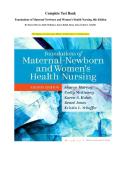
Complete Test Bank
Foundations of Maternal-Newborn and Women's Health Nursing, 8th Edition
By Sharon Murray, Emily McKinney, Karen Holub, Renee Jones, Kristin L. Scheffer
(All Chapters Covered, Latest Edition, Verified Answers with Rationales)
@Mercy Expert
,@Expert Mercy
Chapter 01: Maternity and Women’s Health Care Today
MULTIPLE CHOICE
1. A nurse educator is teaching a group of nursing students about the history of family-
centered maternity care. Which statement should the nurse include in the teaching session?
a. The Sheppard-Towner Act of 1921 promoted family-centered care.
b. Changes in pharmacologic management of labor prompted family-centered care.
c. Demands by physicians for family involvement in childbirth increased the practice of
family-centered care.
d. Parental requests that infants be allowed to remain with them rather than in a nursery
initiated the practice of family-centered care.
Answer: D
As research began to identify the benefits of early, extended parent–infant contact, parents began
to insist that the infant remain with them. This gradually developed into the practice of rooming-
in and finally to family-centered maternity care. The Sheppard-Towner Act provided funds for
state-managed programs for mothers and children but did not promote
family-centered care. The changes in pharmacologic management of labor were not a factor in
family-centered maternity care. Family-centered care was a request by parents, not physicians.
DIF: Cognitive Level: Application OBJ: Nursing Process Step: Planning MSC: Patient Needs:
Health Promotion and Maintenance
2. Expectant parents ask a prenatal nurse educator, ―Which setting for childbirth limits the
amount of parent–infant interaction? Which answer should the nurse provide for these parents in
order to assist them in choosing an appropriate birth setting?
a. Birth center
b. Home birth
c. Traditional hospital birth
d. Labor, birth, and recovery room
Answer: C
@Mercy Expert
,@Expert Mercy
In the traditional hospital setting, the mother may see the infant for only short feeding periods,
and the infant is cared for in a separate nursery. Birth centers are set up to allow an increase in
parent–infant contact. Home births allow the greatest amount of parent–infant contact. The labor,
birth, recovery, and postpartum room setting allows for increased parent–infant contact.
DIF: Cognitive Level: Understanding OBJ: Nursing Process Step: Planning MSC: Patient
Needs: Health Promotion and Maintenance
3. Which statement best describes the advantage of a labor, birth, recovery, and postpartum
(LDRP) room?
a. The family is in a familiar environment.
b. They are less expensive than traditional hospital rooms.
c. The infant is removed to the nursery to allow the mother to rest.
d. The woman‘s support system is encouraged to stay until discharge.
Answer: D
Sleeping equipment is provided in a private room. A hospital setting is never a familiar
environment to new parents. An LDRP room is not less expensive than a traditional hospital
room. The baby remains with the mother at all times and is not removed to the nursery for
routine care or testing. The father or other designated members of the mother‘s support system
are encouraged to stay at all times.
DIF: Cognitive Level: Understanding OBJ: Nursing Process Step: Assessment MSC:
Patient Needs: Health Promotion and Maintenance
4. Which nursing intervention is an independent function of the professional nurse?
a. Administering oral analgesics
b. Requesting diagnostic studies
c. Teaching the patient perineal care
@Mercy Expert
, @Expert Mercy
d. Providing wound care to a surgical incision
Answer: C
Nurses are now responsible for various independent functions, including teaching, counseling,
and intervening in nonmedical problems. Interventions initiated by the physician and carried out
by the nurse are called dependent functions. Administrating oral analgesics is a dependent
function; it is initiated by a physician and carried out by a nurse. Requesting diagnostic studies is
a dependent function. Providing wound care is a dependent function; however, the physician
prescribes the type of wound care through direct orders or protocol.
DIF: Cognitive Level: Understanding OBJ: Nursing Process Step: Assessment MSC:
Patient Needs: Safe and Effective Care Environment
5. Which response by the nurse is the most therapeutic when the patient states, ―I‘m so
afraid to have a cesarean birth ?
a. ―Everything will be OK.
b. ―Don‘t worry about it. It will be over soon.
c. ―What concerns you most about a cesarean birth?
d. ―The physician will be in later and you can talk to him.
Answer: C
The response, ―What concerns you most about a cesarean birth focuses on what the patient is
saying and asks for clarification, which is the most therapeutic response. The response,
―Everything will be ok is belittling the patient‘s feelings. The response, ―Don‘t worry about
it. It will be over soon will indicate that the patient‘s feelings are not important. The response,
―The physician will be in later and you can talk to him does not allow the patient to verbalize
her feelings when she wishes to do that.
DIF: Cognitive Level: Application OBJ: Nursing Process Step: Implementation MSC: Patient
Needs: Psychosocial Integrity
@Mercy Expert
Complete Test Bank
Foundations of Maternal-Newborn and Women's Health Nursing, 8th Edition
By Sharon Murray, Emily McKinney, Karen Holub, Renee Jones, Kristin L. Scheffer
(All Chapters Covered, Latest Edition, Verified Answers with Rationales)
@Mercy Expert
,@Expert Mercy
Chapter 01: Maternity and Women’s Health Care Today
MULTIPLE CHOICE
1. A nurse educator is teaching a group of nursing students about the history of family-
centered maternity care. Which statement should the nurse include in the teaching session?
a. The Sheppard-Towner Act of 1921 promoted family-centered care.
b. Changes in pharmacologic management of labor prompted family-centered care.
c. Demands by physicians for family involvement in childbirth increased the practice of
family-centered care.
d. Parental requests that infants be allowed to remain with them rather than in a nursery
initiated the practice of family-centered care.
Answer: D
As research began to identify the benefits of early, extended parent–infant contact, parents began
to insist that the infant remain with them. This gradually developed into the practice of rooming-
in and finally to family-centered maternity care. The Sheppard-Towner Act provided funds for
state-managed programs for mothers and children but did not promote
family-centered care. The changes in pharmacologic management of labor were not a factor in
family-centered maternity care. Family-centered care was a request by parents, not physicians.
DIF: Cognitive Level: Application OBJ: Nursing Process Step: Planning MSC: Patient Needs:
Health Promotion and Maintenance
2. Expectant parents ask a prenatal nurse educator, ―Which setting for childbirth limits the
amount of parent–infant interaction? Which answer should the nurse provide for these parents in
order to assist them in choosing an appropriate birth setting?
a. Birth center
b. Home birth
c. Traditional hospital birth
d. Labor, birth, and recovery room
Answer: C
@Mercy Expert
,@Expert Mercy
In the traditional hospital setting, the mother may see the infant for only short feeding periods,
and the infant is cared for in a separate nursery. Birth centers are set up to allow an increase in
parent–infant contact. Home births allow the greatest amount of parent–infant contact. The labor,
birth, recovery, and postpartum room setting allows for increased parent–infant contact.
DIF: Cognitive Level: Understanding OBJ: Nursing Process Step: Planning MSC: Patient
Needs: Health Promotion and Maintenance
3. Which statement best describes the advantage of a labor, birth, recovery, and postpartum
(LDRP) room?
a. The family is in a familiar environment.
b. They are less expensive than traditional hospital rooms.
c. The infant is removed to the nursery to allow the mother to rest.
d. The woman‘s support system is encouraged to stay until discharge.
Answer: D
Sleeping equipment is provided in a private room. A hospital setting is never a familiar
environment to new parents. An LDRP room is not less expensive than a traditional hospital
room. The baby remains with the mother at all times and is not removed to the nursery for
routine care or testing. The father or other designated members of the mother‘s support system
are encouraged to stay at all times.
DIF: Cognitive Level: Understanding OBJ: Nursing Process Step: Assessment MSC:
Patient Needs: Health Promotion and Maintenance
4. Which nursing intervention is an independent function of the professional nurse?
a. Administering oral analgesics
b. Requesting diagnostic studies
c. Teaching the patient perineal care
@Mercy Expert
, @Expert Mercy
d. Providing wound care to a surgical incision
Answer: C
Nurses are now responsible for various independent functions, including teaching, counseling,
and intervening in nonmedical problems. Interventions initiated by the physician and carried out
by the nurse are called dependent functions. Administrating oral analgesics is a dependent
function; it is initiated by a physician and carried out by a nurse. Requesting diagnostic studies is
a dependent function. Providing wound care is a dependent function; however, the physician
prescribes the type of wound care through direct orders or protocol.
DIF: Cognitive Level: Understanding OBJ: Nursing Process Step: Assessment MSC:
Patient Needs: Safe and Effective Care Environment
5. Which response by the nurse is the most therapeutic when the patient states, ―I‘m so
afraid to have a cesarean birth ?
a. ―Everything will be OK.
b. ―Don‘t worry about it. It will be over soon.
c. ―What concerns you most about a cesarean birth?
d. ―The physician will be in later and you can talk to him.
Answer: C
The response, ―What concerns you most about a cesarean birth focuses on what the patient is
saying and asks for clarification, which is the most therapeutic response. The response,
―Everything will be ok is belittling the patient‘s feelings. The response, ―Don‘t worry about
it. It will be over soon will indicate that the patient‘s feelings are not important. The response,
―The physician will be in later and you can talk to him does not allow the patient to verbalize
her feelings when she wishes to do that.
DIF: Cognitive Level: Application OBJ: Nursing Process Step: Implementation MSC: Patient
Needs: Psychosocial Integrity
@Mercy Expert

